03 Feb 2026 - {{hitsCtrl.values.hits}}
By Chaturanga Pradeep Samarawickrama
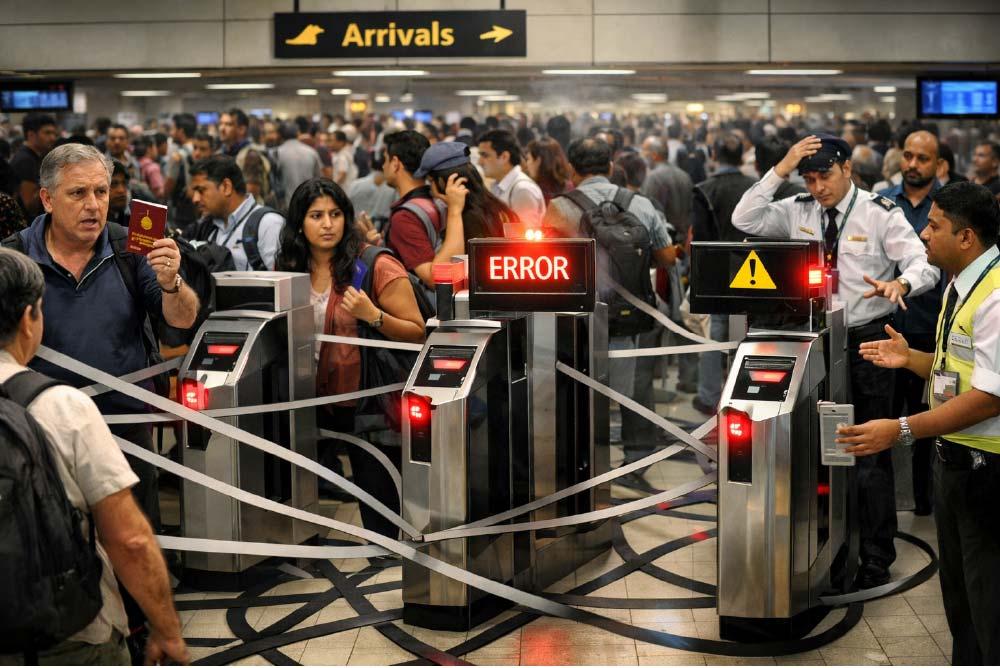
Passengers arriving at Bandaranaike International Airport (BIA) were left inconvenienced and delayed as Sri Lanka’s newly installed automated border control (ABC) e-gates failed to scan passports efficiently, raising questions about the readiness of the high-tech system funded with US$8.4 million by the Japanese government.
The Immigration and Emigration Department confirmed that the inconvenience stemmed from missing passenger information in the Advanced Passenger Information (API) system, which is essential for the e-gates to automatically identify travellers.
The Immigration and Emigration Officers’ Association President Jude Fernando, told the Daily Mirror that the e-gates are designed to scan flight numbers and passenger details automatically, but due to incomplete data transmission from respective airlines, many travellers were redirected to manual checking counters.
“The API facility itself is functioning correctly, but the problem lies with the airlines not providing passenger information on time,” Fernando explained. “We have officers stationed at each e-gate to assist passengers, and so far, around 20,000 passports have been cleared despite the hiccups.”
The e-gates, officially launched on January 28, 2026, are part of a broader effort to modernise border control, enhance security, and streamline immigration processes.
Countries like Austria, Belgium, Bulgaria, Croatia, and Cyprus reportedly took at least two years to fully integrate similar systems smoothly.
Errors encountered at BIA are being recorded in logbooks at the arrival lounge and are being rectified individually. The e-gate system aims to reduce waiting times, minimise human error, and strengthen border security, particularly in responding to infectious disease threats across South Asia.
While the initiative highlights Sri Lanka’s commitment to adopting advanced technology at its main international gateway, the early glitches have sparked debate about whether the airport and airlines were adequately prepared for the rollout of such a system.
Several local passengers have brought to the attention of the Daily Mirror that the Sri Lankan passport usually fails to scan in the e-gates at immigration departments at international airports, and Sri Lankan passengers are then diverted to the immigration counter for a manual check.
When inquired about this, the Immigration and Emigration Officers’ Association President Jude Fernando said the Sri Lankan passport was not an e-passport and was instead a machine-readable passport, which may result in scanning errors in international airports.
However, he said that these international airports had not raised any concerns or lodged any complaints with the Sri Lankan authorities over this matter.
07 Jul 2026 23 minute ago
07 Jul 2026 31 minute ago
07 Jul 2026 39 minute ago
07 Jul 2026 42 minute ago
07 Jul 2026 48 minute ago