26 Jan 2026 - {{hitsCtrl.values.hits}}
By Panduka Keerthinanda
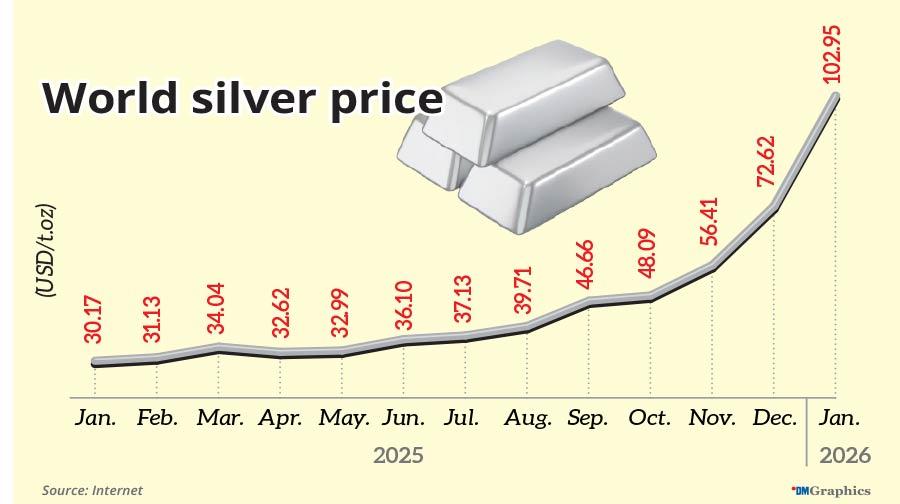
 Silver, often overshadowed by gold in financial headlines, is quietly undergoing a market revolution. However, unlike its more illustrious counterpart, silver’s price surge is not merely a story of monetary hedging or speculative investment. It is a direct threat to the foundational pillars of the 21st-century economy: the green energy transition and the global technology ecosystem. As prices climb on the world market, industries from solar power to consumer electronics are facing a severe production cost crisis, with profound implications for inflation, corporate profitability, and the stability of the world financial system.
Silver is not just a precious metal; it is a critical industrial commodity with unparalleled physical properties. Its exceptional electrical conductivity, thermal resistance, and photosensitivity make it irreplaceable in many key applications:
· *Solar Energy* Silver paste is a crucial component in over 90% of photovoltaic (PV) cells, forming the conductive lines that capture and transfer electricity. Even minor price increases in silver can significantly raise the Levelized Cost of Energy (LCOE) for solar farms.· *Electronics* Nearly every mobile phone, computer, and automobile contains silver in its circuit boards, connectors, and switches. The miniaturization of electronics has made efficient, reliable silver components more critical than ever.· *Electric Vehicles (EVs)* Beyond infotainment systems, silver is essential in the high-power electronics that control EV batteries and motors. The push for higher efficiency and longer range directly increases silver intensity per vehicle.
A sustained price increase in silver triggers a cascade of economic pressures;
(1.) Supply Chain Squeeze: Manufacturers are caught between fixed-price contracts and volatile raw material costs. This squeezes margins, forcing tough choices between absorbing losses, passing costs to consumers, or seeking inferior, less efficient substitutes.(2.) Green Transition Slowdown: Higher solar panel costs could derail national and corporate decarbonization targets. Subsidy programmes would become less effective, and the economic argument for solar over fossil fuels weakens, potentially delaying the global shift to renewable energy.(3) Tech Inflation: The “everyday” technology sector would face widespread cost-push inflation. Consumers may see higher prices for smartphones, laptops, and EVs, potentially cooling demand in already competitive markets. Innovation cycles could slow as R&D budgets are diverted to cover material costs. (4.)Geopolitical Strain: With primary silver production concentrated in a handful of countries (By Mexico, China, Peru), supply disruptions or export controls could exacerbate price volatility, creating new geopolitical flashpoints around resource security.
*Implications for the Global Financial System*
· Equity Market Volatility: The stock prices of tech giants, solar manufacturers, and automakers are highly sensitive to input cost shocks. A sector-wide profitability warning could trigger significant market corrections.· Bond and Commodity Markets: Inflationary pressure from industrial goods complicates Central Bank policies.
The “greenflation” narrative gains strength, influencing interest rate decisions and investment flows into commodity-linked financial instruments.· Investment Crisis: The Environmental, Social, and Governance investment boom is predicated on the viability and growth of green tech. A structural increase in the cost of renewable energy undermines the financial assets, potentially leading to a repricing of this massive market segment.· Supply Chain Financing Stress: Banks and financial institutions providing working capital for manufacturing may face higher risks as company margins erode, leading to tighter credit conditions for the entire industrial sector.
Addressing this vulnerability requires a multi-pronged strategy:
· Accelerated Material Science: Alternative conductive materials in electronics (e.g., copper alloys, graphene,), is imperative.· Recycling Revolution: Establishing efficient, high-yield urban mining processes to recover silver from end-of-life electronics must become a top priority to create a circular secondary supply.· Strategic Stockpiling: Governments and industry consortia may need to consider strategic reserves for critical minerals, including silver, to buffer against extreme market volatility.· Financial Innovation: The development of more robust hedging instruments and supply chain financing products can help companies manage price risk more effectively.
All precious metal’s surge exposes critical vulnerabilities in modern global financial system. One would say, “more than any metal the soaring price of silver is going to effect the world economy in many ways.” It is a stress test for our modern technological and economic model. It exposes a critical vulnerability where a single raw material can simultaneously imperil the green energy transition, disrupt the global tech industry, and send shockwaves through financial markets.
The outcome of this pressure will determine not only the cost of our devices and clean energy but also the resilience of our interconnected financial system.
Best way to go forward is by navigating this challenges urgently. Also collaborating between industry scientists, policymakers, and financiers to innovate, adapt, and secure the foundations of our digital and sustainable future.
25 Jun 2026 19 minute ago
25 Jun 2026 23 minute ago
25 Jun 2026 23 minute ago
25 Jun 2026 29 minute ago
25 Jun 2026 2 hours ago