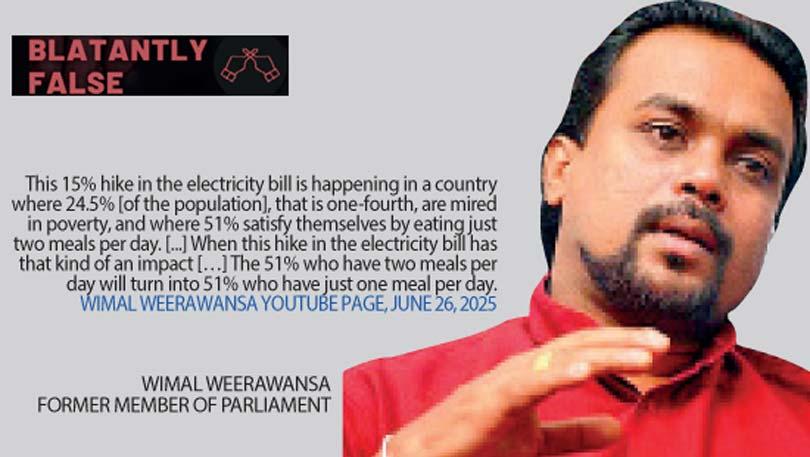
Former MP Wimal Weerawansa makes two claims: (1) That deprivation in Sri Lanka is severe, with 24.5% of the population living in poverty and 51% consuming only two meals per day, and (2) That the recent increase in electricity tariffs will worsen this deprivation—causing the 51% who eat only two meals to reduce consumption to just one meal a day.
Is the former MP correctly citing deprivation statistics on poverty and reduced meals?
On the poverty rate, the Sri Lankan government has not published an official estimate since 2019. The WB, using micro-simulations, has published an unofficial estimate on different poverty criteria. The WB estimates that 24.5% of the population would have had an income of less than $3.65 per person per day in 2024. This is the figure cited by the former MP (see Additional Note 1). However, the WB method results in a lower figure (classified as non-poor) compared to the officially calculated national poverty line. Therefore, for example, in 2019, the WB estimated poverty at 11.3% compared to the official figure of 14.3%.
On reduced meal consumption, HFSS-WFP reports the results of a survey conducted in December 2024 on five food-based coping strategies used by households. Reducing the number of meals is one of the strategies, and 13% of households are resorting to it. Therefore, the former MP’s claim of a 51% reduction in meals is incorrect. It likely refers to the total households adopting some food-based coping strategy, not just meal reduction. The other strategies include relying on less preferred/less expensive food, limiting portion size, borrowing food, and adults restricting consumption. The former MP appears to have misinterpreted the overall 51% as using a food-based coping strategy, specifically reducing the number of meals.
What is the impact of the electricity tariff hike on meal consumption?
To evaluate the former MP’s second claim, FactCheck.lk examined the impact of the increased cost of electricity among those in poverty.
As of May 2025, CEB data shows that 59% of households consume less than 60 units of electricity per month, and 29% consume less than 30 units per month.
A Verité Research study indicates that poverty is closely correlated with low electricity consumption (see Additional Note 2). Therefore, 13% of households identified as reducing meals would be mostly within the groups consuming less than 30 or 60 units a month.
The recent electricity tariff hike increases bills by LKR 20 per month (LKR 0.67 per day) for those consuming 30 units, and by LKR 85 per month (LKR 2.83 per day) for those consuming 60 units per month. This 1–3 rupee per day increase in electricity costs is not large enough to materially affect a household’s ability to afford a meal.
In sum, on claim 1, the former MP correctly cites WB estimates on the poverty rate but highly exaggerates deprivation by misinterpreting figures in the HFSS-WFP report. Regardless of his error in claim 1, the former MP’s claim 2 is egregiously untenable: it is tantamount to claiming that the cost of one meal for a whole family is 1-3 rupees.
Therefore, we classify the former MP’s claim as BLATANTLY FALSE.
N.B. - For sources and additional notes, please refer to the FactCheck.lk website.
*FactCheck.lk’s verdict is based on the most recent information that is publicly accessible. As with every fact check, if new information becomes available, FactCheck.lk will revisit the assessment.
FactCheck is a platform run by Verité Research.
For comments, suggestions and feedback, please visit www.factcheck.lk.