25 Oct 2025 - {{hitsCtrl.values.hits}}
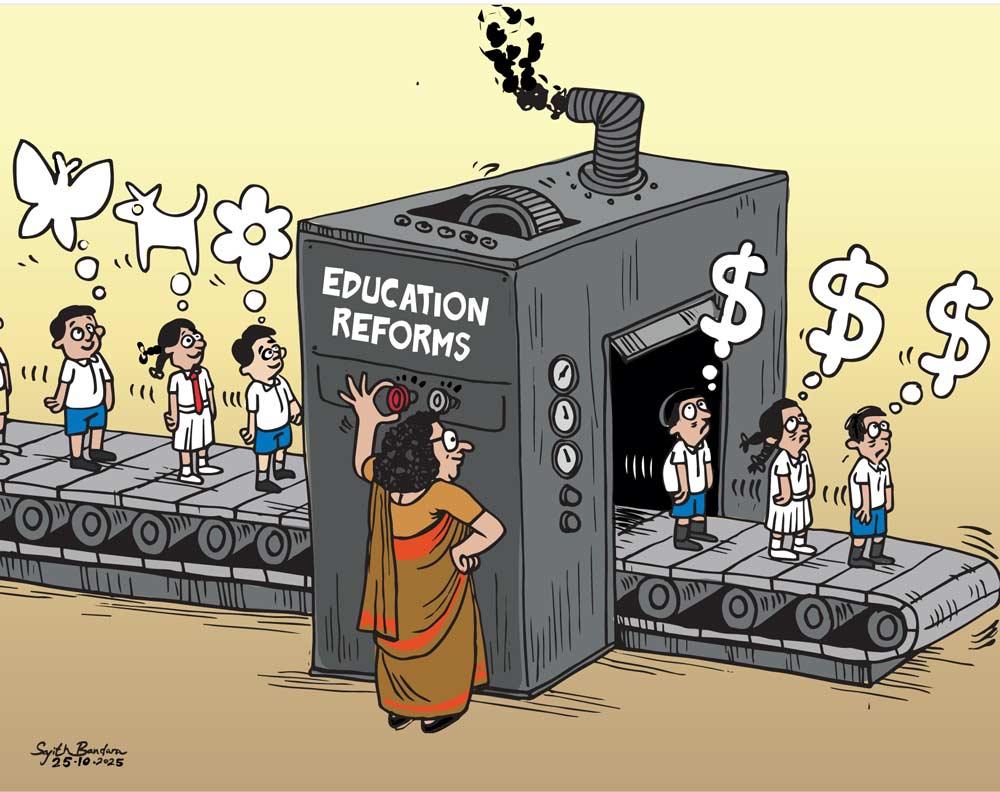
The cartoon presents a stark and unsettling image: children entering a large industrial machine labeled “Education Reforms” — bright-eyed, curious, and full of imagination. They emerge on the other side stripped of individuality, with thought bubbles now filled only with dollar signs. The once lively symbols of creativity — butterflies, animals, flowers — are replaced by the single-minded pursuit of money.
At first glance, the cartoon is a critique of how modern education systems — under the banner of “reform” — often prioritize economic output over human development. What was meant to enlighten minds has become a production line designed to mold students into standardized, market-driven products. The conveyor belt symbolizes uniformity; the machine, industrial efficiency. Together, they represent an education model that values productivity metrics over passion, employability over empathy, and test results over thought.
The teacher operating the machine stands as a tragic figure. Her position of authority implies good intentions — she believes she’s improving education. Yet, her control over the knobs and levers reflects how educators are often constrained by bureaucratic systems that dictate policy from above. They implement reforms designed not by philosophers of learning, but by economists and administrators chasing global competitiveness.
The transformation of children’s thought bubbles — from natural symbols to dollar signs — is perhaps the cartoon’s most powerful metaphor. It visualizes the commercialization of learning, where curiosity is replaced by calculation. Students are not taught to think, but to earn; not to ask questions, but to fit into a predefined economic role. The smoke emerging from the machine subtly suggests something burning — perhaps the remnants of creativity and wonder that once fueled genuine education.
Beyond criticism, the cartoon poses a deeper question about society’s values. If education’s ultimate goal becomes economic success, what happens to imagination, empathy, and critical thinking — the very traits that make societies humane and sustainable?
The cartoon’s brilliance lies in its simplicity: it doesn’t condemn reform itself, but warns against reforms that mistake efficiency for enlightenment. In the race to modernize, it reminds us that education should shape minds — not manufacture them.
10 Jul 2026 44 minute ago
10 Jul 2026 48 minute ago
10 Jul 2026 54 minute ago
10 Jul 2026 1 hours ago
10 Jul 2026 1 hours ago