20 Mar 2023 - {{hitsCtrl.values.hits}}
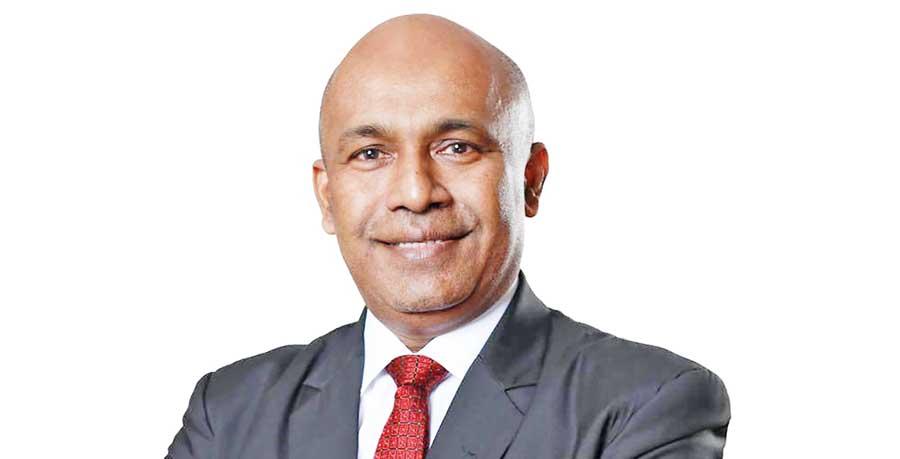
People’s Bank Acting GM/CEO Clive Fonseka
As the name suggests, People’s Bank was established as a bank for the common man over 61 years ago. Today, People’s Bank is an undisputed giant in Sri Lanka’s banking sphere and is an integral part of the country’s financial fabric, serving a diverse 14.5 million customer base. As the largest banking services provider in the country, with over 740 branches, People’s Bank boasts of Rs.3 trillion in assets and Rs.2.4 trillion in customer deposits.
Following is an excerpt from a recent interview Mirror Business conducted with People’s Bank Acting GM/CEO Clive Fonseka, where he shares the challenges and opportunities the state-owned bank is facing in the current demanding operating environment.
 How do you view the role of People’s Bank in the context of being a state bank in the current setting?
Let me bring in a little history, so a comprehensive response can be given. Behind almost all state banks all over the world, there tends to be a larger socioeconomic cause. The origin of People’s Bank is also not different. People’s Bank was established at a time where there was an enormous need for a strong bank for the public, as at the time, the banking sector was driven by commercial competition. So, this ‘larger cause’ runs in the DNA of People’s Bank. Each and every action of the bank, how small or big it could be, is a reflection of it.
For example, during the COVID-19 pandemic, People’s Bank didn’t think twice to provide relief to its customers. During the pandemic, People’s Bank, as a group, provided interest concessions to over 400,000 retail customers, 21,000 businesses and 55,000 leasing customers, which is the most for any bank in the country. Also, we managed to give these concessions within a matter of days from the time the government decided to grant them. The value of interest concessions granted is more than Rs.4 billion.
Similarly, during the most difficult periods of the economic crisis, People’s Bank, even with enormous difficulties, made the required funds available for the purchase of fuel, coal, medicines, etc. For example, we have provided approximately US $ 2 billion in 2022 alone for importation of oil when the entire country was strapped for foreign currency. Similarly, we have facilitated importation of coal for electricity generation and vaccines to prevent COVID-19. We facilitated and continue to facilitate such transactions even when it is not profitable for us to do so in the interest of the nation. It is hard to imagine a private or foreign bank would behave the same way under similar circumstances.
So, the role of a state bank, particularly in a developing economy like Sri Lanka, is unique and critical. But it doesn’t mean that we get special treatment or regulatory forbearance. Same rules that are applicable to all the banks apply to us as well and we don’t get a free pass. In other words, our obligations always tend to outweigh our rights, of which we are perfectly fine with.
It is no secret that the ongoing economic crisis has a huge bearing on the country’s banking sector. How is People’s Bank coping with the situation?
As you rightly said, economic crisis has a very deep impact on the banking sector. Increased NPAs, extremely high interest rates, industry-wide exposure to sovereign debt instruments and impending capital adequacy issues are some of the major difficulties banks are facing at the moment. On top of that, the uncertainty surrounding a potential domestic debt restructuring (DDR) is also weighing heavily on the banks.
As far as People’s Bank is concerned, People’s Bank is also facing all these issues at varying degrees. However, our exposure to international sovereign bonds is very low—about US $ 49 million in terms of face value. So, we have the least exposure to external debt restructuring among big banks. We also have the best capital adequacy levels within the industry. We are hopeful that with the gradual recovery, we are seeing in the economic front, fortunes of banks will also become much better. Things are looking much brighter now than six months ago and I’m convinced that they will look even brighter after six months from now. We need to prudently navigate the current crisis situation, so that when the economy gets back on to the growth trajectory, the banks could capitalise on it. But the elephant in the room is DDR. As I said earlier, if a DDR takes place, it will have an enormous impact on all the banks, insurance companies, pension funds, etc.
People’s Bank is known for its strong relationships with foreign counterparts, multilateral development agencies, etc. Are these relationships still intact, particularly given what happened during the last eight to 12 months?
Sri Lanka defaulting on its foreign debt has had a massive impact on the banking sector, probably more than on any other sector in the economy. But even during those difficult times, People’s Bank was able to maintain its relationship with foreign banks and development agencies. People’s Bank has a very strong relationship with foreign banks. People’s Bank had about 22-24 percent of the total foreign currency borrowings by the local banking sector – bilateral basis. Because of the country’s situation, the foreign banks became sceptical and everyone took a step back. But with the International Monetary Fund coming in and a potential improvement in the country’s credit rating situation, these relationships could be revitalised.
You assumed duties as Acting GM/CEO recently. What are the immediate challenges you had to address?
Well, challenges are originating from a combination of factors that I’ve already mentioned. But I would identify the need to reprice our loan book as an immediate challenge that we need to tackle. While some private and state banks have already done this in the face of the surging interest rates, we haven’t done that yet and as a result, it is exerting a lot of pressure to our financial position. We fully understand the difficulties that our customers are going through. But for the bank to operate in an efficient manner, in the current marketplace, we believe repricing of our loan book remains critical.
But doesn’t that go against People’s Bank’s ethos of not going after the bottom line?
Making a profit comes secondary to People’s Bank and serving the national interest and making a contribution to society always takes precedent. We are talking about extraordinary circumstances here and how People’s Bank should navigate the storm to stay strong to extend its services in the long run. This intended repricing of the loan book it not aimed at generating profits but to maintain the bank’s operations sustainably in the short to medium term.
The contributions by People’s Bank towards the wellbeing of the public and national economy remain unparalleled.
Over the last three years alone, we have provided over Rs.1 trillion worth of funding to the Finance Ministry and multiple state-owned enterprises, enabling them to provide the much-needed services to the public. Also, we gave back over Rs.45 billion to the state as taxes and dividends.
In terms of customer loans, during this three-year period, we have granted over Rs.55 billion to SME businesses, over Rs.500 million to teachers, artists and media personnel, over Rs.400 million to women entrepreneurs and over Rs.350 million to university student to purchase laptops.
In addition, we have granted over Rs.33 billion in loans to armed forces personnel and over Rs.3.3 billion loans to disabled officers of the armed forces.
Also, it is noteworthy to mention that during the COVID-19 pandemic, we kept 70 percent of our branches open for the benefit of the public and also managed to disburse Rs.14.4 billion under the ‘Saubhagya’ COVID-19 Working Capital Loan Facility introduced by the government, to support entrepreneurs and the business community.
I believe these examples are enough to establish the fact that People’s Bank is not essentially driven by the bottom line performance but by our eagerness to make a contribution to society and to the national economy.
It is not wrong to say that People’s Bank reinvented itself several years ago when it aggressively embraced digitalisation and become the country’s leader in digital banking. How do you plan to take this legacy forward?
People’s Bank is Sri Lanka’s most digitalised bank and we have won a number of awards locally as well as globally as a testament to that. We are a trend-setter and pioneer in that regard and we hope to preserve and further enhance our position as we go forward. While we believe that a strong brick and mortar branch network is essential to serve our large customer base throughout the island, we also know that digital banking is the future. In 2022, our digital platform accounted for close to 73 percent of all customer transactions. So, we will continue to nurture and invest in our digital platform to better serve our evolving clientele and to preserve our leadership position in that front.
07 Jul 2026 3 hours ago
07 Jul 2026 4 hours ago
07 Jul 2026 4 hours ago
07 Jul 2026 4 hours ago
07 Jul 2026 5 hours ago