01 Oct 2025 - {{hitsCtrl.values.hits}}
Sri Lanka’s external sector continued its steady recovery in August 2025, supported by solid export growth, rising remittances, and a tourism revival, official data from the Central Bank of Sri Lanka (CBSL) showed.
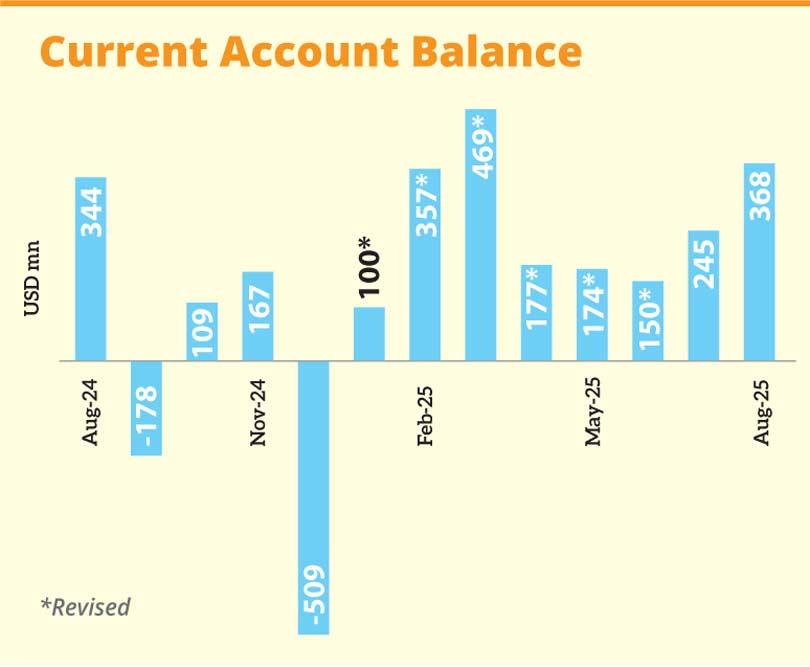
The island nation’s current account maintained its streak of monthly surpluses, while the merchandise trade deficit narrowed compared to August 2024, as exports grew faster than imports. However, the terms of trade deteriorated over the year, with import prices rising more sharply than export prices.
Vehicle imports remained high, with combined personal and commercial imports reaching US$ 249 million in August, pushing the cumulative figure for the first eight months of 2025 to US$ 918 million.
The services sector recorded net inflows of US$ 2.7 billion during January–August 2025, up 2.3 percent from the previous year, despite a slight month-on-month decline in August. Tourism, a key foreign exchange earner, saw visitor arrivals rise 20.4 percent year-on-year to 198,235 in August, generating US$ 259 million in earnings. Cumulative tourism receipts for January–August were estimated at US$ 2.3 billion, up from US$ 2.1 billion a year earlier.
Workers’ remittances continued to be a bright spot, rising 17.9 percent to US$ 681 million in August, with cumulative inflows for the first eight months up 19.3 percent from the same period in 2024.
Foreign investment flows were mixed: government securities attracted net inflows in August, while the Colombo Stock Exchange (CSE) saw a net outflow across both primary and secondary markets. Gross official reserves, including a swap facility with the People’s Bank of China, edged up slightly to US$ 6.2 billion by the end of August, even as the country continued servicing external debt.
The Sri Lankan rupee has depreciated 3.3 percent against the U.S. dollar in the nine months ending September 2025, reflecting ongoing pressures on the currency despite the external sector’s improving fundamentals.
08 Jul 2026 2 hours ago
08 Jul 2026 2 hours ago
08 Jul 2026 3 hours ago
08 Jul 2026 3 hours ago
08 Jul 2026 3 hours ago