07 Mar 2026 - {{hitsCtrl.values.hits}}
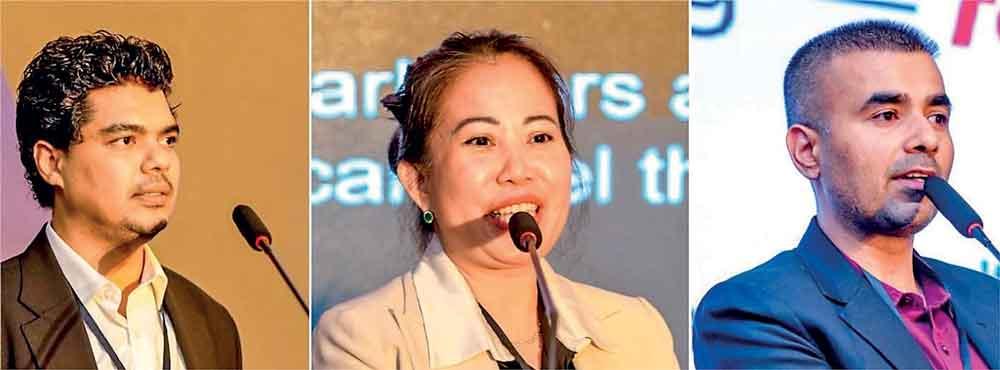
From left: Thanzyl Thajudeen, Angel Calinisan and Anubhav Khanduja
By Nishel Fernando
As Sri Lanka’s digital landscape undergoes a rapid transformation, local corporates and MSMEs are being urged to look beyond established advertising avenues and embrace social listening to safeguard brand reputation and drive growth. With the country home to 12 million active internet users generating millions of conversations, the market has reached a digital “inflection point,” necessitating a shift from mere social media presence to active, data-driven listening.
This pivot is the focal point of a strategic partnership between Colombo-based boutique PR agency Mark and Comm and global consumer intelligence giants Talkwalker and Hootsuite, aimed at equipping Sri Lankan businesses with enterprise-grade tools to decode consumer sentiment.
The urgency of this shift was underscored at the recent “Brands: Listen, Learn and Lead” summit, which convened 100 senior marketing leaders from banking, telecommunications, FMCG, and hospitality sectors. The event highlighted a critical market gap: while Sri Lankan corporates are heavily investing in digital platforms, they often lack the sophisticated tooling required to measure impact or mitigate risks. While budgets for legacy communication channels and broadcast media remain substantial, the audience dynamics are shifting irreversibly. The collaboration aims to bridge this gap by combining Talkwalker’s advanced AI-powered listening capabilities with Mark and Comm’s local market expertise.
Bridging the Strategy Gap
Following the event, the trio—comprising Mark and Comm’s Thanzyl Thajudeen, Talkwalker’s Angel Calinisan, and Hootsuite’s Anubhav Khanduja joined Mirror Business for an in-depth discussion to elaborate on how this partnership will reshape the local market and address the critical gaps in the current marketing ecosystem.
During the discussion, the group highlighted a significant disconnect: while spending is evident, the strategic alignment often lags behind consumer behavior. Anubhav Khanduja, Strategic Enterprise Account Executive at Hootsuite, believes the timing is crucial.
“Sri Lanka is going through an inflection point. The spend is already there. People are already spending budgets. But it’s always been on [established channels]. Now, with the penetration of audiences getting more on the digital front, brands are not ready today to take that and get the most out of it,” Khanduja explained to Mirror Business. “Ultimately, the goal is to build a long-term presence in consumers’ minds and also relate to them through an authentic appeal. So that’s missing.”
The partnership intends to target key sectors including finance, consumer goods, healthcare, and telecommunications—industries where consumer sentiment can make or break a brand. By introducing social listening, these entities can move from reactive customer service to proactive brand management. This involves not just monitoring direct mentions, but understanding the broader context of conversations happening across diverse platforms, from mainstream sites like Facebook and TikTok to localized forums such as Elakiri, which has emerged as a hub for transparent, unfiltered public opinion.
Beyond the Digital “Monolith”
For many Sri Lankan conglomerates, the reliance on conventional market research is being challenged by the speed of digital information. The standard methods of quarterly surveys are often too slow to capture the volatile nature of modern consumer sentiment. Angel Calinisan, Client Growth & Innovation Director for Emerging Markets at Talkwalker, emphasizes that social listening acts as a real-time “dipstick” for market mood, offering a distinct advantage over static reports.
“There is a tons of data available now. If you backtrack 10, 20 years ago, the only way you can get data is to do your own research. But now even if you don’t do research, a lot of data is free,” Calinisan noted. “There’s a lot that they can glean from social data. You don’t need to do research. Let’s say if I’m doing research before quarterly, I can do now let’s say maybe once a year, and the in-between I can do the social listening dipstick kind of thing.”
This shift is not merely about efficiency; it is about survival in a fragmented media ecosystem. Calinisan points out that it is no longer sufficient to treat “digital” as a monolith; brands must discern where their specific audiences reside to avoid “skewed data.”
“It is important for brands to be able to get data across different sources. My colleague mentioned not just social, but forums. My next question now is, when do people go there? What are the type of conversations that they do there? Is it more of 30 to 45 working, or more of the highly educated? It’s important to understand these things,” Calinisan said. “Otherwise... let’s say you’re only getting Facebook. You’ll get a lot, but you’re missing out on the other demographics.”
The Crisis Early Warning System
This granular understanding is particularly relevant for crisis aversion. In an era where a single negative review or viral post can cascade into a PR disaster, social listening serves as an early warning system. Case studies presented at the summit demonstrated that global giants utilizing these tools achieved a 75 percent reduction in misinformation spread and a 50 percent faster response time during crises. By monitoring keywords and sentiment shifts, brands can address grievances or correct misinformation immediately.
Agility for MSMEs and Exporters
The relevance of these tools extends beyond large conglomerates. For Sri Lanka’s Micro, Small, and Medium Enterprises (MSMEs), social listening offers a competitive edge that defies their size. Unlike large corporations that may be bogged down by bureaucracy, MSMEs can use data to pivot rapidly.
“One of the strengths of these smaller companies is they are very agile. They learn fast. They fail fast, they learn fast too. And they can roll out new things faster than the bigger corporations,” Calinisan noted. “Once they have that data, if they can have access to that data, imagine the velocity at which they can introduce new things to the market. It’s going to fuel them and allow them to compete even without the size of the corporates.”
This agility is essential for exporters as well. Thanzyl Thajudeen, Managing Director of Mark and Comm, highlighted that exporters often struggle with HQ-level decision-making that undervalues global digital tools. “They are still not looking at the value of what these tools can be and that they can capture a lot of things globally,” Thajudeen said, noting that local brands expanding to markets like India need to monitor market pulse remotely and accurately.
Furthermore, the tools allow brands to tap into cultural nuances. Calinisan observed that Sri Lankans are quick to adopt global trends but often add a unique local flavor, such as the recent “2016 is the new 2026” nostalgia trend. “They put a local twist onto it. And instead of playing Western songs, they’re using local,” she observed.
Overcoming the “Wait and See” Culture
Despite the clear benefits, adoption in Sri Lanka faces cultural hurdles. There is a traditional hesitancy among local corporates to be the “first mover” in adopting new technology. However, the “wait and see” approach carries its own risks. As Khanduja points out, the purchasing power is shifting to younger generations—Gen Z and Gen Alpha—who are notoriously absent from legacy broadcast channels.
“The biggest shift that’s happening is that your buyer is now changing from your traditional household to Generation Z, Generation Alpha, that are now influencing key buying decisions in their households,” Khanduja observed. “With Gen Z, they are looking at forums like Reddit, Quora, Elakiri. So it’s very important to be where your new audience and decision makers are.”
Looking ahead to 2026, the landscape will evolve further. Khanduja outlined critical future trends, noting that social platforms are increasingly functioning as primary search engines, replacing traditional browsers for younger demographics. Additionally, the power of employee advocacy is expected to become a major revenue driver, moving beyond simple follower counts to genuine engagement.
A Three-Pronged Approach
The partnership between Mark and Comm and the global tech providers is structured to address these specific local needs through a three-pronged approach: product enablement, delivery support, and sales support.
“We are going to invest on three areas,” Khanduja detailed. “Number one is going to be focused on product enablement... rather than being a partner, we want them to be able to also lead their own conversations eventually. Second is in terms of delivery... we will extend that as well to the Mark and Comm team. And third is going to be sales support... we want to make sure that knowledge share in terms of whether a client should choose a platform or not, is something that we are able to share with the team as well.”
The alliance delivers a comprehensive, end-to-end intelligence suite for local businesses. Mark and Comm serves as the exclusive partner for Hootsuite and Talkwalker in Sri Lanka and the Maldives. This expertise is coupled with Hootsuite’s industry-leading social media management and analytics platform, used by over 25 million professionals, and Talkwalker’s AI-powered capabilities which monitor 150 million sources across 187 languages.
Currently, the venture has identified approximately 10 key customers in Sri Lanka, with ambitious targets to expand this to 100 within the first year. As Sri Lanka moves forward, the integration of such high-level analytics into daily business operations will likely become the standard rather than the exception.
“Every technology follows a curve,” Khanduja concluded. “Where we are at in that journey is people are now realizing the importance of social media—no company can stay without having their presence—but the value of it needs to be proved. That’s where we come in.”
04 Jul 2026 25 minute ago
04 Jul 2026 6 minute ago
04 Jul 2026 29 minute ago
04 Jul 2026 30 minute ago
04 Jul 2026 32 minute ago