13 Nov 2025 - {{hitsCtrl.values.hits}}
 |
 |
 |
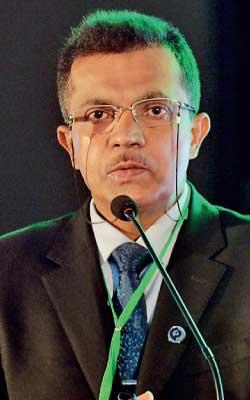 |
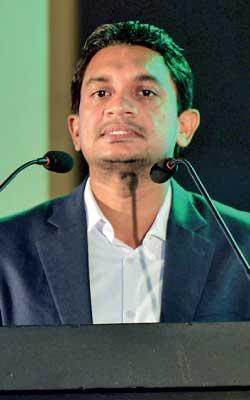
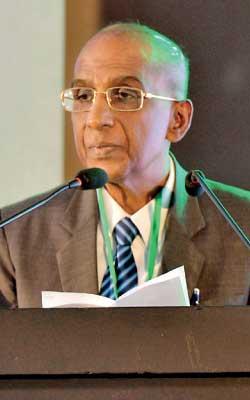
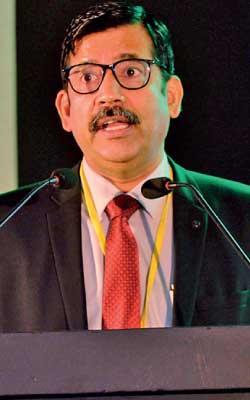
| Chathuranga Abeysinghe | Gamini Gunasekara | K.S. Venkatagiri | Samantha Kumarasena PIX BY PRADEEP PATHIRANA |
Sri Lanka’s new economic vision is beginning to take shape, one that measures growth not merely by numbers but by how responsibly those numbers are achieved.
At the third International Conference on Resource Efficiency and Circular Economy, held in Colombo last week, Industry and Entrepreneurship Development Deputy Minister Chathuranga Abeysinghe outlined a defining shift in Sri Lanka’s industrial philosophy.
Speaking to an audience of business leaders and sustainability advocates, Abeysinghe said Sri Lanka is laying the groundwork for a manufacturing-led economy built on efficiency, sustainability and circularity.
“For the first time since 1977, Sri Lanka has a government that believes in a manufacturing base,” he said, addressing the forum organised by the National Cleaner Production Centre Sri Lanka (NCPCSL).
“Our goal is to drive close to 30 percent of our GDP from manufacturing. But to get there, there is no other way than resource efficiency.”
The government’s push comes as the country looks to climb from a US $ 90 billion economy to US $ 300 billion, a leap Abeysinghe insists can only happen through better use of resources, not greater exploitation of them.
From ideology to implementation
In one of the strongest signals yet of a policy reorientation, Abeysinghe drew a distinction between the old model of profit maximisation and a new model grounded in long-term value creation. “The world still runs on price, not value,” he said.
“When there’s no price tag on the environment, there’s no protection.”
He said the government’s ideology, described as centre-left, seeks to embed sustainability into education, industry and governance.
“We want to create a sustainable world for the entire mankind and that begins with changing mindsets,” he added, framing sustainability as both an economic and moral imperative.
Circularity as a strategic advantage
The government sees the circular economy as Sri Lanka’s next competitive frontier. With the global demand for circular products growing by over 10 percent annually, he said the country must act fast to claim a niche position.
“If Sri Lankan products can be converted into circular products within the next 10 years, we will have a strong niche market,” he said.
“Rather than fighting in the red ocean, there’s a blue ocean emerging for circularity.”
This, he stressed, would allow the Sri Lankan exporters to align with global value chains that increasingly demand traceability, ethical sourcing and minimal waste.
Missing link: Consumer
According to Abeysinghe, the success of any circular initiative hinges on consumer behaviour.
“Circularity can only take root when consumers demand it. Governments will not change, businesses will not change, until the consumers put more value on products that carry circularity,” he said. He called for greater investment in consumer education and awareness, suggesting that sustainability should become part of social identity rather than a corporate checkbox.
“Today, we laugh at people who wear used clothes,” he said pointedly.
“That mindset must change.”
Measuring impact over image
Turning his attention to corporate accountability, Abeysinghe urged industries to move beyond “glossy green reports” and focus on measurable impact.
“If you don’t have data, no problem is going to get solved,” he said, calling for transparent disclosure of environmental and social metrics.
He proposed that Sri Lanka publish data showing which companies genuinely create social and environmental value and which do not.
“Until we measure and publish, nobody is going to change,” he said.
Path ahead
Abeysinghe assured the NCPCSL that the government would provide full support and thought leadership in building a sustainable industrial base. He also underscored the need for technology and collaboration, urging industries to invest in systems that reduce waste rather than merely manage it.
“Sustainability has always been part of our DNA. It’s time to rediscover that strength and make it the foundation of Sri Lanka’s next phase of growth,” he said.
Sri Lanka’s National Cleaner Production Centre (NCPC) is fast carving its name on the global sustainability map, with its ecolabelling initiative earning praise from international experts as the nation doubles down on its manufacturing ambitions.
At the third International Conference on Resource Efficiency and Circular Economy, Global Ecolabelling Network (GEN) Chair K.S. Venkatagiri hailed the NCPC’s ecolabel programme as “one of the youngest and most promising” within the 60-member global network.
The recognition, he said, placed Sri Lanka in an enviable position among emerging economies striving to align industrial growth with environmental responsibility.
“Building a credible ecolabel from the ground up is no small feat,” Venkatagiri remarked, acknowledging the NCPC’s commitment to developing a Type I ecolabel, the highest category under the international ISO 14024 standard.
“Sri Lanka’s ecolabel has a strong foundation, rooted in life-cycle analysis and third-party verification. That level of credibility gives it the potential to stand shoulder to shoulder with some of the best ecolabelling systems in the world.”
He noted that manufacturing is naturally resource-heavy, carbon-intensive, water-demanding and waste-generating but it doesn’t have to be damaging.
The circular economy offers a way to grow without depleting. When industries design for reuse, efficiency and recyclability, they strengthen, not compromise, their competitiveness, he said.
For the NCPC, which has spent years driving cleaner production practices in local industries, ecolabelling is a natural evolution. The label not only signals to consumers that a product meets rigorous environmental standards but also gives manufacturers a framework to measure and reduce their resource footprint.
Industry observers see the initiative as a powerful tool to transform how Sri Lankan businesses view sustainability, from a compliance burden into a strategic differentiator. As global supply chains tighten environmental benchmarks, companies that adopt credible ecolabels stand to gain easier access to premium markets and sustainability-conscious investors.
Venkatagiri said the GEN, which serves as a platform for sharing best practices among national ecolabelling schemes, is eager to deepen its collaboration with the NCPC.
“Sri Lanka’s entry into the network brings fresh momentum to the region. It opens the door for more South Asian cooperation on ecolabelling, trade facilitation and policy harmonisation,” he said.
The NCPC’s efforts also signal a cultural shift in how Sri Lankan industry approaches sustainability, no longer as an afterthought but as an enabler of innovation and long-term value creation. Experts at the conference noted that cleaner production and circular design principles can help firms lower input costs, enhance brand equity and future-proof their operations against regulatory tightening.
“Sri Lanka is not following the world’s sustainability agenda; it’s shaping its own. And that, perhaps, is the most powerful statement a developing nation can make today,” he said.
13 Jun 2026 7 hours ago
13 Jun 2026 7 hours ago
13 Jun 2026 9 hours ago
13 Jun 2026 9 hours ago
13 Jun 2026 9 hours ago