23 Dec 2016 - {{hitsCtrl.values.hits}}
By Chandeepa Wettasinghe
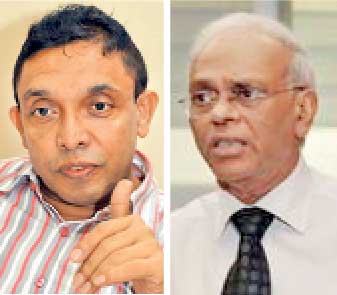 Despite the bullish attitude of the country’s finance minister, Sri Lanka’s import-driven economy is unlikely to experience any respite on its external front for a significant period of time, senior economists warned recently, compounding fears over the trigger of another economic crisis.
Sri Lanka’s official reserves had fallen from the US $ 6.5 billion levels that existed from July through September to US $ 5.65 billion in November, while the rupee had fallen by over 2.5 percent within the same period.
“A billion will go out, another billion will come in from various ways,” Finance Minister Ravi Karunanayake said last week. He was this week quoted as saying that the rupee will remain stable in 2017.
Interestingly, he accused the stooges of the former Central Bank Governor Ajith Nivard Cabraal, who still hold office in the Central Bank, were sabotaging the rupee and the foreign reserves. Large outflows have been experienced not only in Sri Lanka but also in other emerging markets due to the expectations of a US Treasury rate hike—which became a reality last week—and the general short-term positive sentiment on Donald Trump’s economic plans for the US. “There is nothing surprising about this because we already know that short-term foreign exchange inflows are highly volatile and highly sensitive to global market changes,” Colombo University Economics Department Prof. Sirimal Abeyratne told Mirror Business.
Ratings agency Moody’s this week advised a rate hike to stop outflows and attract inflows to local deposits and securities while the International Monetary Fund (IMF) had also advised of a rate hike—though for separate reasons of stopping runaway credit growth.
The Central Bank has so far in 2016 increased policy rates twice—50 basis points each—in February and July. Despite such, the usual lag in policy transmission has only been able to partly cut the appetite for credit.
Prof. Abeyratne said that monetary policy tightening or new bond issuances wouldn’t help the country. The Central Bank has already indicated that it would again look at the raising funds through an international bond issue in 2017. “Sri Lanka’s foreign exchange problem is not a short-term one but fundamentally a deep-rooted long-term one, so that the Central Bank has nothing to do with that,” Abeyratne added. Former Central Bank Deputy Governor Dr. W.A. Wijewardena also told Mirror Business that monetary policy tightening, increased remittances, loans or investments would not protect Sri Lanka’s foreign exchange. “Foreign exchange inflows from remittances, foreign direct investments and loan proceeds have not been sufficient to flood the markets and meet the demand for dollars.
Hence, the rupee cannot escape its downward slide,” he said.
Foreign outflows, coupled with the trade deficit contributed to foreign reserves falling to US $ 5.3 billion in the first half of the year, before new borrowings helped boost the figure to US $ 6.5 billion in July.
Prof. Abeyratne noted that Sri Lanka has to move towards exports instead of remittances to boost its current account and opt for investments instead of borrowings to support its capital account.
“As long as the country is trapped in this vicious cycle, the exchange rate is volatile in the short run and on downward path in the long run. In the coming year too, this will continue because the problem is more fundamental and requires long-term remedies through reforms,” he said.
Frontier Research CEO Amal Sanderatne during a recent forum in Colombo noted that a US $ 2 billion fall in reserves over a period of one to two years is usually followed by a crisis, with further significant devaluation in the rupee.
The Sri Lankan government is attempting to increase trade and investments, with the signing of agreements to attract billions of dollars worth of investments, as well as free trade pacts with several countries, including China.
However, Central Bank Governor Dr. Indrajit Coomaraswamy recently noted that improvements to the ease of doing business in the country are moving slowly.
Meanwhile, Dr. Wijewardena noted that all Sri Lankans have to reduce consumption further to conserve foreign reserves.
“This is a time all Sri Lankans should appreciate the need for thrift and refrain from having unnecessary galas. This should be from the very top to the lowest levels in society,” he said. He added that funds from the sale of the Hambantota port infrastructure to China won’t matter unless the country becomes thrift and implements reforms.
“Money to be raised from Hambantota and Mattala would evaporate into thin air unless these economic reforms are implemented promptly,” Dr. Wijewardena added.
In the short term, the government will raise US $ 1.12 billion from the 80 percent sale of the Hambantota port, while long-term gains expected from it stands around nearly US $ 10 billion in investments.
The government is under pressure to improve the foreign reserves since under the terms of the US $ 1.5 billion International Monetary Fund (IMF) loan arrangement, the net reserves are required to improve by US $ 671 million at the end of this year from US $ 5.03 billion at the start of 2016.
The gross reserves at the start of the year had been US $ 7.3 billion, courtesy of a US $ 1 billion deposited by a ‘mystery investor’.
19 Jun 2026 29 minute ago
19 Jun 2026 35 minute ago
19 Jun 2026 46 minute ago
19 Jun 2026 1 hours ago
19 Jun 2026 2 hours ago