08 Nov 2025 - {{hitsCtrl.values.hits}}


1. Preamble
Honourable Speaker,
|
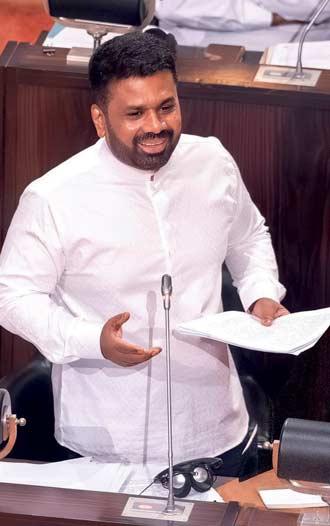
President Anura Kumara Dissanayake in his capacity as the Finance Minister presenting the second budget of the National People’s Power government. |
It is our great pleasure to present our second National Budget to this House.
Following the historic mandate given to us by the Sri Lankan citizens, within a short time period of a year, we have taken many decisive steps with a clear vision to fulfill their aspirations. We have embarked on a continuous mission to modernize the economic and political structure, create a people-centered governance, establish the rule of law and order, strengthen governance, and bring our economic achievements to the people living at the grassroot level.
I am pleased to announce to this House that the government’s reforms have restored fiscal, macroeconomic and social stability within a short period of one year.
The economy grew by 4.8 percent in the first half of 2025, driven by strong growth across all sectors, surpassing the forecasts of multilateral organizations. Inflation has now returned to a positive value. The financial sector has stabilized with the reduction in the Treasury Bill interest rate. The exchange rate has also stabilized.
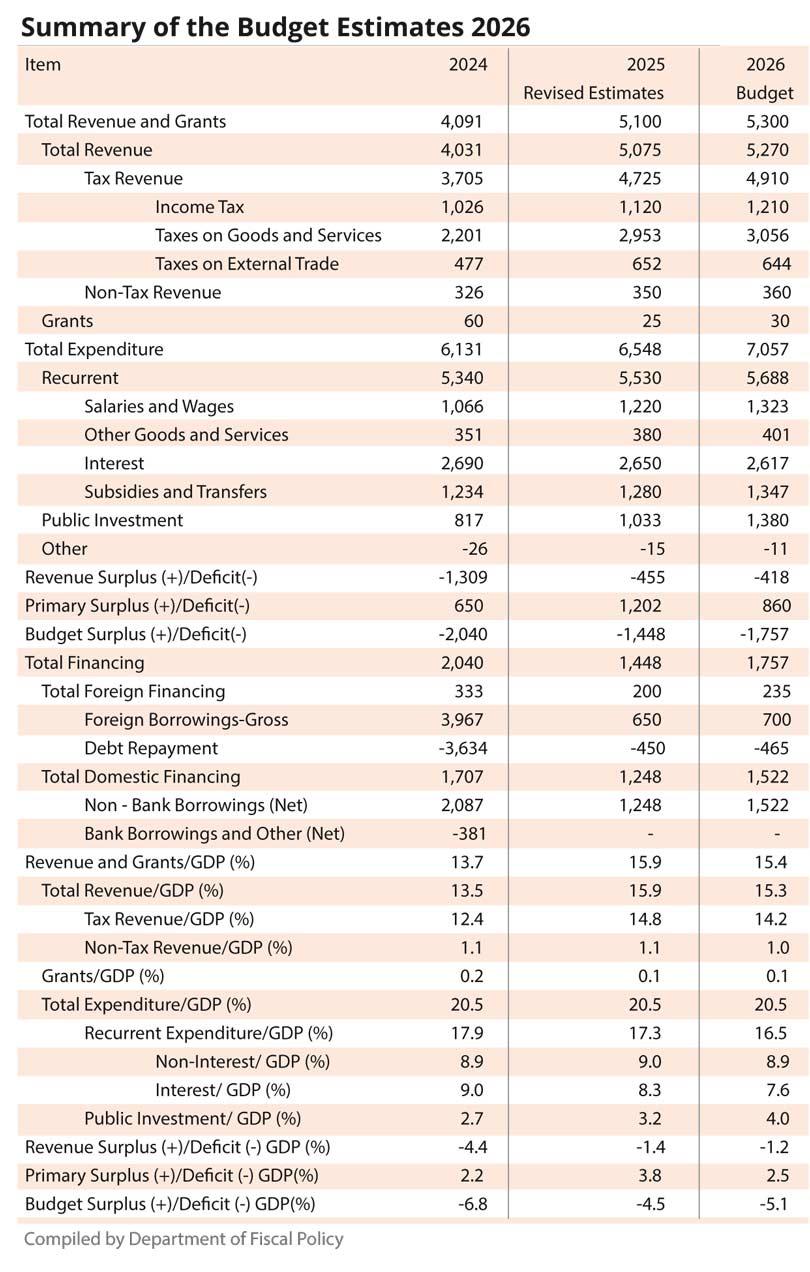
The external sector, including imports and exports, has strengthened even amidst global shocks. Due to the increase in exports, tourism, and foreign remittance inflows, the gross official reserves have exceeded USD 6 billion. It is expected that this year, after almost two decades since 2006, the Government revenue will be able to reach the level of 16 percent of GDP.
It is also expected that, the highest primary surplus as a percentage of GDP in its history will be recorded in this year, significantly exceeding the target value of 2.3 percent. Due to these circumstances, we have been able to build strong relationships with international stakeholders and build investor confidence like never before.
The initial strategy to rescue the country from the economic crisis was to establish a transparent and accountable public financial management along with fiscal discipline. By strengthening domestic revenue mobilization, digitizing revenue administration, and rationalizing Government expenditure, we were able to record a high primary surplus. The continuous increase in this primary surplus will contribute to a significant reduction in the central Government debt as a percentage of GDP from 114.2 percent in 2022 to 96.8 percent by 2026. Furthermore, we expect to achieve that figure at a level of about 87.0 percent by 2030. These results have paved the way for our desired exit from the debt crisis.
The economic crisis that existed has gradually escalated into an exploding level in the year 2020. This has spread like a domino effect across all sectors of the economy. The end result was that we were declared a sovereign default status in April 2022.This economic bankruptcy has created a ‘lost decade’ for our country.
Our debt restructuring process is nearly completed. Sri Lanka has been placed on a sustainable fiscal path and the confidence of both domestic and international investors has been further strengthened. These remarkable achievements have led to the country’s sovereign ratings being upgraded by international rating agencies; Fitch Ratings, Moody’s, and S&P to CCC+, Caa1, and CCC+, respectively. These new ratings further reflect investment confidence in Sri Lanka.
We are implementing the necessary economic reforms under the Extended Fund Facility arrangements of the International Monetary Fund (IMF-EFF) and with the participation of other international development partners to meet our national requirements.
Social protection and human resource development is also a core objective of our policy approach. Accordingly, the ‘Aswesuma’ programme has been expanded and reformed to ensure it supports the truly deserving low-income families. To ensure that only genuine low-income earners continue to receive this assistance, these beneficiaries will be reviewed in 2026. Also, allowances for the elderly and kidney patients were increased.
Mahapola scholarships and bursaries were also increased to support university students. School students from Aswesuma beneficiary families were given an allowance to purchase books and school supplies. The aim of these activities is to bring the benefits of economic growth to every citizen of the country.
The public sector needs to be reformed and modernized in order to provide better and more efficient services. For this, our commitment was demonstrated in our first budget. To that end, the salaries of public servants have already been increased in 3 phases. Steps have been taken to fill essential vacancies in the public sector. Strategies are being formulated for the digitalization drive of the public sector. The public sector is being reorganized. The objectives of this are to build an efficient and attractive public service that can truly serve the people.
We have been able to accelerate governance reforms and anti-corruption drives, ensuring transparency, accountability and public trust.
We are creating an investor-friendly environment through measures taken to prevent corruption. Both the Strategic Development Projects Act and the Port City Act are being amended to provide tax incentives based on transparent, rule-based criteria. To increase the transparency of tax exemptions, a tax expenditure statements is published on the Ministry of Finance’s website on a bi-annually basis. The Simplified Value Added Tax (SVAT) system has also been removed, making the tax refund process transparent and efficient, which will further strengthen our tax administration.
Steps have also been taken to make State-Owned Enterprises more efficient. A new “Public Commercial Business Management Act” is to be introduced for State-Owned Enterprises and the Bill is scheduled to be presented to this Parliament in the first half of 2026.
A special task force will be appointment to review the management and use of state lands. It is expected that the Public Assets Management Bill be passed in 2026 to improve the transparency, management and disposal of public assets. Cost-reflective energy pricing continues and concessions will be confined to the necessary sectors. To disrupt the networks of institutions that support corruption, we are strengthening the anti-money laundering framework by introducing a functional beneficial ownership registry by January 2026. Further, the “Proceeds of Crime Act” has already been passed. A separate police division, headed by a Deputy Inspector General of Police, has already been established to enforce this endeavor.
In line with this vision, we aim to build a safe, secure and just society. We must free our children from the long-standing victimization of drugs and organized crime.
With this second Budget, we expect to further strengthen the foundation we laid in the first Budget and achieve a rapid economic leap. We expect the contribution and support of all parties to overcome challenges and move forward on our journey towards a prosperous country and a beautiful life.
2. Strategic Objectives of the Budget
2.1 Sustainable and Inclusive Economic Growth
Our key strategic objective is to achieve a sustained growth rate exceeding 7 percent within the next few years, ensuring that the benefits of such growth are shared equitably across all regions, communities and social groups of the country. For this initiative, a participatory economy, increasing productivity, promoting innovation, and private sector-led investment and growth will be the main driving forces of our economy.
We will continue to attract foreign investment through a transparent and rules-based mechanism. We also need to integrate Sri Lanka into global value chains by strengthening exports and value-added industries. Public-Private Partnerships (PPPs) and the modernization of State-Owned Enterprises will further strengthen these efforts. It is also essential to implement strategic infrastructure development projects efficiently, transparently and responsibly.
2.2 Higher Income through Export Diversification
With the aim of further enhancing Sri Lanka’s export growth, efforts are being made to diversify exports, improve export competitiveness, connect with global value chains and capture new export markets as well as expand existing markets in accordance with the National Export Development Plan (2025-2029). An expert committee has already been appointed to review existing trade agreements and facilitate to negotiate new free trade agreements, with the objective of expanding Sri Lanka’s export potential. We are working to introduce a new tariff policy, improve the necessary financial facilities for the promotion of new goods and services exports and establish a Trade National Single Window (TNSW).
2.3 Ensuring Debt Sustainability
The International Monetary Fund (IMF) had declared in 2022 that Sri Lanka’s debt level was unsustainable. The main reasons for this declaration were irresponsible borrowing for non-priority projects, failure to generate the necessary assets from the loans obtained, failure to complete the relevant projects on time, and failure to manage debt within a formal and systematic policy framework. However, we are currently developing a clear plan to ensure debt sustainability, particularly through the Public Debt Management Office. Market confidence has grown rapidly due to the near-complete debt restructuring process and our intervention to achieve macroeconomic stability. Also, in a context where Sri Lanka’s credit ratings have been upgraded, our government is moving systematically and steadily, along a clear path towards achieving debt sustainability.
Maintaining the gross financial requirement at a level below 13 percent of GDP in the medium term, and annual central government foreign currency debt servicing at a level not exceeding 4.5 percent of GDP is a strategy to ensure debt sustainability. Accordingly, as the public financial situation has strengthened, public debt as a percentage of GDP has begun to decline gradually.
The public debt target as a percentage of GDP of 95 percent by 2032 is gradually reaching. Given the remarkable performance achieved in the public finances and our debt management strategy, we believe that there is a high level of potential to maintain public debt as a percentage of GDP below 90 percent by 2032.
Certain groups are spreading an unfounded opinion that an inability to pay foreign debt may arise in 2028. But what is the real situation? We made the payment of USD 1,674 million for foreign debt servicing in 2024. Foreign debt service in 2025 amounted to USD 2,435 million, of which USD 1,948 million had been paid by September 30. Another USD 487 million is set to be paid by December 31 of this year. Accordingly, foreign debt service payments in 2025 are an increase of USD 761 million compared to 2024.
The foreign debt service payment in 2028 is only USD 3,259 million. That is, an increase of only USD 824 million compared to 2025. We have the capacity to pay this. Therefore, we believe that the people of this country will not accept such false propaganda.
Further, a portion of International Sovereign Bonds (ISBs) obtained by the Government has been as Governance-Linked Bonds (GLB). They should be repaid in 2034 and 2035. The creditors have agreed to provide relief in the debt restructuring process depending on the progress that Sri Lanka achieves on two indicators during the debt restructuring process.
Accordingly, the government’s revenue targets for 2026-2027 should be maintained above 15.3 percent and 15.4 percent of GDP, respectively, and the fiscal strategy should be announced within the stipulated time frame. If these targets are met, the creditors have agreed to provide a 0.75 percent reduction in the annual interest rate payable from 2028 to 2035.
Accordingly, the Government will receive a debt servicing benefit of USD 7.9 million per year. The Government is working to achieve these economic targets.
2.4 Strengthening the Production Economy
As an economy heavily dependent on imports, Sri Lanka remains vulnerable to global shocks. Therefore, we expect to build a production economy. We are currently working to provide targeted subsidies, necessary technology and market access to our Small and Medium-sized Enterprises (SMEs) to manufacture the goods loacally that are currently imported. We are also focusing on increasing the participation of the private sector in large-scale production and in adding value to local products. For this, we expect to invest in the necessary infrastructure and utilize PPPs for human resource development.
2.5 Eradicating Rural Poverty
To eradicate rural poverty, the smallest unit, the village, must be transformed into a prosperous village. The benefits of the growth of the economy at the national level must be brought to the village level as rural people will also receive such benefits. As such, empowering the rural people to engage in productive economic activities is our main strategy.
A modern and sustainable development programme that leaves no one behind is being implemented at the national level for this purpose. It is implemented under a development framework based on sustainable development goals and targets, including increasing economic opportunities, developing infrastructure, promoting a productive economy, planned urbanization, and improving education and health facilities.
At the same time, a strong social protection programme must be created for those who need special care and those who fall into transitional poverty due to the impact of various crises. It must be noted that our policy of achieving a Thriving Nation - ABeautiful Life has been formulated to achieve this goal.
2.6 Promoting Digitalization
We have identified digitalization as an important strategic approach to enhance our economic growth and social life. We have identified that the digital economy in our country has the potential to grow to USD 15 billion. Also, this digital transformation that we are achieving makes a significant contribution to transparent and efficient governance and service delivery. Therefore, we are in the process of providing the necessary financial support and create the legal and institutional environment to build a strong digital infrastructure.
3. Medium-Term Macroeconomic Path
We will continue to build upon the ongoing macroeconomic stabilization, strengthened governance, and revenue-based fiscal consolidation which we have already achieved. Our goal is to confidently steer our economy towards strong, sustainable, and inclusive growth. We are working towards achieving an economic growth rate of over 7 percent in the medium term.
We have laid a solid foundation in the first year to achieve these objectives. Accordingly:
Our economic growth increased to 4.8 percent in the first half of 2025, compared to 4.6 percent recorded in the same period of 2024.
The unemployment rate declined to 3.8 percent in the first quarter of 2025, compared to 4.5 percent recorded in the same period of 2024.
We have ended an era of fiscal recklessness and replaced it with a prudent legal framework. This legal framework will safeguard us from future shocks and ensure that every citizen manages their taxes with discipline, transparency and accountability.
We are systematically and efficiently increasing Government revenue. Government revenue is projected to exceed15.3 percent of GDP by 2026. The Department of Inland Revenue is being modernized through the implementation of RAMIS 3.0. Our goal is to increase Government revenue to 20 percent of GDP in the long term. We also aim to gradually adjust the direct-to-indirect tax ratio from 25:75 to 40:60, thereby ensuring a more progressive and equitable tax system.
We will maintain primary expenditure within the 13 percent limit and maintain public investment at a minimum of 4 percent of GDP, to strengthen social safety nets for the most vulnerable and develop essential infrastructure.
I now present to this Parliament the Budget Proposals for the year 2026.
4. Private Sector and Investment-led Economic Growth
4.1 Creating an Investment-friendly Environment
4.2 Integrated Framework for Strengthening Small and Medium Enterprises in Sri Lanka
Rs. 6,200 million has been allocated to provide loans up to Rs. 50 million under a concessional interest rate program for the development of agricultural value chains. Under the Pledge Loan Scheme, small and medium-scale paddy mill owners can obtain loans up to Rs. 50 million at a concessional interest rate. Rs. 15,000 million has been allocated for this purpose.
It is proposed to allocate Rs. 800 million to establish a Sustainable Farmers’ Loan Fund aimed at increasing access to agricultural projects.
In addition, funds have been allocated for all concessional loan proposals, including youth entrepreneurship loan schemes, microfinance loans, and women entrepreneurship empowerment loan schemes. Accordingly, loan facilities of Rs. 80,000 million have been provided for 2026 for loan schemes such as refinance loans, grants, pledge loans, collateral-free loans, and interest subsidies.
5. Promotion of Tourism Industry
The tourism sector is expected to grow rapidly, with a target of increasing tourism earnings to USD 8 billion and tourist arrivals to 4 million by 2030. Steps have been taken to restructure institutions in the tourism sector to improve productivity and efficiency in order to overcome the major challenge to the development of the tourism sector, which are the coordination issues between various stakeholders.
In addition to strengthening institutions, it is essential to continue investing in infrastructure development, human resource development, and conducting an integrated marketing and advertising campaign to achieve the goals of various sectors of the tourism industry.
Sri Lanka has a unique opportunity to establish itself as a leading International Transit Hub to meet the growing demand for air transport and facilitate the movement of passengers and cargo. Our strategic location provides unparalleled access to both the Western and Eastern regions.
To make this vision a reality, we must invest in state-of-the-art airport facilities and develop our own airline with an adequate fleet of aircraft. To this end, we will resume the stalled project to expand the Bandaranaike International Airport in the first quarter of next year. Further, work is underway to successfully complete the debt restructuring process of SriLankan Airlines.
6. Modernization and Digitalization
Digital economic development is a critical path to economic growth and global competitiveness that benefits all. Sri Lanka has missed many opportunities on its development path, but this digitalization opportunity should not be missed. With Government investment of over Rs. 25,500 million in 2026, Sri Lanka has the potential to capture a significant share of the digital transformation. By providing infrastructure needs, streamlining investment processes, and fostering innovation-friendly environments, these proposals provide a workable roadmap for sustainable digital advancement. Through improved infrastructure, streamlined investment processes, and innovation-friendly environments, these proposals offer a viable roadmap for sustainable digital advancement.
To ensure the participation of every citizen, efforts are underway to expand broadband access across the country, attract foreign direct investments, and foster an ecosystem that supports new entrepreneurs. Investments are being encouraged in next-generation digital infrastructure, including artificial intelligence, cloud computing, and data centers. For this purpose, an allocation of Rs. 3,000 million has been provided.
7. Strengthening R&D Sector for Economic and Social Advancement
The draft Research and Development Policy of the Government has been finalized. In line with the Government’s development process, the national programme to bring research to commercialization will be implemented by identifying priorities while providing appropriate resources.
The National Research, Development and Commercialization Institute and the National Council on Research and Development will be established as a centralized administrative institution to oversee the entire process, and the relevant bill will be presented to this council in 2026.
A provision of Rs. 1,200 million has been allocated for the national programme to bring research to commercialization.
8. Continuous Programme of Clean Sri Lanka
In our previous budget, it was proposed that our country would become a Clean Country - a Clean Sri Lanka in order to build A Thriving Nation – A Beautiful Life. The objectives of the Clean Sri Lanka project include improving ethical policies and responding to a cleaner physical environment and an island-wide moral commitment. We reiterate that the Clean Sri Lanka programme is not limited to one book or a single project and that this programme is not a roadmap that will be completed in a day, a month, or a few years.
We introduced the Clean Sri Lanka programme as a programme that everyone can agree on, regardless of party affiliation, in order to make this country a standardized and beautiful country. Rs. 6,500 million has been allocated for that programme.
9. A Nation United National Operation
I would like to remind you that the drug menace is a very serious epidemic facing our country and the real situation is more terrifying than we think. This drug epidemic is even invading the school bags of young children who know nothing. It is also knocking on the doors of almost every home. Today, ‘A Nation United’ National Operation to eliminate toxic drugs from the entire social fabric has been launched. It is a programme that does not stop, does not retreat, and fights to the end, under any challenge.
10. Supporting the Disabled Community
The disabled community, which is about 1.6 million people scattered throughout the country, representing around 7 percent of the total population. As a country that has ratified the National Convention on the Rights of the Disabled, the Government has the responsibility to protect all the rights of the disabled community.
11. Education and Training
Rs. 1,500 million will be allocated from the budget for the construction of hostels in selected universities, especially in the South-East, Jaffna (Kilinochchi), Vavuniya, Eastern and Sabaragamuwa universities. Provisions have also been made in this year’s budget for the renovation of hostels that have not been properly maintained due to the financial crisis in the country. Going forward, more attention will be paid to utilizing the building facilities of the surrounding community when providing dormitory facilities for university students.
12. A Healthy Population for a Developed Country
Declining birth rates, increasing elderly populations, increasing prevalence of non-communicable diseases, nutritional problems, and climate change have adversely affected the health of the entire human community. Despite the existence of free healthcare services, it is an issue that people have to bear significant personal expenses for their health needs for a long time. The government will provide solutions to these issues in the coming years, utilizing modern technology.
13. Sustainable and Inclusive Development
Community Development Councils (CDCs)are established in every Grama Niladhari division to identify the real development needs and opportunities of the people. Steps are being taken to plan regional development programmes of the Government according to the development needs identified by CDCs. The responsibility of creating a prosperous village and a secure life in every aspect is entrusted to these CDCs. Through this, we are working to make the people the real owners of development.
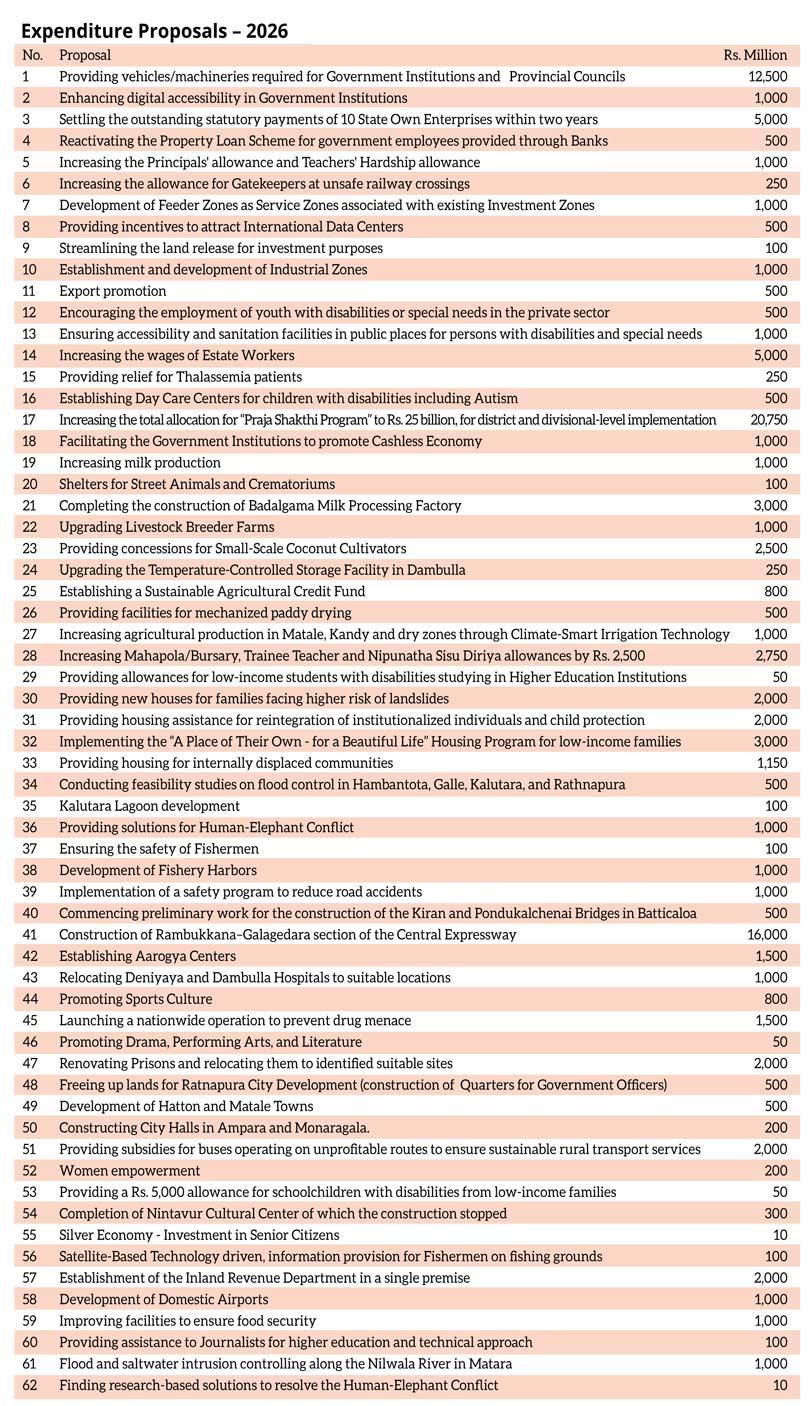
Accordingly, in order to implement the integrated rural development programme island-wide under the National Campaign for Eradicating Poverty, we propose to allocate Rs. 20,750 million in addition to the provisions of Rs. 4,250 million allocated for the ‘Praja Shakthi’ programme, increasing the total allocation to Rs. 25,000 million.
14. Uplifting the Living Standards of Estate Workers
It is our position that estate workers should be paid a fair daily wage commensurate with their service. It is proposed to increase the current minimum daily wage of Rs. 1,350 to Rs. 1,550 from January 2026. Furthermore, in addition to the salary of Rs. 1,550, it is proposed to pay Rs. 200 as a daily attendance incentive by the government. It is proposed to allocate Rs. 5,000 million for this purpose.
15. Regional Development
The Government expects to actively involve all citizens of the country, especially the rural community, in the country’s development programmes. We have given priority to improving the living standards of people living in underdeveloped areas and strengthening social life.
For national development to be successful, it is essential to improve administrative efficiency, social welfare, infrastructure including roads and strengthen economic relations at the provincial and regional levels. For this purpose, we allocate more funds than last year to the Provincial Councils and local government institutions.
16. Investing in the Silver Economy
Sri Lanka is undergoing a rapid demographic transition, with the proportion of the population aged 60 and over growing faster than the younger population. It is proposed to allocate Rs. 10 million to the Ministry of Rural Development, Social Security, and Community Empowerment to formulate a policy to make them active stakeholders in society.
17. Empowering Women: Nutrition, Safety, and Economic Opportunities
In 2026, we expect to enhance the Thriposha programme and the Monthly Nutrition Assistance Programme for Pregnant and Lactating Mothers, and ensuring wider coverage and improved delivery of these programmes through strengthened community health networks.
The contribution of the female community to our country’s labor force is very important. However, the female labour force participation rate remains at a low level around 32 percent. This budget has allocated Rs. 240 million to uplift self-employment, household industries, etc., carried out by women entrepreneurs across the island at the Divisional Secretariat level. Under this, efforts will be made to provide assistance to women entrepreneurs to start new businesses and strengthen self-employment activities. In addition to this, an additional Rs. 200 million is proposed to be allocated for programmes aimed at the welfare of women.
18. Providing Relief to Sri Lankans Abroad
Our highest net source of foreign exchange is the remittances made by Sri Lankans abroad. In appreciation of the contribution made by this group to the development of our country, we are introducing a housing loan scheme at concessional interest for migrant workers. It is proposed to implement it using the funds of the Sri Lanka Bureau of Foreign Employment according to the interest reimbursement method.
Similarly, a contributory pension scheme for foreign workers is being introduced. The Bureau of Foreign Employment will carry out the necessary work to implement the basic work quickly and within the year 2026.
Rs. 2,000 million will be allocated from the funds of the Bureau of Foreign Employment in the initial phase of these programmes.
19. Mitigating the Human-Elephant Conflict
The Human-Elephant Conflict results in the loss of about 80 human lives and over 260 elephants annually. The highest number of incidents are reported in the Anuradhapura, Polonnaruwa, and Ampara districts. The Human-Elephant Conflict in Sri Lanka poses a serious threat to both the rural and national economies.
20. Promoting Drama, Performing Arts and Literature
A meaningful platform has been created to advance Sri Lanka’s cultural diversity, reconciliation, and inclusive national identity. The Government’s policy framework emphasizes the importance of education, culture, and inter-community dialogue in building a compassionate society that respects heritage and diversity.
We propose to allocate an additional Rs. 50 million in addition to the existing allocations to promote drama, performing arts and literature as an area of cultural enrichment.
21. Promotion of the Media Sector
22. Developing Sports Culture
Developing a sports culture creates a healthy, vibrant, cooperative, and “An energetic citizen - Triumphant people” in society. Therefore, Rs. 1,800 million has been allocated to promote sports culture among our children and youth by expanding opportunities for sports facilities. We propose to allocate an additional Rs. 800 million for this purpose.
Rs. 1,163 million have been allocated to provide facilities for players to participate in international sports competitions, second-tier sports pools, international sports tournaments, national sports competitions, and high-caliber sports teams to provide facilities for about 4,000 participating athletes.
Under the development of sports infrastructure, Rs. 225 million has been allocated in this year’s budget for the development of sports complexes in the Mannar and Vavuniya districts, and Rs. 150 million for the completion of the Kalmunai Sports Stadium. Subsequently, Rs. 150 million has been allocated for the development of sports complexes in the Northern and Eastern provinces.
23. Economic Sovereignty and Food Security
23.1Agriculture and Livestock Sector
We propose to provide the necessary provisions of Rs. 250 million in this budget to complete the construction work that is hindering the use of the warehouse and install a solar panel system. Attention needs to be paid to a more appropriate methodology for the operation and management of this cold storage facility.
For this programme, it is expected to implement a programme to improve the breeding, nutrition and health of dairy cattle by organizing farmers based on each Veterinary Division.
For this purpose, we propose to organize farmers and increase local milk production, based on the potential of Veterinary Divisions.We propose to allocate Rs. 1,000 million for the preliminary work including the feasibility study of this project under the “Small and Medium sized Livestock Development Programme”.
We propose to complete the work of the Badalgama Dairy Factory as soon as possible and relocate the current Narahenpita milk factory to this location.
Honorable Speaker, while allocating funds for development of this dairy factory, we expect to conduct an investigation into the corruption and waste of public funds that has occurred in this regard.
23.2 Strengthening Coconut Cultivation
Therefore, as a long-term strategy to increase coconut production, we have allocated Rs. 600 million for the further expansion of coconut cultivation in the already established Northern Coconut Triangle based on the recommendations of the Coconut Research Institute.
Therefore, in order to achieve the expected export targets by achieving the medium-term productivity goals of the coconut sector, it is proposed to allocate Rs. 2,500 million to implement a structured programme to motivate coconut growers who own less than 5 acres out of the estimated 447,000 acres currently under coconut cultivation.
24. Fisheries Industry
24.1 Development of Infrastructure Facilities in Fishery Harbours
Focusing on providing necessary assistance for safe and quality fishing vessel operations, improving efficiency, and minimizing post-harvest losses, we have allocated Rs. 300 million for the renovation, rehabilitation, and upgrading of existing infrastructure facilities at selected fishery harbours, including Beruwala, Ambalangoda, Kudawella, and Nilwella.
Further, in addition to the provisions already allocated for further improvement of essential infrastructure facilities in fishery harbours, it is proposed to allocate an additional Rs. 1,000 million.
24.2 Providing Modern Technology to Enhance the Safety of Fishermen
24.3 Increasing Fish Harvest
24.4 Promoting the Blue Economy
Sri Lanka’s blue economy plays a vital role in national prosperity and sustainable development. Sri Lanka’s strategic location in the Indian Ocean provides a unique opportunity to harness our marine and coastal resources for sustainable economic growth and also provides an opportunity to emerge as a regional hub for blue economy investments.
Rs. 100 million has been allocated to conduct a detailed study on the economic benefits that can be achieved through marine and coastal fisheries, marine aquaculture, ecotourism, diving-related activities, marine biotechnology and development of seabed resources in the Exclusive Economic Zone (EEZ).
25. Irrigation and Water Supply
25.1 Irrigation
25.2 Urban Flood Control
25.3. Improvement of Drinking Water Supply
The drinking water supply has so far met only 62 percent of the requirement. The lack of access to clean drinking water has become a major problem facing the people. New water supply projects are being initiated and the ongoing projects are being completed expeditiously. Rs. 85,700 million has been allocated for the implementation of drinking water supply projects as well as community water supply projects covering districts such as Gampaha, Kalutara, Anuradhapura, Kandy, Jaffna, Kilinochchi and Kurunegala. Furthermore, steps are being taken to implement the necessary infrastructure facilities for drinking water supply in collaboration with the private sector.
26. Sustainable Infrastructure Development
26.1 Public Transportation
The current public transportation sector is facing numerous challenges. The inefficiency of the overall transportation system, the lack of adequate facilities, and the insecurity within the transport network are causing passengers to further distance themselves from public transport.
Achieving the government’s long-term vision of “A good public transportation service - Speedy destination” requires the creation of an efficient and sustainable passenger transportation system, which is a key priority of the current government. For this purpose, Rs. 67,200 million has been allocated in this budget. Among them, the main projects to be implemented include the following:
26.2 Road Development
The economic crisis experienced by the country led to the suspension of numerous road development projects, resulting in various complications. Measures have been taken to resolve these issues and recommence the implementation of those projects. For overall road development in the year 2026, Rs. 342,000 million or Rs. 342 billion has been allocated. This includes the following projects:
A decision has also been taken to provide financial facilities for the construction of the Kadawatha-Mirigama section of the Central Expressway, among the expressways that were currently on hold. Development work on the Kadawatha-Mirigama Expressway section has already commenced and Rs. 66,150 million has been allocated for the year 2026.
The construction of the Pothuhera–Rambukkana section of the Central Expressway–Phase III from Pothuhera to Galagedara is scheduled for completion in the first quarter of 2027. Rs. 10,500 million has been allocated for this purpose. Furthermore, it is proposed to commence construction work on the Rambukkana–Galagedara section of the same phase using domestic funding, taking into account the fiscal space. For this purpose, an allocation of Rs. 20,000 million is proposed, comprising both the remaining provisions from the Road Development Authority’s debt repayment arising from the full settlement of a portion of future loan obligations within this year and an additional budgetary allocation.
Furthermore, the necessary feasibility studies for the widening of the Katugastota–Galagedara road section are scheduled to commence next year. In parallel with the construction of the Kandy Multi-Modal Transport Centre, provisions have been made in this budget to widen and upgrade several access roads leading into Kandy city. These developments are expected to help reduce traffic congestion within the city to a considerable extent.
Land acquisition activities for the proposed Kurunegala–Dambulla Expressway are currently in progress. Rs. 1,000 million has been allocated to complete the land acquisition process for this project.
The construction of the 25-kilometre section of the Ruwanpura Expressway from Kahathuduwa to Ingiriya had been undertaken in an irregular and fragmented manner, and work was temporarily suspended with the onset of the economic crisis. As a result of these partially completed constructions, the local communities have been facing several economic, social, and environmental challenges.
Accordingly, it is proposed to reassess the improvement of the existing access road from Kahathuduwa to Ingiriya, based on a review of the feasibility study conducted in 2018 and further analysis of the information derived from the study. Land acquisition activities for this expressway section continue and Rs. 1,500 million has been allocated for this purpose.
Feasibility Study on the Construction of the Link between the Port Access Elevated Highway and the Marine Drive Extension (Phase II)
With the objective of enhancing road connectivity to the Colombo Port and the Port City, an elevated highway project is currently under construction. To address the traffic congestion expected around the Lotus Roundabout area and its surroundings near Galle Face, following the integration of this expressway into the national road network, Rs. 330 million has been allocated to conduct a feasibility study on constructing a link between the Port City end of the Port Access Elevated Highway and the Marine Drive.
26.3 Implementation of a Road Safety Programme to Minimize Traffic Accidents
It has been observed that road accidents have increased rapidly in recent times, with a significant proportion resulting in fatalities. According to the Sri Lanka Police Road Accident Report, a total of 24,589 road related accidents were reported in 2024, of which 2,262 were fatal, resulting in the loss of 2,368 lives. These accidents have not only caused immense hardship to the public but have also led to considerable economic losses as a whole.
It is proposed to allocate an additional Rs. 1,000 million, supplementary to the provisions already set aside, for the implementation of a comprehensive road safety programme. This programme aims to enhance road safety infrastructure through the integration of safety strategies into road design and the improvement of unsafe road sections.
27. Energy Sector
27.1 Green Energy
Since our Government assumed power in September of last year, we have taken decisive measures to introduce a competitive bidding system for government procurements, with the objective of ensuring the most favorable prices for consumers. A major achievement of this effort was clearly visible in the recent awarding of power generation projects.
The previous administration had awarded two tenders for a total capacity of 500 MW at a rate of US cents 8.26 per kilowatt-hour, without following a proper procurement process and without even factoring in the cost of a substation for connecting the wind power capacity.
We recently, on 28th October 2025, opened two tenders for two power projects in Mullikulam and I am very proud to report to this House on the remarkable results achieved. Accordingly, bids were submitted for the Phase I, 50 MW power plant at a price of US cents 3.96 per unit and for the Phase II,50 MW power plant at a price of US cents 3.77 per unit. In addition, the Mannar Phase 1 Expansion Project, a 50MW project, was awarded at an impressive price of US cents 4.65 per unit.
27.2 People-Centric Energy Transition
As a major step towards a People-centric Energy Transition, the Sri Lanka Electricity Act was amended and four separate fully State-Owned Companies were established to handle the functions of generation, transmission, distribution and system control with the aim of improving the national economy and the living standards of the people.
According to the Long-Term Generation Plan 2025 - 2044 published by the Ceylon Electricity Board, it is estimated that the electricity requirement will increase by about 60 percent in the next decade.
We have been debating for decades about how to generate electricity. Plans were outdated, procurement was not done properly, construction was delayed. The electricity generated was mostly used only to provide light, run a fan, and run an AC, and while it could be argued that it would improve the standard of living of the people, the weaknesses in powering electricity consumption for economic activities remained.
We now focus on entering new areas to revitalize the national economy by utilizing electricity. Namely;
1. Data Centres
2. Transport Electrification
3. Green Hydrogen
4. Green Ammonia
We need to develop electricity consumption that targets new economic opportunities. To achieve this, electricity transmission and distribution systems need to be developed using modern, smart technology.
To empower this work, an Integrated Economic Development Framework will be established by integrating Energy, Digital, and Transport.
It is expected to introduce Energy Transition Act in next year with the aim of establishing the necessary legal framework for this purpose.
28. Effective Utilization of Underutilized Buildings and Structures
It is currently reported that there are more than 2,700 structures built by various government agencies that are currently abandoned or partially completed and not being used properly. They can be identified as educational buildings, hospitals, textile industry buildings, vocational training centres, community halls, service centres and multi-purpose buildings, warehouses, cultural centres and other buildings.
We are studying the possibility of improving these underutilized buildings or structures and using them for income-generating projects such as hotels, business centres, factories or other purposes through public-private partnerships and accordingly, we are preparing the necessary plans to effectively utilize these resources.
Accordingly, efforts are being made to provide value for these investments by ensuring that these structures, which were built at high cost without proper feasibility studies in the past, are not letting deteriorate and ensuring optimal use.
29. Supply Chain Development
29.1 Infrastructure Developments to Improve Container Operations Within the Port
Sri Lanka has significant potential to become a regional leader in Port Logistics, leveraging its strategic location. In the next year, we expect to enhance the capacity of the Colombo Port and enhance operational efficiency through major development initiatives, including the Western Container Terminal Phase II project with the support of the Asian Development Bank, feasibility studies for the proposed Ports Logistics Centres with the support of the World Bank, and the proposed Colombo North Port Development Project. In addition, the Kerawalapitiya Customs Verification Centre and Trade Facilitation Centres in the Bloemendal area will be established.
In addition to developing the necessary infrastructure to positioning the ports in Sri Lanka as a leading logistics hub in the region, digitalization and automation of port operations are being enhanced to ensure seamless and efficient port operations, including the implementation of the Port Community System as an integrated data management system.
29.2 Infrastructure Development to Make Airport Operations more Efficient (Air Cargo Centre)
The second phase of the airport development, which was halted due to economic downturns and other factors, will begin construction in early 2026. JICA has already agreed to provide financial facilities for this purpose.
Bandaranaike International Airport is on its way to becoming a regional hub for air cargo, with ongoing development activities, including the expansion of SriLankan Airlines’ cargo terminal and cargo handling facilities.
However, to overcome further challenges, particularly in the cold chain system, lack of sufficient storage capacity and outdated systems, and to achieve the full potential of the air cargo sector and to ensure operational efficiency and financial sustainability, it is proposed to provide advanced facilities such as cold storage required to handle air cargo to the newly constructed cargo terminal through a Public Private Partnership (PPP) model.
30. New Approach to Urban Development
n Urban development projects have been implemented informally and without prioritization, without proper study and planning, and due to that have not been able to achieve the desired results. Therefore, the city development process will be conducted according to a formal plan with proper studies effective from 2026. Efforts are being made to establish an efficient, sustainable, tourists and investment-attractive city network. Rs. 2,000 million have been allocated to commence preliminary work to identify the feasibility of 10 identified cities across the island, including Jaffna, Eheliyagoda, Batticaloa, Chilaw, and Matara, and this amount will be released based on requirement and progress.
30.1 Waste Management Facilities for Local Government Institutions
With the increasing trend of urbanization, proper solid waste management has become a challenge for local governments. Due to improper disposal of waste, environmental and health impacts, animal distress and public complaints are becoming increasingly serious day by day.
In response to this problem, it is proposed to allocate funds from the budget 2026 to provide local governments with environmentally friendly, cost-effective and hygienic solid waste transport equipment such as compactors, tractors and trailers. The procurement process has already begun to purchase 700 machines with an allocation of Rs. 8,000 million from the remaining capital expenditure in 2025.
Accordingly, Rs. 900 million has been allocated for the implementation of solid waste management under the Ministry of Public Administration, Provincial Councils and Local Government to provide vehicles and equipment for the systematic disposal of solid waste and maintenance.
30.2 Meeting the Expenditures of Local Government Institutions (Regional Development)
Local Government Institutions are institutions with independent powers, but they have been made dependent on the General Treasury even for the payment of salaries. In providing provisions for the payment of salaries from the General Treasury, it is proposed to introduce a new system instead of the existing system of providing provisions by reducing the percentages of 20 and 40 percent of the estimate.
Accordingly, based on the study recently conducted by the Ministry of Public Administration, Provincial Councils and Local Government, it is proposed to initiate a formal system of providing government contribution to each local government institution, taking into account the income and actual expenditure of the local government institutions.
In doing so, if a budget deficit arises in a local government institution, provisions will be provided for capital expenditure to cover it.
Rs. 2,500 million for the strengthening of local government institutions, improvement of infrastructure facilities in local government institutions, and revenue generation programs has been allocated for this purpose.
30.3 Introducing Services and Facilities for the Care of Street Dogs and the Burial/Cremation of Pets
With the changing lifestyles in urban and semi-urban areas, the trend of having pets is growing rapidly. At the same time, burial and cremation of pets when they die remains a problem. The demand for respectful and environmentally responsible alternatives has also increased.
It has also been recognized that there is a need to develop a system to take care of stray dogs and pets in urban areas in collaboration with the local authorities.
As a consideration to this need, it is proposed to allocate Rs.100 million to implement a pilot project in the local authorities of Kesbewa and Piliyandala areas, with the aim of encouraging the provision of services for the burial of pets, cremation and careof stray animals.
31. A Safe Home for Every Individual
“Shade for the head is peace for the mind,” every citizen believes. Having a decent home is a basic human right for every human being, regardless of their status. There are people in this country who suffer and sigh for a house throughout their lives. With the hope of bringing comfort to the lives of the citizens of our country, we are embarking on the process of fulfilling the dream of a house.
There are many factors that leads to housing problems. Among them, there are various reasons such as poverty, insufficient income, scarcity of land, increase in construction costs, migration, informal urbanization, displacement and natural disasters. In 2026, ahousing development programme with a new approach is expected to be implemented, encompassing all social groups facing housing issues. Under this programme, construction work on 27,000 new homes including those currently under construction, is expected to be completed.
31.1 Solving Housing Problems Arising out of Low Income Communities and Urbanization
31.2 Provision of Housing for the Malayagam Community
Rs.4,290 million has been allocated with the assistance of the Government of India, for the construction of 2,000 housesto upgrade the housing and infrastructure facilities of the Malayagam Estate workers living in Central, Uva, Sabaragamuwa, North Western and Southern Provinces. Further, a sum of Rs. 1,305 million has been allocated for the completion of work on 943houses currently in the Northern and Southern Provinces with the assistance of the Government of India.
31.3 Provision of Houses for People Displaced by Natural Disasters
About 9,000 rural and estate family units living in areas made vulnerable due to landslides and other environmental issues have been identified. In the next three years, it will be imperative to provide safe housing for these families. An additional Rs. 2,000million is proposed to be allocated for the construction of houses for 1,200 such families this year,in addition to the Rs. 1,000 million already allocated.
31.4 Provision of Housing for Internally Displaced Communities
The current allocation of Rs. 3,850 million for the construction of 2,500 houses for families who do not own any houses due to the conflict in the Northern and Eastern provinces will be increased to Rs. 5,000 million.
31.5 Housing Assistance for Resocialization and Child Care
We have embarked on a new journey by introducing a special programme in the Budget 2025, providing a grant to young people who have grown up in children’s detention centers to build a stable and safe home, giving them the strength they need to rebuild their lives. Strengthening this initiative further, we propose to provide a financial provision of Rs. 2 million to those who have lived and socialized in children’s detention centers at any stage of their lives and to families of children at risk identified by the National Child Protection Authority, to purchase a land and build a house, build a house on land they own or renovate existing houses. Accordingly, we propose to allocate Rs. 2,000 million for this purpose.
32. Modernization of the Public Service
To achieve future achievements economically, socially and culturally, we recognize the necessity of a strong public service for our country. However, at present, the public service bears a relatively high-cost burden for the provision of public services. Politicized recruitment to the public service, institutions that have historically completed their functions, and various institutions that have been established for the same functions have contributed to this. We are taking steps to properly evaluate the essential services that the government should provide and close down government institutions that have completed their functions, merge various government institutions that perform the same function, and reorganize outdated objectives according to new objectives. We have initiated steps to close down 33 such institutions that do not perform any commercial, regulatory or administrative activities.
Further, non-commercial institutions that have deviated from the original purpose of their establishment and are not suitable for the current context have also been identified and are preparing to close them.
The above State-Owned Enterprises do not contribute to the national economy or service provision, and their financial records are very difficult to find, and due to legal issues regarding unsettled liabilities and asset ownership, a final decision has not been taken on this matter. A unit has already been established under the Ministry of Finance to resolve these issues and expedite the process.
Based on the recommendations made on State-Owned non-commercial institutions, 21 institutions will be reorganized to consolidate the same functions, 14 institutions in the research sector will be merged to establish one national-level institution, 9 institutions that are currently not operating in a commercial model will be converted into financially independent institutions, and 13 institutions will be liquidated as the objectives for which they were established at that time are no longer needed at present.
32.1 Regularization of Recruitment in the Public Service
The public service mechanism has been completely paralyzed due to the lack of formal recruitment for vacancies in the public service for many years. Therefore, after a formal study conducted by the Committee to Review the Recruitment Process and Manage the Number of Employees in the Public Service, established under the chairmanship of the Prime Minister, approval has been given to recruit nearly 75,000 people under a proper system.
32.2 Increasing Digital Access in Government Institutions
The complex procedures of government institutions that directly provide public services should be simplified (Business Process Reengineering) and those facilities should be provided under digital methods expeditiously. For this purpose, it is proposed to allocate another Rs. 1,000 million in addition to the provisions currently allocated for applications in line with the digitalization program (Digital Blue Print) already prepared by the government.
32.3 Providing Vehicles Required for Government Institutions/Machinery Required for Provincial Government Institutions
The government’s current fleet of vehicles and machinery is inadequate and a significant portion of the existing vehicles and machinery are obsolete, resulting in substantial expenditures on repairs and maintenance. This situation has become a significant obstacle to the continuation of the development activities that the government is expected to achieve.
Considering this situation, the government has decided to purchase a number of vehicles and machinery essential for government institutions, as well as vehicles to be provided on the basis of return after the end of the parliamentary members’ term. For this purpose, it is proposed to allocate a total of Rs. 12,500 million as the primary requirement.
32.4 Settlement of Outstanding Statutory Payments of Government Institutions
Due to the lack of proper management or financial discipline in recruiting employees for State Owned Enterprises, which are used as places to provide jobs to supporters for political gain, numerous state institutions have become a huge burden on the people, are in debt to banks, and are unable to pay their Employees’ Provident Funds, Employee Trust Funds, and tax payments.
Lanka Sugar Company (Private) Limited
Janatha Estates Development Board
Sri Lanka State Plantations Corporation
Sri Lanka Rupavahini Corporation
Ceylon Fisheries Corporation
National Livestock Development Board
Elkaduwa Plantations Limited
Sri Lanka Broadcasting Corporation
North Sea Limited
Ceylon Ceramics Corporation
A total of Rs. 11,000 million is required to settle the outstanding arrears of statutory allowances such as Employees’ Provident Fund (EPF), Employees’ Trust Fund (ETF), Gratuity Allowances and taxes of 10 State owned Enterprises.
It is proposed to pay these unpaid statutory payments in phases and to allocate Rs. 5,000 million for the year 2026. It is expected that this will ensure the payment of the outstanding Employees’ Provident Funds and Employees’ Trust Funds of the current employees of these institutions as well as the payment of the employee gratuity entitlements of the retired employees and to restructure their balance sheet liabilities.
32.5 Settlement of Treasury Guarantees and Letters of Comfort Issued by the Government to Public Enterprises
Treasury guarantees or letters of Comfort have been issued to state banks for the state-owned enterprises to obtain loans. Due to long term losses and financial crises, such enterprises are unable to repay these loans. These obligations which will be in effect until 31.12.2026 will be settled during this year considering as an urgent need.
32.6 Payment of Government Contributions for the Interest Paid to Senior Citizen Accounts
Although an additional interest of about 15 percent was given to the savings of senior citizens, the outstanding amount that should have been paid to the banks in 2022 and 2023 but has not been paid so far is being settled. For this, from the interest to be borne by the government (from the government contribution), the unpaid amount of Rs. 10,000 million has already been paid in 2025, and the remaining outstanding amount of Rs. 45,700 million is also being paid in full this year.
33. Salaries and pension in the public sector
33.1 Establishment of a Salaries and Pensions Commission
It is our responsibility to manage salary and pension policies in a sustainable manner. Considering the salary anomalies that have arisen over the years, and the challenges to public financial management, a Salaries and Pensions Commission is being established to provide solutions to the problems of public employees and pensioners regarding salaries and allowances.
33.2 Amendment of the Condition of the Appointment Letter Regarding the Entitlement to Contributory Pension Benefits
All government officers recruited into the public service on or after 2016.01.01 have mentioned the entitlement to contributory pension benefits in the appointment letters issued. However, if such an employee retires, it is not practical to consider them outside the existing pension scheme. The clause regarding pension entitlement is being removed from the appointment letters and their entitlement to the existing pension scheme is confirmed.
33.3 Second Phase of Public Sector Salary Increase
An allocation of Rs. 110 billion has been provided for the implementation of the second phase of the salary revisions made in 2025. Accordingly, these salaries will be paid to all public servants commencing from January 2026.
33.4 Second Phase of Pension Anomaly Rectification for Retirees Before 2020
In the second phase of pension revision, the pensions of those who retired before 2020 will be revised based on the salary structure of 2019. An amount of Rs. 20,000 million has been allocated for the payment of this revised salary from July 2026.
33.5 Providing Housing and Property Loans to Public Servants at Concessional Interest Rates
The property loan scheme provided to public servants is expected to be activated under a new structure to provide loans up to Rs. 50 lakhs. In that case, we propose to allocate Rs. 500 million to provide loans at 4 percent concessional interest rate up to the initial Rs. 30 lakhs and at 2 percent concessional interest rate from Rs. 30 lakhs to Rs. 50 lakhs.
33.6 Expanding the Coverage of Health Benefits under the Agrahara Scheme
Although public servants receive certain concessions under the Agrahara Insurance Scheme currently in operation for public servants, in order to ensure that the benefits provided to employees are remained at a stable level due to the minimum employee contribution of Rs. 125, we propose to increase the contribution amount of Rs. 125 by another Rs. 75 and the monthly contributions of Rs. 300 and Rs. 600 by another Rs. 150.
33.7 Increase in Festival Advance
It is proposed to increase the interest-free festive advance of Rs. 10,000 provided to government employees to Rs. 15,000.
33.8 Distress Loan Advance
In line with the increase in the salaries of public servants, we have taken steps to increase the amount of distress loan advances that they can obtain at an interest rate of 4.2 percent from Rs. 250,000 to Rs. 400,000. To ensure that these advances can be obtained within a short period of time without any disruption, Rs. 10,000 million has been allocated for the advance account limit of public servants.
33.9 Increase in Allowances for Teachers Engaged in Remote Service and Allowances for Principals
Since the allowances paid to teachers working in schools in remote areas have not been increased for 20 years, we propose to increase the allowance by Rs. 1,500 to motivate those teachers.
In recognition of the administrative responsibilities and accountability of principals in achieving educational goals, we propose to increase the principal allowance paid to principals serving in the position of principal by Rs. 1,500 and to allocate Rs. 1,000 million to increase the achievement of educational goals.
33.10 Increasing the Allowance of Gatekeepers at Unsafe Railway Crossings
The frequent accidents at unsafe railway crossings result in a significant number of deaths annually, with a significant number of people becoming permanently disabled. As remedial measures to this situation, about 1,000 gatekeepers have been employed. We propose to allocate Rs. 250million to increase the minimum allowance currently paid to them from Rs. 7,500 to Rs. 15,000 per month for an eight-hour shift.
33.11 Formalization of Permanent Appointments for Employees Engaged on Temporary, Casual, Substitute, Contract, or Concessionary Basis
It has been reported that, due to previous governments not formally granting permanent appointments to employees recruited on a temporary, casual, substitute, contract, or concessionary basis, approximately 9,800 employees receiving only minimum wages are currently serving in various institutions within the public sector.
Although permanent appointments have been given to only a portion of these employees on various occasions, these employees have been denied the opportunity for regularization.
The government confirms that recruitments to the public service in an irregular manner over a long period of time will not be made under our government in the future, and we acknowledge the need to regularize the services of these employees who have already been recruited and have not been given proper service conditions. Accordingly, we propose to grant permanent appointments to all employees currently employed in various institutions for more than 6 months who have fulfilled the qualifications under Public Administration Circular 25/2014 and Public Administration Circular 29/2019.
34. Fiscal Discipline and Macroeconomic Stability
34.1 Revenue Measures and Domestic Revenue Mobilization
In parallel with the full implementation of the Public Financial Management Act, No. 44 of 2024, our government is committed to building a modern tax system based on transparency, fairness, and administrative efficiency. In line with international benchmarks, our goal is to achieve and maintain tax revenue at a level exceeding 15 percent of GDP in the medium term, secure the necessary fiscal space for critical social investments, strengthen investor confidence, and expand our financial markets.
34.2 Progress in Government Tax Revenue Collection
When our government took office, revenue collection was at a low level. Tax compliance was poor, and public confidence in the entire system had eroded. We are pleased to announce that, within just one year, we have made significant progress in revenue collection.
Accordingly, government revenue, including grants, increased to Rs. 3,800 billion in the first nine months of 2025 from Rs. 2,900 billion in the same period of 2024. At this moment, we wish to express our sincere gratitude to all government officials who have contributed to this task.
The Simplified VAT System (SVAT) has been abolished with effect from October 01, 2025, and has been shifted to an approved refund process to improve tax compliance and reduce misuse. The total number of registered taxpayers has increased by 3 lakhs as of September 30, 2025 compared to 2024.
Our approach to strengthening revenue collection is anchored in the principle of shared responsibility, reflecting the social contract between the citizen and the Government. We are implementing a comprehensive reform agenda that rationalizes tax expenditures, strengthens income taxes, improves the efficiency of VAT and excise duty, and expands the formal sector through simplified procedures and digital-first compliance frameworks. These measures must be aligned with broader institutional reforms to improve the efficiency of expenditure, accountability, and public trust.
35. Revenue Proposals – 2026
35.1 Imposition of Value Added Tax and Social Security Contribution Levy on Imported Coconut Oil and Palm Oil
Locally produced coconut oil and palm oil are subjected to Value Added Tax and Social Security Contribution Levy, while imported coconut oil and palm oil are subjected to Special Commodity Levy at Rs. 150 per kilogram and Rs. 275 per kilogram, respectively.
To ensure a level playing field, it is proposed to remove the Special Commodity Levy on imported coconut oil and palm oil and instead implement the general tax structure including Value Added Tax. It is also proposed to implement this proposal from April 2026.
35.2 Reduction of registration threshold of Value Added Tax and Social Security Contribution Levy
With the view of broadening the tax base, we propose to reduce the annual turnover threshold for the registration from Rs. 60 million to Rs.36 million Value Added Tax and Social Security Contribution Levy effective from April 01, 2026.
35.3 Removal of CESS and imposition of VAT on Imported Fabric
Locally manufactured fabric is subjected to VAT and the imported fabric, although exempted from VAT, is subjected CESS of Rs.100 per kilo gram. To ensure a level playing field, it is proposed to remove CESS and impose VAT on the imported fabric. This will be implemented effective from April 01, 2026.
35.4 Imposition of Social Security Contribution Levy on Vehicles
It is observed that the social security contribution levy on the sale of vehicles is not being collected properly. Therefore, the social security contribution levyis proposed to be charged at the time of import or manufacture and sale of vehicles, and exempt this tax at the time of after-sales. This is expected to be implemented effective from April 2026.
35.5 Implementation of the National Tariff Policy
We propose to revise the current Customs Import Duty rates of 0%, 15%, 20%, in line with the National Tariff Policy, to 0%, 10%, 20%, 30%, effective from April 2026. Also, with the aim of boosting economic growth by increasing the competitiveness of external trade, we expect the gradual phase out of para-tariffs through the proposed revisions in Customs Import Duty rates. We propose to prepare and implement a plan according to a time frame for the phaseout of para-tariff with a minimal impact on government revenue.
35.6 Improving the Tax Audit Process
To enhance the integrity, efficiency and fairness of tax administration, the Government will introduce a modern tax audit framework effective on the returns filed from January 2026. These reforms will streamline audit procedures and reduce the illegal connections between taxpayers and officials, thereby minimizing opportunities for discretion and corruption.
Under the new system, the selection of audit cases will be based on transparent risk assessments conducted by the Risk Management Unit and, when necessary, reviewed by a committee appointed by the Commissioner General of Inland Revenue. These changes, implemented through amendments to the relevant tax statutes, demonstrate the Government’s accountability for establishing a transparent, rule-based and credible revenue administration that supports Sri Lanka’s journey towards sustainable economic growth.
35.7 Amendments to the Telecommunications Tax Act and Strengthening Government’s Programme Against Money Laundering and the Financing of Terrorism
Any bad debt incurred by the telecommunications service provider should be included in the payment of the Telecommunications Levy on the provision of telecommunications services. Similarly, any bad debt recovered should be included in the payment of the relevant tax. It is proposed to amend the Telecommunications Tax Act, No. 21 of 2011, to introduce the relevant amendments and to reflect the changes made from time to time in relation to telecommunications taxes.
Legal provisions are proposed to be included in the relevant tax laws to allow tax administration authorities to exchange information with the Financial Intelligence Unit and other enforcement agencies regarding the Anti-Money Laundering and Countering the Financing of Terrorism (AML/CFT) Framework.
Also, to strengthen the government’s efforts against money laundering and the financing of terrorism, necessary legal provisions are proposed to be introduced in all tax legislations for enforcement, including the interpretation of tax-related crimes, prosecution by the Attorney General and imposition of fines, penalties.
35.8 Development of the National Electronic Invoicing System
To initiate a national e-invoicing system, Sri Lanka has introduced an API-based integrated framework to enable seamless connectivity between taxpayers’ Enterprise Resource Planning (ERP) systems and the Revenue Administration Management Information System (RAMIS).
This initiative is expected to be completed and implemented within this year, following a pilot project involving a selected group of companies that have upgraded their ERP systems to support API integration.
In the first phase, the system will be expanded to cover export-oriented enterprises and integration with selected pilot companies through the API mechanism. In the second phase, all VAT-registered taxpayers will be included.
In the third phase, the e-invoice system is expected to be deployed through point-of-sale (POS) machines to record transactions in real time, improve tax compliance, and enhance the efficiency and transparency of VAT administration through a fully web-based platform.
35.9 Department of Inland Revenue in a Single Office Premises
The Department of Inland Revenue is one of the main institutions responsible for generating government revenue, and directing its tax collection process towards digitalization enables the provision of a more efficient service.
Under this condition, by operating the main office of the Department of Inland Revenue and its related offices within a single premises, it will be possible to provide taxpayers with a simpler, more reliable, and efficient service, while also strengthening the tax collection process in a sustainable manner. Since taxpayers are the main beneficiaries of this institution, it is essential to develop the necessary physical facilities to provide them with a quality service.
Accordingly, it is proposed to allocate Rs. 2,000 million to establish a new office complex after selecting the most suitable location among the proposed sites and conducting a feasibility study.
36. Changing the date of publication of the Final Budget Position Report and the Mid-Year Fiscal Position Report
Considering the delays in the timely dissemination of essential public financial information required for effective fiscal oversight and policy coordination during the financial year, we propose to enhance fiscal transparency and make public financial management more responsive by advancing the publication deadlines. Accordingly, the deadline for releasing the Final Budget Position Report (Annual Report) will be moved from June 30 to May 31 each year, and the publication of the Mid-Year Fiscal Position Report will be advanced from October 31 to August 31 each year.
37. Borrowing Limit
The borrowing limit of the Appropriation Bill for the financial year 2026 is presented in Annexure II. The technical note on the relevant expenditure measures is given in Annexure III. Further, the documents to be presented with the second reading of the budget under the Public Financial Management Act, No. 44 of 2024 have also been tabled.
37.1 Reducing the Maximum Borrowing Limit for the Year 2026
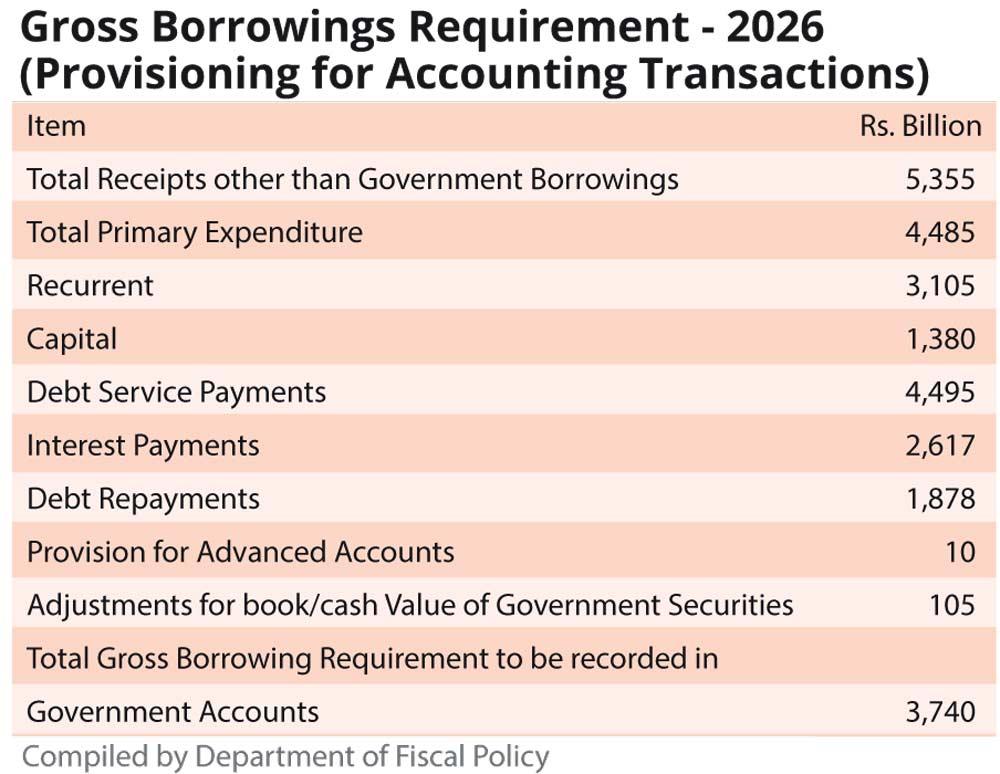
Due to the revisions to the revenue estimates expected through the budget proposals, the borrowing limit in the Appropriation Bill presented to this Parliament on 26.09.2025 should be revised by reducing it by Rs. 60 billion to Rs. 3,740 billion. This revision is presented in Annex II of this Budget Speech.
37.2 Amendments to the Appropriation Bill arising from the Revision of Subjects and Functions of Ministries
Following the submission of the Appropriation Bill to Parliament, certain subjects and functions of Ministries were revised as per the Extraordinary Gazette No. 2485/65 dated 18.10.2025. Accordingly, the necessary amendments to this Bill, in line with those revisions, will be made under the respective expenditure heads at the Second Reading of the Budget.
The changes to expenditure heads required for the year 2025, in line with the revision of subjects and functions, have already been outlined in National Budget Circular No. 04/2025.
38. Conclusion
Accordingly, for the first time in history, we have placed before the country the second Budget of a government that has not misused public funds or used improper privileges.
We have decisively changed the difference between the citizen and the public representative.
Our sole objective is to create an economy where people who do not eat three meals a day can get three nutritious meals, to create an environment for every child to receive education, to provide shade for every head, and to ensure a healthy life for every citizen.
When appointing to various positions, we looked at talent, ability, honesty, desire to work for the country and skill, and not whether they helped us or were one of our own. His political background, nationality, kinship, religion, school studied, former country, etc. are not relevant to us. We have no personal agendas. All we wanted was to know whether or not the services of these people would benefit the people of the country.
In order to transform Sri Lanka into a favorable destination for investors, we have already created a rule of law, long-term government policies, an independent judiciary and an investment-friendly environment free from corruption. A transparent investment environment free from hand-to-hand dealings, bribery and favoritism has now been created. Also, new legal frameworks, visa policies and other infrastructure facilities required by investors are being developed expeditiously and business facilities are being created.
This budget has been presented with the sincere hope of making the path to realizing our vision and dream of every Sri Lankan enjoying a good life a reality.
09 Jul 2026 48 minute ago
09 Jul 2026 2 hours ago
09 Jul 2026 3 hours ago
09 Jul 2026 8 hours ago
08 Jul 2026 08 Jul 2026