23 Feb 2026 - {{hitsCtrl.values.hits}}
 The Democratic Socialist Republic of Sri Lanka is currently navigating two entirely different, violently colliding realities that threaten to tear the national fabric asunder. For the general public, understanding this divergence is no longer an academic exercise; it is a critical necessity, as it dictates not just the macroeconomic future of the nation, but the daily survival of its citizens.
In the wood-paneled corridors of the Ministry of Finance and the Central Bank in Colombo, the narrative is one of virtual arithmetic triumph. By the dawn of 2026, the aggressive fiscal consolidation pursued under the International Monetary Fund (IMF) Extended Fund Facility had driven government revenue toward a landmark 15.9 percent of GDP.
This has culminated in a projected primary surplus of 2.3 percent, meaning the government is finally collecting more in taxes than it spends on public services, excluding interest payments on old debt. To the casual observer of global financial news, this reads as a monumental success. It is a feat of virtual accounting achieved through ruthless, disciplined tax extraction and severe expenditure control.
Yet, step outside those institutional walls, and the physical reality tells a story of systemic, accelerating collapse. The landfall of Ditwah in late November 2025 served as the definitive, tragic indictment of a policy framework that prioritizes “virtual wealth” over “real resilience”.
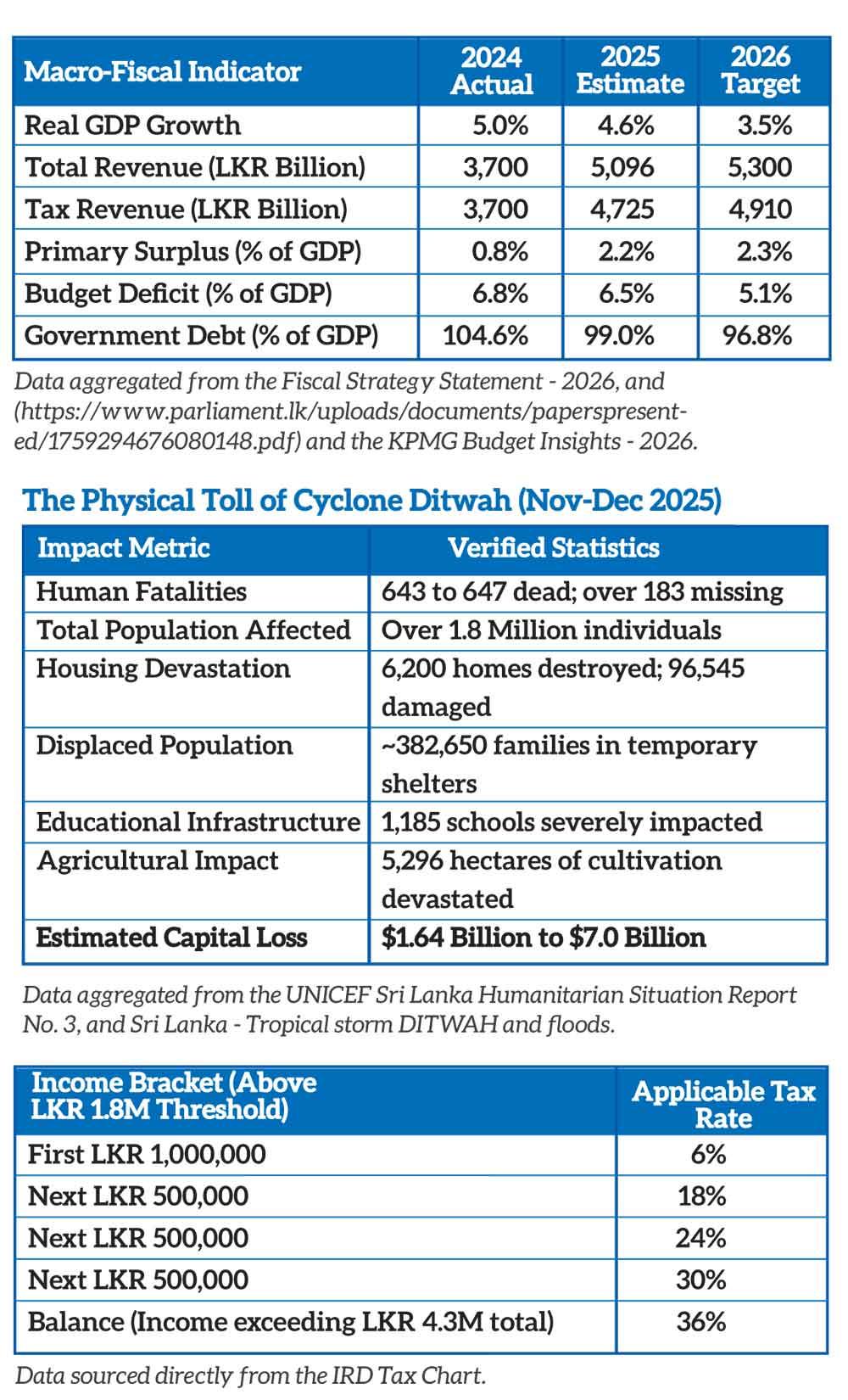
The storm, recognized as the deadliest natural disaster to strike the island since the 2004 Indian Ocean Tsunami, erased billions in real capital overnight, claiming over 640 lives and leaving roughly 1.8 million people in desperate need of humanitarian assistance.
The convergence of these two realities; record-breaking tax collection occurring simultaneously with record-breaking physical devastation, reveals a terrifying underlying truth: Sri Lanka is caught in what can be described as a “Thermodynamic Trap.” We are attempting to solve a devastating physical crisis of infrastructure, climate, and human capital using strictly virtual accounting solutions. By over-taxing the productive professional class to service historical, spreadsheet-based debt while our real, physical wealth is literally washed away by climate entropy, the state is inadvertently engineering the economic hollowing out of the nation.
The collision of virtual debt and real entropy
To truly grasp the mechanics of this crisis, one must shift away from standard financial models and view the economy through the lens of physics, specifically, the concepts of energy, entropy, and the physics of peace. Traditional economics, particularly the frameworks favoured by international creditors, often confuse money with actual wealth. But “virtual wealth”, which includes sovereign bonds, fiat currency, corporate equities, and financial claims, is merely an abstraction. It is a number on a ledger that can grow endlessly through the mathematical magic of compound interest.
“Real wealth,” on the other hand, consists of the physical infrastructure, the agricultural yields that feed the population, the hospitals, the power grids, and the highly trained human capital that actually sustain a functioning society. Unlike the numbers on a Central Bank spreadsheet, real wealth is governed by the inescapable laws of thermodynamics, specifically entropy. Real wealth rusts, rots, depreciates, and requires constant, massive inputs of physical energy and capital to maintain and grow.
Currently, Sri Lanka’s fiscal policy is myopically fixated on balancing the virtual ledger. While the achievement of a 2.3 percent primary surplus is hailed by international creditors and rating agencies as the absolute pinnacle of “macroeconomic stability,” it actively masks a deeper, more dangerous physical instability: the rapid deterioration of the nation’s productive capacity. The World Bank highlighted that the Sri Lankan economic recovery remains incomplete, noting that poverty levels are still alarmingly elevated, running twice as high as they were prior to the 2019 crisis. Furthermore, the labor market recovery remains agonizingly slow, with the labor force participation rate falling to 47.4 percent and an additional 10 percent of the population living just a fraction above the poverty line.
This presents a terrifying scenario where the state’s balance sheet looks increasingly healthy to foreign investors, but the citizens who make up the state are economically suffocating. A nation cannot thrive if its ledgers are perfectly balanced but its bridges are washed away and its workforce is starving.
Macro-Fiscal Targets and the Real Growth Dilemma
The 2026 National Budget, presented by President Anura Kumara Dissanayake on November 7, 2025, perfectly reflects the precarious and contradictory nature of this proclaimed “stability.”
The architecture of this budget is designed almost entirely to satisfy external debt restructuring requirements and appease international markets, rather than to stimulate domestic prosperity and physical resilience.
The table illustrates the stark contrast between the government’s aggressive revenue ambitions and the reality of the nation’s slowing economic engine.
For the general reader, the most alarming metric in this projection is the undeniable slowdown in real economic growth. After a post-crisis bounce of 5.0 percent in 2024, growth is to decelerate to 3.5 percent in 2026 and 3.1 percent in 2027.
This deceleration is not a natural economic cycle; it is a direct symptom of the thermodynamic trap. By forcibly extracting progressively higher taxes (climbing from Rs. 3,700 billion in 2024 to an incredibly ambitious targeted Rs. 4,910 billion in 2026) to meet rigid primary surplus targets, the government is systematically draining the capital available for the private sector.
When businesses and middle-class consumers are stripped of their disposable income to service national debt, they cannot invest, they cannot expand, and they cannot create the jobs necessary for “real” growth. Independent economists and think tanks have rightly pointed out that a growth rate of 3.5 percent is essentially “zero growth” for a developing nation that desperately needs to catch up to its regional peers. A durable recovery, rather than mere stabilization, requires a sustained trajectory closer to 7-8 percent. Instead, the current fiscal framework acts as a massive economic vacuum, pulling vitality out of the domestic markets to feed the sovereign debt ledger. The Public Investment Programme (PIP) 2026–2030 attempts to mitigate this by targeting an average annual real GDP growth rate of 3.1 percent to reach a GDP of $120 billion by 2030, but these goals remain highly vulnerable to the continuing extraction of private capital.
The “Missing Middle” and the Extraction of Human Energy
The central mechanism of this domestic extraction is the controversial and deeply felt tax regime. On paper, and in political speeches, the government attempted to offer a concession to the working class by increasing the personal tax-free threshold to Rs. 1.8 million annually.
This translates to a monthly tax-free allowance of Rs. 150,000, which provides genuine relief to lower-income earners. However, what was given with one hand was ruthlessly taken from the middle class with the other. The amendment simultaneously removed the intermediate 12% tax slab, creating a steep “tax cliff” that heavily penalizes the professional class.
For the general audience, a “tax cliff” means that once a professional’s income slightly exceeds the safe threshold, they are immediately hit with a significantly higher tax burden, rather than being eased into it.
The 2025/2026 Personal Income Tax Slabs
For resident individuals and non-resident citizens, the progressive rates (see table) apply to any taxable income that exceeds the new Rs. 1.8 million threshold.
While a 36% top marginal tax rate might appear comparable to rates seen in developed Western nations, it cannot be viewed in isolation. In a developed nation, high taxes generally buy high-quality public services, reliable infrastructure, and robust social safety nets.
In Sri Lanka, this direct income tax is compounded with exceptionally high indirect taxes. When the income tax is combined with the indirect taxes, the true burden is revealed.
The effective “tax wedge”, which is the total percentage of a professional’s income that is absorbed by the state through direct and indirect means before they can save or invest, often sits between 45 percent and 50 percent for a formal sector employee. This means a mid-level manager, engineer, or university lecturer is essentially working half the year solely for the government.
This is not sustainable taxation; to return to our thermodynamic metaphor, it is the equivalent of burning the load-bearing furniture to heat the house. By taxing professionals at punitive rates to pay for the historical financial mismanagement of past administrations and the immense costs of immediate climate shocks, the state is making survival in Sri Lanka financially unviable for its most skilled, productive citizens.
The very people required to engineer the recovery, the doctors who heal the workforce, the engineers who rebuild the grid, the IT professionals who bring in foreign currency, and the academics who train the next generation, are being driven out of the country by a hostile fiscal environment.
The exodus of the professional elite: A national wealth drain
The human cost of this extractive regime is not merely a theoretical talking point for economists; it is highly visible in record-breaking, undeniable migration statistics. Human capital is the ultimate form of “real wealth” and creative energy in any modern economy. When that energy leaves, the system inevitably begins to collapse, regardless of what the Central Bank’s ledgers indicate.
In 2024 alone, foreign employment departures hit a staggering 314,828 individuals. While many of these are semi-skilled laborers seeking better wages in the Middle East to send back vital remittances, a deeply concerning and growing percentage represents the flight of the highly educated professional elite.
The medical sector serves as the ultimate canary in the coal mine for this thermodynamic collapse. According to a recent, deeply concerning peer-reviewed study published in the International Journal of Health Planning and Management, between the crisis years of 2022 and 2024, Sri Lanka lost an astonishing 1,489 doctors. Crucially, this number includes highly specialized and nearly irreplaceable consultants. To put this into a historical perspective, this rate of medical migration is significantly higher than the exodus observed during the most brutal years of the civil war from 2006 to 2009.
The financial loss to the Sri Lankan taxpayer resulting from this brain drain is staggering, representing a massive transfer of wealth from a developing nation to the developed world. Sri Lanka operates a free public education and healthcare system, heavily subsidizing the creation of its medical professionals from primary school through medical college. Therefore, the departure of these 1,489 doctors represents a direct, irrecoverable capital loss of approximately Rs. 12.5 billion (roughly $ 41.5 million) to the taxpayer.
This presents the ultimate thermodynamic irony of current government policy: the state implements punishing taxes on the professional class to generate revenue to pay down sovereign debt. This punitive taxation, combined with a rising cost of living, causes the professional to flee. The flight of the professional destroys the very “human capital” required to manage the nation’s hospitals, engineer its infrastructure, and drive the economic innovation required for long-term survival. The ledger may temporarily balance, but the physical reality of the nation is bleeding to death.
This shortage of doctors presents a multi-dimensional threat to the public healthcare system. The loss of human energy has severely strained healthcare infrastructure and worsened inequities regarding access to care, leaving rural and underserved areas entirely devoid of critical specialties like psychiatry, anesthesiology, and emergency medicine.
The untaxed entropy: Static wealth and the informal economy
While the formal, salaried sector is squeezed to its absolute breaking point, a massive portion of the nation’s economy (historically estimated at 42 percent or higher) operates informally, existing entirely outside the direct tax net. This creates a profound and dangerous structural inequity.
The immense burden of national recovery is being carried almost entirely by a shrinking minority of documented professionals and formal corporations, while nearly half the economy evades direct contribution.
Furthermore, a vast amount of the nation’s real wealth is hidden in what economists call “Static Assets.” These are assets such as undeveloped land parcels, luxury real estate hoarding, and gold. Static assets do not contribute to the daily “work” or energy flow of the economy; they do not create jobs, they do not produce export goods, and they do not generate taxable income streams. They merely sit, acting as a store of value for the wealthy while the rest of the country struggles to generate cash flow.
To address this glaring loophole, the government, under heavy and persistent pressure from the IMF, has committed to introducing an Imputed Rental Income Tax, which is set for full implementation in April 2026. For the average citizen, this concept is highly confusing and deeply concerning. Conceptually, this is a wealth tax focused on property. It operates by estimating the “potential income” a homeowner could earn if they were to rent out their property, adding that hypothetical amount to their total taxable income, and then taxing it accordingly.
The stated goal of the Ministry of Finance is to yield 0.2 percent of GDP by 2025 and 0.4 percent of GDP by 2026 by targeting high-wealth individuals who hoard multiple or extraordinarily high-value properties. The Ministry has publicly clarified that the tax will feature an exemption for primary residences to protect average homeowners.
However, the policy has sparked massive controversy among the general public and economic analysts alike. Critics argue that it acts as an absurd “tax on non-existing income” that could unjustly penalize individuals who are “asset-rich but cash-poor.”
For example, a middle-class retiree living on a fixed pension in a family home that has rapidly appreciated in value due to urban expansion could be pushed into a punitively high income tax bracket, despite having zero actual cash flow to pay the tax.
While similar systems exist in European countries like Belgium and Switzerland, their successful, fair implementation in Sri Lanka relies on an administrative miracle. It requires the urgent establishment of a digital Sales Price and Rents Register (SPRR) and a comprehensive, nationwide property valuation database. Without accurate Information Systems, this tax risks becoming another blunt instrument that further traumatizes an already fragile populace.
Simultaneously, the state is struggling to capture revenue from the rapidly evolving digital economy. Recent studies have highlighted the vast, untaxed potential of the “YouTube economy,” where digital content creators operate largely outside traditional frameworks. Sri Lanka boasts an internet penetration rate of 53.6 percent, and the digital content sector grew exponentially post-Covid. However, enforcing compliance remains a massive operational hurdle. The Inland Revenue Department lacks the technological integration with platforms like Google and the human resources required to track multi-platform monetization effectively, leaving another massive gap in the tax net.
Cyclone Ditwah: The physical face of economic erosion
All debates regarding taxation, GDP growth, and digital economies become terrifyingly irrelevant when the physical foundation of the country is swept away. The catastrophic impact of Ditwah serves as a visceral, horrifying reminder that a balanced national budget is meaningless if the nation’s physical infrastructure is being dismantled by climate entropy.
Ditwah was not merely a severe weather event; it was a profound economic shock that wiped out years of slow, painful capital accumulation in a matter of hours. Originating as a depression offshore the southeastern coast, the cyclone swept northward, bringing torrential rains exceeding 300 mm and triggering widespread flooding and landslides across 25 districts, deeply exposing the fragility of the nation’s physical wealth.
The sheer scale of the destruction is difficult to comprehend through a purely financial lens. Looking at the Kelani River Basin Flood Impact Analysis – November 2025 alone, over 12,300 hectares were inundated, submerging over 53,000 structures ranging from residential homes to factories and hospitals. The agricultural sector, which employs 26.4 percent of the nation’s workforce, was hit with devastating force. Thousands of hectares of active paddy fields, rubber, and coconut plantations were destroyed, threatening food security and rural livelihoods for years to come.
Major infrastructure vulnerabilities were glaringly exposed. A bund breach at the Mavil Aru Reservoir caused extensive flooding in Trincomalee, while 30 percent of the national power grid was disrupted, forcing the temporary shutdown of critical hydropower plants like Kotmale and Rantambe.
The destruction was so severe that the IMF deferred its Fifth Review, stating it needed time to assess the economic impact before moving forward. Consequently, the government was forced to pass a staggering ‘Rebuilding Sri Lanka’ initiative just to cover the immediate costs of relief and basic reconstruction. When the state celebrates the extraction of Rs. 150 billion in new tax revenues from its citizens, but loses a conservatively estimated Rs. 500 billion (and potentially up to $7 billion) in capital assets due to a single storm, it is essentially treading water in a rapidly rising tide of entropy. The nation is trapped in a cycle where economic gains are entirely virtual, while economic losses are intensely, devastatingly physical.
The “Real-Wealth” Trigger Dashboard: A New Paradigm
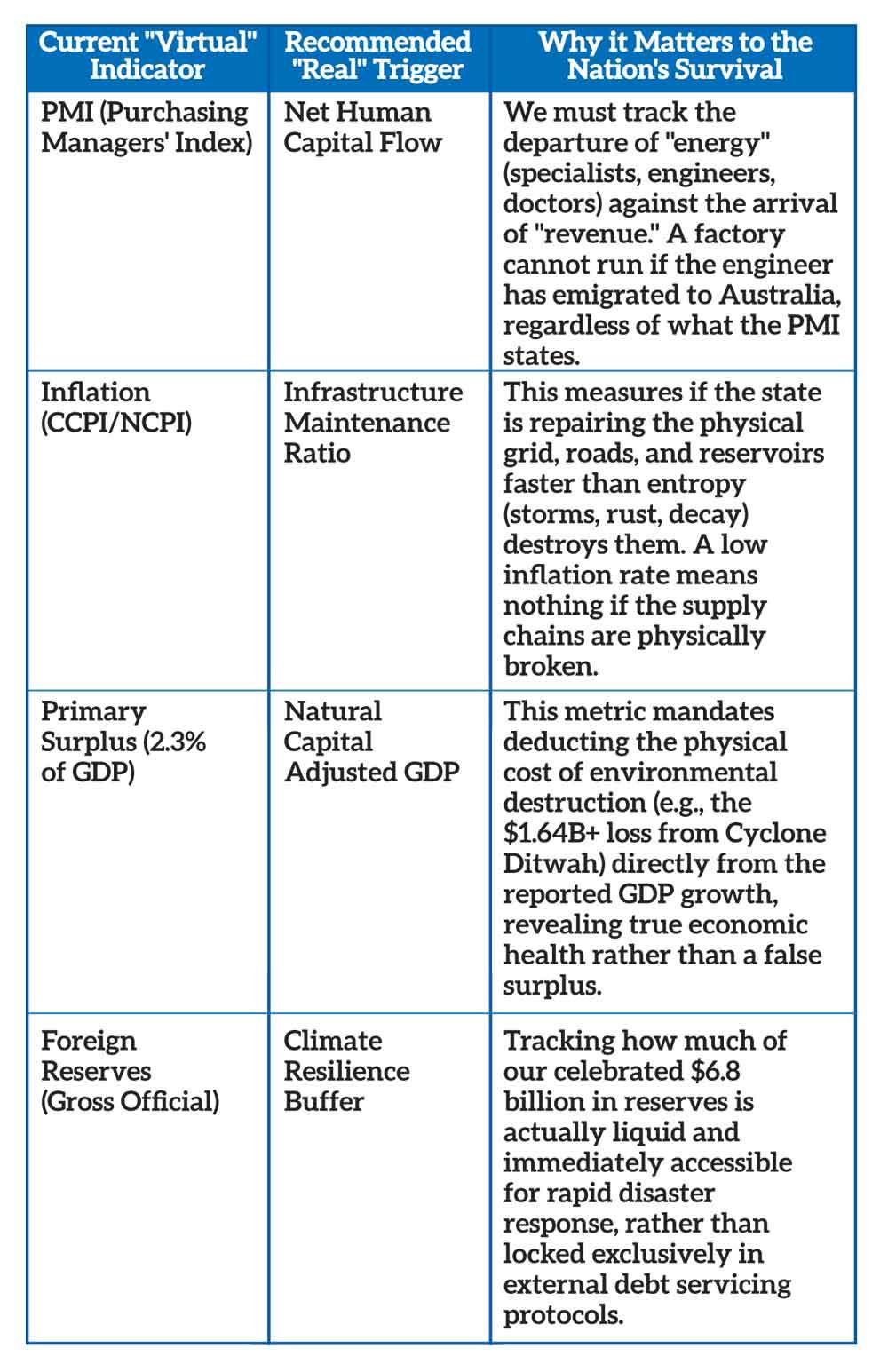
To escape this thermodynamic trap, Sri Lanka requires an urgent, paradigm-shifting overhaul of how it measures success. We must move away from exclusive reliance on Macro- Financial indicators and integrate Physical-Entropy indicators into the highest levels of government decision-making.
This requires embracing a framework where Energy, Entropy, and Empathy are viewed as tangible economic variables. Energy represents the drive and production of the workforce; Entropy is the waste, climate destruction, and depreciation of assets; and Empathy is the policy stabilizing mechanism that ensures growth actually translates into human livelihoods. If the government is to survive the colliding forces of debt and climate change, it must adopt a “Real-Wealth” Dashboard.
The table outlines how traditional metrics must be replaced, or heavily contextualized, by real-world physical triggers.
(The writer is a Senior Economist, Researcher, and Investment Analyst with over twelve years of experience in capital markets and financial modeling)
06 Jun 2026 8 minute ago
06 Jun 2026 41 minute ago
06 Jun 2026 1 hours ago
06 Jun 2026 2 hours ago
06 Jun 2026 2 hours ago