20 Nov 2025 - {{hitsCtrl.values.hits}}
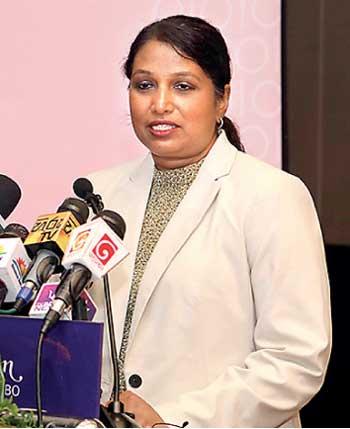 |
| Shehani Seneviratne PIC BY PRADEEP DILRUKSHANA |
By Nishel Fernando
Sri Lanka has successfully bridged its long-standing gap in IT graduate numbers, with the annual supply now reaching approximately 17,000, according to top industry official Shehani Seneviratne.
Seneviratne, the Chairperson of SLASSCOM and Chief Operating Officer of 99x, noted that the industry’s main challenge is no longer about the headcount but the urgent need for artificial intelligence (AI) upskilling.
She explained that for years, the tech sector struggled with a shortage of new entrants, which often slowed down growth. However, combined efforts across state and private universities have pushed the annual graduate output to 17,000, a figure she cited as sufficient to meet the current numerical demand.
“We have kind of fixed the quantity issue. But now we are working on upskilling this talent to meet the current technology needs of our customers,” Seneviratne said while addressing the launch of Agentri AI in Colombo last week, 99x’s own agentic orchestrator platform.
She pointed out that international client expectations have changed significantly, with a demand for skills that go beyond basic coding.
Seneviratne highlighted a major shift in the software engineering landscape, where AI agents are increasingly taking over routine tasks such as basic development and quality assurance. This change pushes human engineers to focus on “domain-centric architecture” and complex problem-solving rather than repetitive work.
“The routine Monday tasks can be automated and the profile of an engineer is going up. They are doing more value-added tasks. Because of this, all our projects are now using what we call AI-led development,” she said.
Seneviratne illustrated this with examples from 99x’s own operations, revealing that the company uses AI agents well beyond its engineering teams. She described an AI agent named ‘Percy the Prospector’ used by its marketing department for lead generation and other agents in human resources that screen CVs against job requirements to speed up recruitment.
She warned that speed has become a critical factor in the global market.
“It is no longer the case where our customers can wait two or three months for a Proof of Concept (POC). We are given only a couple of days. We need to use these tools to deliver these prototypes if we are to win contracts,” she said.
To support this transition, the SLASSCOM has launched several educational initiatives. Seneviratne detailed the rollout of “AI Code Clubs” in 100 schools last year to introduce AI tools to students at an early age. Additionally, the chamber has published a new “Industry Persona”—a guideline that explicitly requires AI tool proficiency for any graduate entering the workforce.
“I sincerely hope that Sri Lanka will come up as an innovation hub for AI in the near future,” she concluded, emphasising that the entire workforce must adapt to these changes to maintain the island’s reputation as a competitive global talent location.
19 Jun 2026 2 hours ago
18 Jun 2026 6 hours ago
18 Jun 2026 6 hours ago
18 Jun 2026 7 hours ago
18 Jun 2026 7 hours ago







