14 Mar 2025 - {{hitsCtrl.values.hits}}
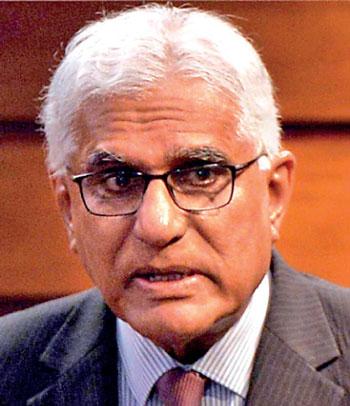 |
| Dr. Indrajit Coomaraswamy - Pic by Pradeep Pathirena |
Adds cutting exposure to foreign holdings of rupee securities was deliberate to minimise volatility and troubles
Despite a pushback against future borrowings via International Sovereign Bonds (ISBs) from certain quarters, a former central banker and eminent economist said Sri Lanka will, at some point, have to tap international capital markets to prevent further economic compression and close the external financing gap, which remains wide.
According to Dr. Indrajit Coomaraswamy, Sri Lanka should not and cannot achieve smooth debt management and gradually reduce its external financing needs before tapping ISBs again—something the country has neither done nor been able to do since 2019.
“We have to go to the market again at some point,” he said, delivering the first in a series of the Central Bank’s 75th-anniversary orations earlier this week.
He explained that without such borrowings—typically at a relatively lower cost than portfolio investments in rupee government securities and with longer maturities—Sri Lanka will struggle to bridge its external financing gap.
Further, he said that unless funds come from sovereign bonds, Sri Lanka would experience compression in both consumption and investment, which the country cannot afford due to the deep contraction and its economic consequences on businesses and the public alike.“And ISBs are probably the most effective way of doing it unless we sell ourselves to some donor who will bankroll us, which I don’t think is a good outcome,” Dr. Coomaraswamy added.
The former governor of the Central Bank (2016–2019) also used the forum to respond to criticism over the significant sovereign bond issuances during his tenure and to clarify why they were necessary at the time.
He noted that total outstanding sovereign bonds rose from US$ 5.0 billion at the beginning of 2015 to US$ 15.0 billion by the end of 2019, with US$ 4.5 billion raised in 2019 alone.
According to him, this was done for two reasons—first, to reduce reliance on highly volatile portfolio inflows into government securities, which stood at around US$ 3.5 billion in early 2015, and second, to reduce approximately US$ 2.5 billion worth of currency swaps with other central banks.
He said portfolio investments in rupee securities were causing significant trouble due to their extreme volatility, creating uncertainties for policy-making at a time when the U.S. Federal Reserve was raising interest rates.As a result, he said they brought portfolio investments down to about US$ 600 million and currency swaps down to US$ 500 million by the end of 2019, from where they stood at the start of 2015.
He further emphasied that funds raised through ISBs were crucial in extending the maturities of Sri Lanka’s external debt and lowering borrowing costs, as ISBs were issued at rates between 6 percent and 7 percent, compared to rupee bonds, which were around 12 percent at the time.
Speaking specifically about the US$ 4.5 billion worth of bonds issued in 2019, he said funds were raised both to extend maturities and to create buffers for the next administration, which was almost certain to come into power later that year due to public dissatisfaction following the Easter bombings.
He added that they were also fairly certain the economic stabilisation programme would not continue under a future administration, which could lead to the discontinuation of the then-ongoing International Monetary Fund (IMF) programme.
Surprisingly, he noted, even the markets were willing to lend to Sri Lanka at the time, as they believed in the country’s progress in strengthening macroeconomic fundamentals under the IMF programme and through the Active Liability Management Act, which was passed in parliament during that period.
Pushing back against claims that large-scale bond issuances were primarily responsible for Sri Lanka’s 2022 debt default, Dr. Coomaraswamy argued that these borrowings actually helped delay an otherwise inevitable default.“If we hadn’t continued to borrow or issue ISBs, we would have defaulted much earlier because we were literally borrowing to repay the debt,” he stressed.
Citing several studies, he said at least 90 percent of fresh borrowings during that period were used to settle existing debts.
21 Jul 2026 3 hours ago
21 Jul 2026 4 hours ago
21 Jul 2026 4 hours ago
21 Jul 2026 4 hours ago
21 Jul 2026 6 hours ago