27 Aug 2025 - {{hitsCtrl.values.hits}}
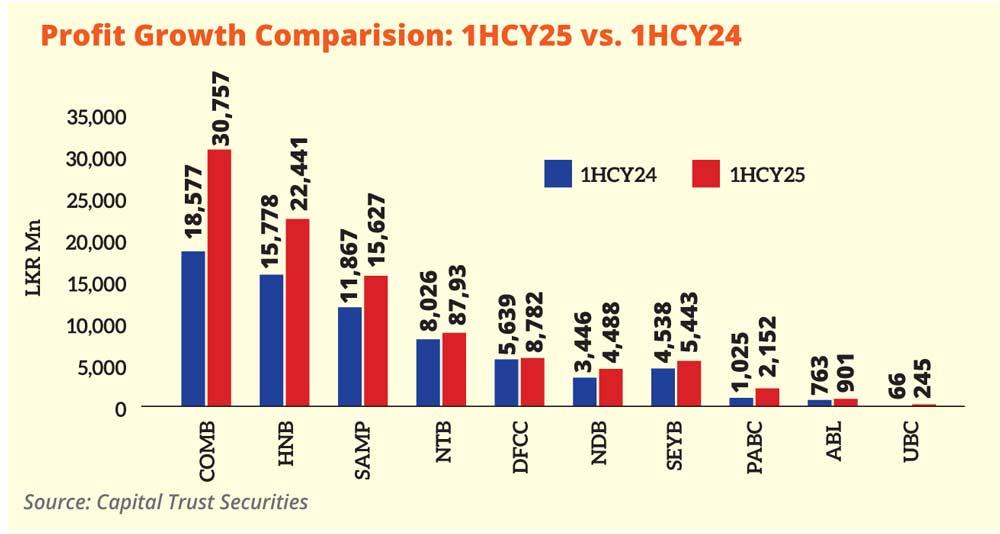
Sri Lanka’s listed commercial banks posted strong earnings for the June quarter, boosted by loan growth, lower provisions for bad loans and higher fee income, though margins narrowed, Capital Trust Securities said in a report.
The research arm of the brokerage said cumulative profits at 10 listed commercial banks rose 33.2 percent year-on-year to Rs. 49.10 billion (US$163.6 million).
Commercial Bank of Ceylon, the country’s largest private lender by assets, reported the highest profit at Rs.15.97 billion, more than double from a year earlier. Hatton National Bank earned Rs. 11.74 billion, up 37 perceent, while Sampath Bank posted Rs. 6.70 billion, down 17 percent.
Banks expanded lending sharply during the quarter, reflecting growing confidence in the economy as interest rates remained lower. Licensed commercial banks increased outstanding private sector credit by Rs. 441.5 billion in the quarter, taking first-half credit growth to Rs. 716.1 billion, or 17.9 percent year-on-year.
“Banks placed significant emphasis on expanding their gross loan books during the first half of 2025, as lower interest rates fuelled heightened demand for new loans while the banks opened their lending taps wide open,” Capital Trust Securities said.
Commercial Bank led loan book growth with Rs. 200.24 billion in new lending, followed by Hatton National Bank with Rs. 117.26 billion and National Development Bank with Rs.97.70 billion.
Earnings were further supported by reduced loan-loss provisions, with the exception of DFCC Bank, as asset quality improved and Stage 3 loans declined. Fee-based income from credit growth, digital transactions, trade and card activity also added to profits.
Some lenders, however, have faced criticism for imposing opaque fees, such as charges for counter withdrawals and minimum balance penalties, drawing calls for stronger regulatory oversight.
Improved efficiency also boosted results, with banks reporting lower cost-to-income ratios in the first half. A Capital Trust survey suggested loan demand and banks’ willingness to lend are likely to rise further in the third quarter, pointing to continued earnings momentum.
20 Jul 2026 20 Jul 2026
20 Jul 2026 20 Jul 2026
20 Jul 2026 20 Jul 2026
20 Jul 2026 20 Jul 2026
20 Jul 2026 20 Jul 2026