27 Jan 2025 - {{hitsCtrl.values.hits}}
|
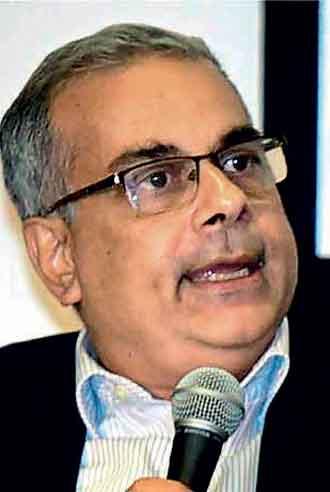
Murtaza Jafferjee |
Duminda Hulangamuwa |
Charaka Perera |
Pix by Samantha Perera
By Nishel Fernando
As the importation of passenger vehicles is set to reopen with effect from 1st February, the government is being urged to adopt a tax system to address the possible initial surge in demand for vehicle imports and to minimise revenue leakage through under-invoicing.
Advocata Institute Chair Murtaza Jafferjee proposed a surcharge tax on vehicle imports, to be phased out within a stipulated time frame, to manage the anticipated surge in demand initially.
“So what I would advise the government this: the people who want cars quickly, pay more. So announce a policy and say the tax system is going to be for the next six months. After six months, drop it; after 12 months, drop it,” said Jafferjee while addressing a discussion organised by HNB Leasing in Colombo last week.
However, he stressed that the government must announce this tax policy in advance and remain committed to it.
Ceylon Motor Traders’ Association (CMTA) Past President Charaka Perera also supported this tax policy.
Meanwhile, Senior Economic Advisor to the President Duminda Hulangamuwa shared that the main aim of reopening vehicle imports is to collect Rs. 300 billion in government revenue. While property taxes could have been a more equitable way to raise government revenue, Jafferjee acknowledged that vehicles present an easier avenue for taxation.
“Sri Lankans love their cars more than their houses. You can exploit this behaviour. I don’t know why they love their cars so much—basically because a personality is much cheaper than buying their expensive car.
However, he pointed out that the current unit-based duty system is unfair and flawed, leading to under-invoicing.
“The current system, based on the size and capacity of the engine, is completely flawed and is creating too much distortion in the market. And with this whole electric car versus the normal internal combustion engine issue, we have mixed up the whole differential, and you are artificially distorting the market.
“Ideally, if you want to apply value but there’s a problem of under-invoicing and you need a unit method, use gross vehicle weight because gross vehicle weight cannot be gamed. You are not getting involved in engineering decisions on the size of the engine etc.,” he explained.
He also emphasised that VAT is the best form of taxation to collect revenue efficiently and equitably from vehicles.
Although the gazette is set to be issued on 1st February, Hulangamuwa noted that it would take 1 to 1.5 months for a used vehicle and 5–6 months for brand new vehicles to arrive in the country.
21 Jul 2026 3 hours ago
21 Jul 2026 4 hours ago
21 Jul 2026 4 hours ago
21 Jul 2026 4 hours ago
21 Jul 2026 6 hours ago