Reply To:
Name - Reply Comment
Cyclone Ditwah has passed. But the damage it has caused is irreversible. With over 400 recorded deaths and more people still marked as missing, the Cyclone had affected over a million people in the country.
Following the 2004 tsunami, people became aware of the extent of a natural disaster. In fact the name tsunami itself was unheard of for a majority of people in the country. It was following the tsunami that policymakers started taking disaster management more seriously. Subsequently, the Disaster Management Act No. 13 of 2005 was enacted as the primary legislation in Sri Lanka for managing disasters, establishing the National Council for Disaster Management (NCDM) and the Disaster Management Centre (DMC). Its purpose is to protect lives and the environment through the establishment of a framework for disaster planning, preparedness, and response, including the declaration of a state of disaster and the provision of compensation.
The Disaster Management Council is a high-level inter-ministerial body that provides direction and policy guidance for disaster risk management in the country. Its activities include dissemination of early warnings, emergency response and coordination of relief activities, planning and preparedness and mitigation and post-disaster activities.
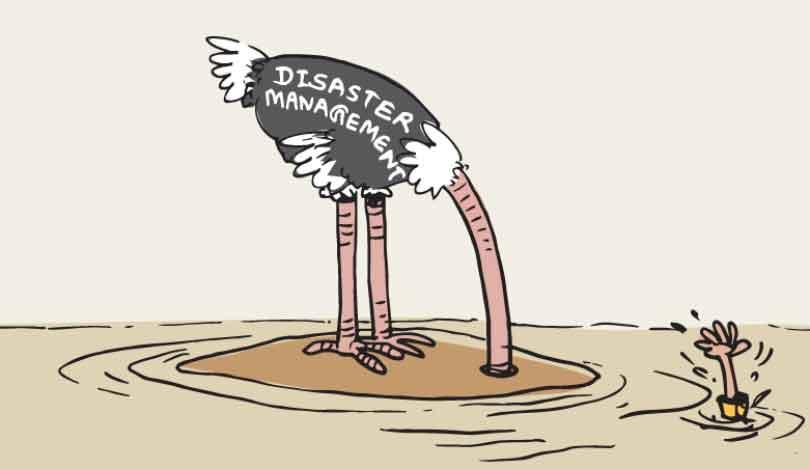
But despite it’s clear role and activities, it’s quite concerning to see the amount of neglect on the disaster management front which led to the loss of lives, disappearances and damage to property.
Geology experts have underscored the need to priorities disaster management and disaster-risk preparedness. Unofficial records estimate over 800 landslides being reported from upper parts of the country. Over 160 roads have been damaged which highlights the need to upgrade existing infrastructure. Early warnings have become unpredictable and the weather department has been scrutinized for the longest time for issuing contradictory weather forecasts. Therefore people have lost their interest in weather related updates.
But over the past few years, Sri Lanka has witnessed rapid climate change conditions which means that the government and responsible authorities need to concentrate on this aspect. This is what countries such as Japan has done in the aftermath of repeated earthquakes and other natural disasters. Japanese citizens have the opportunity to train themselves in braving an earthquake. Another example is Japan’s earthquake-resistant infrastructure uses a combination of flexible structures, base isolation, and damping systems to withstand seismic activity. These techniques allow buildings to sway safely by absorbing and reducing vibrations through reinforced steel frames, shock absorbers, and specialised materials, while also incorporating flexible joints in bridges and roads to prevent breakage.
When the 2016 deluge occurred, people in low-lying settlements such as Kolonnawa, Kohilawatta, Kotikawatta faced the brunt of the disaster. It was a stressful experience for them as they were displaced in an instance. But this time, people from these areas had to face a bigger impact in the aftermath of the Cyclone. So who should be blamed for this ? Why couldn’t any government after 2016 draw lessons from the disaster and take necessary actions to reduce the impact?
The role of a disaster management center should go beyond narrating figures. Statistics are an important aspect of any disaster but this time, reality speaks louder than numbers. Many authorities are unable to obtain actual figures or assess the actual impact of the catastrophe as they cannot reach certain parts of the country as yet.
People wonder why they had to face the impact of a natural disaster for the second time. The Opposition blamed the government for their inaction to take early warnings seriously and act accordingly to minimise the impact of the disaster. When the tsunami struck, the authorities started planning on improving coastal infrastructure and ensure the safety of people. But 20 years later, when authorities are being questioned about their plan to improve coastal infrastructure and infrastructure in other high risk landslide-prone areas, they say that they are still planning.
So when would they stop planning and implement their plans in the best interest of citizens, remains a question.