Reply To:
Name - Reply Comment
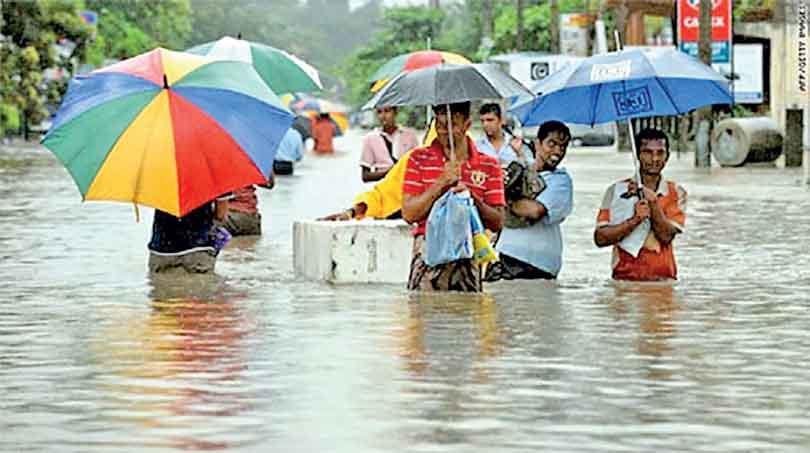
Flood damage caused by Cyclone Ditwah
 As Sri Lanka reels from the worst-ever natural disaster since the 2004 Indian Ocean tsunami, there are legitimate questions about whether a better organised pre-emptive disaster response could have saved many hundreds of lives lost to landslides and floods in the wake of Cyclone Ditwah.
As of 10 am yesterday, the death toll had risen to 410, and another 336 were still missing, according to the Disaster Management Centre.
The districts and areas where the highest number of deaths and missing persons were reported are traditionally landslide-prone areas, which are mapped out for their scale of vulnerability. In the past, during heavy rain seasons, government agencies successfully undertook state-led, organised evacuations in response to early warnings of potential landslide hazards. The past exercises may not have been on the scale required by Cyclone Ditwah. However, they set a template to follow. Unfortunately, this time such state-led measures were noticeably absent or, when implemented, were too little and too late.
Districts which suffered the most deaths in Cyclone Ditwah are Kandy (88 dead, 150 missing), Nuwara Eliya ( 75 dead and 62 missing), Badulla (83 dead, 28 missing), Kurunegala ( 52 dead and 27 missing),and Kegalle 22 dead and 48 missing) and Matale (24 dead and six missing), all of which are classified as highly landslide-prone areas.
There are established procedures under the national mechanism of the Disaster Management to be adopted by the National Disaster Management Centre and relevant authorities before and during a natural disaster. While there are many elements of the plan, for all practical reasons, the most crucial task ahead of an impending disaster is to evacuate the public from the high-risk areas -- more so because in Sri Lanka, it is the landslides that are the primary catalyst of deaths, and they concentrate on pre-identified landslide-prone localities.
That means such measures should entail a coordinated course of action, rather than just issuing early warnings to the public and expecting their voluntary evacuation. As the Sri Lankan experience repeatedly shows, Sri Lankans rarely opt to evacuate of their own volition. People are often tied to their land and opt to take chances, especially since the previous natural disaster, which killed over 200 people in landslides and flash floods in 2017, is now a distant memory. That underscored the need for a state-led, organised evacuation exercise, which had been practised in the past. Though it was not fail-safe, had often saved lives.
Cyclone Ditwah, despite its trail of destruction, is not a high-category (category one or higher) on the Saffir-Simpson Hurricane Wind Scale and is classified as a tropical storm.
Our unique vulnerability
The magnitude of the destruction reveals Sri Lanka’s unique vulnerability, especially in its landslide-prone hill districts. The vast majority of deaths in the latest disaster were also due to landslides and flooding triggered by heavy rainfall. In Parliament, opposition MP Kabir Hashim criticised the failure to pre-emptive release of sluice gates at major hill country reservoirs ahead of the heavy rain. He alleged that this led to the knee-jerk opening of water gates later, amid heavy rain, effectively worsening, or perhaps triggering, floods.
This is definitely not a time for a political blame game, even before the dead are buried, and many hundreds of thousands of displaced people languish in temporary shelters. However, the magnitude of the disaster leaves room for soul-searching, many questions to answer, and many lessons to learn.
Who were actually warned?
The government had been blamed for a delayed response despite the Director General of the Meteorological Department having warned of an impending cyclone as early as November 12. However, the warning is made in a television interview. The question is whether the president and the cabinet were adequately briefed on the impending natural disaster, whether they were alerted to the scale of the danger, and whether other related government agencies (DMC., District agents, line ministries, and tri-forces and police) were proactively alerted of the impending risk with its potential magnitude.
It is also important to establish whether the failure of an adequate early warning response was a fault of the political leadership or the institutional apparatus, which were either too slow to act or lacked cohesion in their response. The president too, is criticised for the belated announcement of a state of emergency, with the delay attributed to ideological hesitation to resort to emergency law. Yet, by then, the announcement was largely symbolic, and the relevant agencies were at work, though the damage which could have been avoided with a state-led, forceful disaster response, had been done.
There are other mistakes amid the disaster, including the notable absence of early warning announcements and of disaster response communication in Tamil.Such failures reveal more than the breach of language rights; they reveal the broader organisational disorder within state agencies, which are designed to be the nation’s saviours during times of natural disaster.
The latest disaster should be a time for reflection and for revamping the disaster response mechanism. Rather than getting into a political blame game, the government and the opposition should probe into where it went wrong and restructure the national mechanism to avoid repetition and optimise its capabilities.
Inevitably, other shortfalls in the state’s disaster response capabilities were evident as well. A chopper crashed in the rescue mission, killing the pilot. Five navy personnel were swept away in field mitigation work in Mullaitivu. The Sri Lankan air force was suffering from a shortage of flight worthy air assets, which contributs to accidents and deaths and also compromises disaster response operations.
With appropriate heavy machinery, the lives lost in Mullaitivu could have been saved. There was a shortage of inflatable water rescue boats for standard flood rescue missions; locals were forced to bring their fibreglass boats instead. In one instance, a group of youth travelled from Trincomalee to Anuradhapura hauling their fishing boat in the back of a truck to participate in a rescue mission. There is a noticeable lack of heavy-lifting equipment to clear roads buried under landslides. Temporary shelters lack toilet facilities, which could be addressed with prefabricated toilets. None of these requires extensive capital expenditure – compared to much wasteful spending in every government budget. Yet their shortcomings are seriously hampering disaster response. The Sri Lankan military has man power and trained personnel, but it lacks the equipment to operate on a large scale. Such shortfalls should be addressed under a comprehensive national plan for future disaster response.
‘Rebuild Sri Lanka Fund’
In the immediate aftermath of the disaster, though, the government has set up a “Rebuild Sri Lanka fund”, with a management committee heavy with the bigwigs in the corporate sector. The move is criticised in some quarters over a potential conflict of interest. Yet, leave aside all the self-righteous sanctimony amidst the crisis, the appointment of the corporate leadership should provide a degree of efficiency and result-oriented management of Sri Lanka’s recovery process. The alternative will be gridlock similar to the post-Tsunami reconstruction. As for conflicts of interest, there should, of course, be an independent and transparent tender procedure. The absence of women and minority representatives is concerning, and that should be addressed to avoid the committee looking excessively lopsided.
However, a private-public partnership in nation-building after a natural disaster should not be limited to that. It should provide a template for economic modernisation in Sri Lanka, among other things, through private-sector-managed industrial zones.