Reply To:
Name - Reply Comment
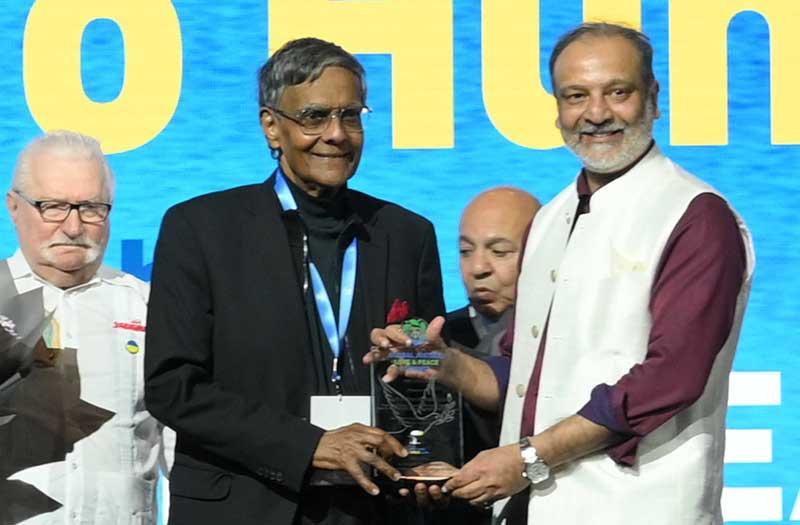
Prof. Munasinghe awarded major prize for outstanding contributions to world peace, from conference chairman Dr. Khorakiwala
Mohan Munasinghe co-winner of the 2007 Nobel Peace Prize (Vice Chair, IPCC), and recipient of the 2021 Blue Planet Prize, was honoured with a major award for exceptional contributions to World Peace at the Global Nobel Peace Summit in Dubai, 13-14 April 2025. He gave two keynote speeches at the opening and closing sessions, and also signed the Global Peace Charter, together with 12 other Nobel Peace Prize Laureates.
He said by 2030, humanity would require the resources of two planets to sustain itself. “There is so much inequality. The richest people on Earth consume a hundred times more than the poorest. It’s not fair. The more we destroy the planet’s resources, the more we will fight over what is left. To bring peace and harmony to the world, we must first find peace and harmony within ourselves.”
Nations must harmonize the ‘sustainable development triangle’ (including economy, society and environment), which leads to balanced inclusive green growth (BIGG). He advocated supporting the UN’s Sustainable Development Goals, which he called humanity’s final opportunity to right its course and achieve the earth civilization of the 21st century. Munasinghe recommends integrating climate change into national sustainable development strategy. He said that human beings are the cause of climate change, while the poor will be the ones who suffer the worst impacts. This is a gross injustice because the problem was caused by the excessive greenhouse gas emissions of the rich.
He apologized to future generations, because his generation was leaving them a world that is damaged, divided, and dangerous. “I am sorry we let it come to this.” Finally, Prof. Munasinghe offered hope, expressing faith in the youth to lead the way forward — if they learn from the past. “Don’t repeat our mistakes. Don’t ignore science,” he urged.
The sustainability implementing triangle requires business and civil society to work with government to achieve the 17 SDG. He stressed that “Business is part of the solution, and not necessarily the problem”. Ethical managers are essential for business sustainability, while methods like value-chain, life cycle analysis can help firms achieve win-win outcomes that reduce both costs and natural resource use.” Digital technology will facilitate both sustainable production and consumption. He stressed that cities are the starting point for a digital technology-led, smart sustainability transformation focusing on better infrastructure and governance.
He noted that world leadership is weak and incapable of tackling the many sustainable development issues, including climate change, which only makes other threats worse. He explained how the BRICS countries (Brazil, Russia, India, China and South Africa) have overtaken the G7 countries in terms of global gross domestic product in PPP terms. The BRICS+ led Global Majority (85% of the global population) are shifting away from the Western-led unipolar world order to a more balanced, multilateral world, with priorities focusing on sustainable development, poverty eradication, peaceful trade, cultural links, etc. Now, with digital, green and other new technologies, there are more opportunities for poor countries to level the playing field and restore their dignity and self-respect. While issuing the Global Peace Charter, he also called for the Peace Community to bridge the gap between BRICS+ and the west, to build a more prosperous world, and especially to avoid nuclear World War 3.
Professor Munasinghe is Chairman of the MIND Group in Colombo, which includes the non-profit Munasinghe Institute for Development (MIND), a UN recognized centre of excellence on sustainable development, and MIND AM focusing on data analytics and management. He is Chairman of the Board of Climate & Conservation Consortium (CCC). He is also Board Director of Eureka Group, Distinguished Guest Professor at Peking Univ., China, and Chairman of the Presidential Expert Committee on Sustainable Sri Lanka 2030 Vision.
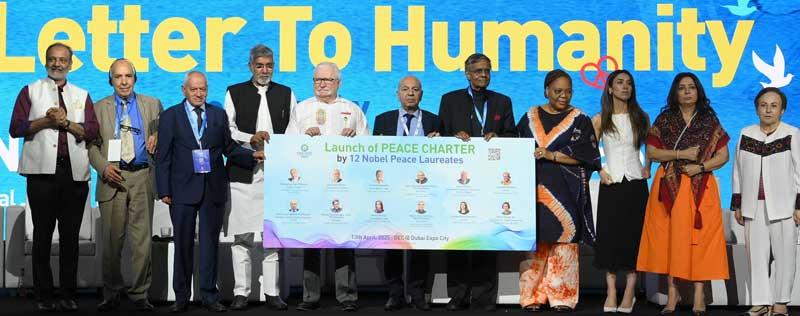
12 Nobel Peace Prize Laureates, including Prof. Munasinghe, issued the Global Peace Charter at the Global Justice, Love and Peace Summit (GJPLS) in Dubai, 13-14 April 2025.