 Kamanthi Wickramasinghe
 Reply To:
Name - Reply Comment
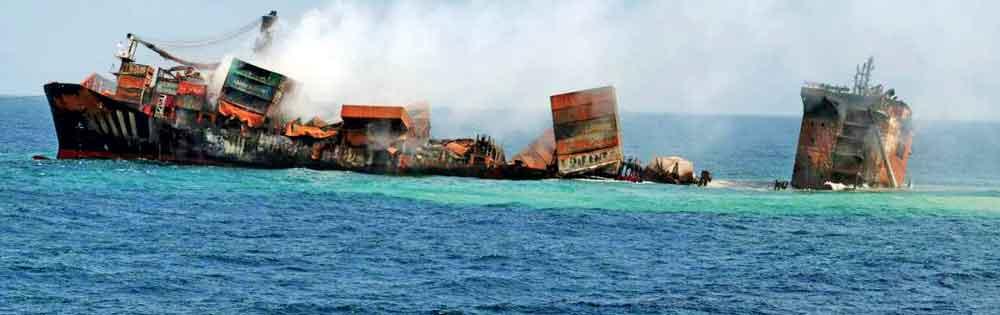
X-Press Pearl inferno- the worst ecological disaster in Sri Lanka’s history
 The island becomes signatory to the agreement under the UNCLOS on the conservation and sustainable use of marine Biological Diversity of Areas beyond National Jurisdiction in February 2025
Following the signing of the Agreement, the GOSL has undertaken to establish an Inter-Ministerial Committee to oversee the ratification of the agreement

A panel discussion was organised recently by the Embassy of France in Sri Lanka, ahead of the third United Nations Ocean Conference scheduled to be held in Nice from June 9-13. Seated from left are: Rohan Masakorala, Dr. Ganeshan Wignaraja, Rear Admiral (Retd) Y.N. Jayaratne, Moderator Asiri Fernando, Rémi Lambert, Ravinatha Aryasinha and Dr. K.H.M.L. Amaralal
Sri Lanka recently became the 109th signatory to the agreement under the United Nations Convention on the Law of the Sea (UNCLOS) on the Conservation and Sustainable use of Marine Biological Diversity of Areas beyond National Jurisdiction (BBNJ Agreement) in February 2025. This decision will enhance Sri Lanka’s potential to receive assistance for capacity-building projects, transfer of technology, and knowledge sharing in the country’s efforts in marine conservation. Following the signing of the Agreement, the Government of Sri Lanka (GOSL) has undertaken to establish an Inter-Ministerial Committee to oversee the ratification of the agreement and implementation of the Agreement’s provisions. The Committee is expected to commence and coordinate the drafting of legislation with international assistance to develop the necessary domestic legal framework aimed at early ratification.
Significance of the BBNJ Agreement
The BBNJ Agreement becomes the third implementing agreement to the UNCLOS. The Agreement addresses four main issues:
This landmark decision represents a pivotal step towards addressing the escalating threats facing Sri Lankan waters due to unregulated human activities in international waters. By ratifying the BBNJ agreement, commonly known as the Global Oceans Treaty, Sri Lanka will have the opportunity to support large-scale marine protected areas, promote sustainable fisheries management, and encourage marine scientific research. This is particularly vital given the growing concerns over overexploitation, habitat degradation, and the loss of biodiversity in international waters.
UNOC3 and accelerating progress on SDG 14
Speaking at a recent panel discussion organised by the Embassy of France in Sri Lanka, ahead of the third United Nations Ocean Conference scheduled to be held in Nice from June 9-13, Laila Nazarali, UN Senior Human Rights Advisor to the Resident Coordinator highlighted the pivotal role of UNOC-3 in accelerating progress on Sustainable Development Goal 14 and called for greater collective ambition ahead of the Nice conference. She said that Sri Lanka is emerging as a hub for maritime law enforcement and cooperation. Nazarali commended the establishment of the Regional Centre for Maritime Studies with the support of France to serve as a platform for regional training exercises, cross border coordination forums and engagements with international cadres.
Adding her remarks on the X-Press Pearl Disaster, she said that in response to the X-press Pearl disaster - the worst ecological incident in Sri Lanka’s history, Sri Lanka is pursuing criminal accountability while strengthening national frameworks to combat marine pollution. “These are some of the salient examples from Sri Lanka’s context that come to mind when reflecting on United Nation’s Secretary General’s recent address at the UN Security Council’s High Level open debate on maritime security where he emphasised that maritime security and sustainability can only be achieved through deeper cooperation and respect for international laws including the UNCLOS. However, to achieve this we need stronger partnerships to scale up financing, to improve technologies and share capacities,” she said while adding that island nations such as Sri Lanka should amplify their voices.
BBNJ and its impact on fisher folk
The new legislation is believed to have a significant impact on coastal communities. Explaining further, Dr. K.H.M.L. Amaralal, Deputy Director General at National Aquatic Resources Research and Development Agency (NARA) said that as an island nation, Sri Lanka mostly depends on its ocean resources. “Right now we cannot moderate or manage certain activities that take place at the high seas. Around 225,000 fisher folk are directly involved in this industry while it another 2.5 million people receive livelihood support from the fisheries sector. The communities would benefit from this legislation as it would assist them to generate more income. By declaring Marine Protected Areas (MPAs) we could improve stocks of migratory fish species such as tuna and fishermen could generate more income. This would allow them to reinvest in aquaculture and other businesses,” he said while adding that this Agreement would help Sri Lanka improve its food security.
Challenges and opportunities within the Indian Ocean domain
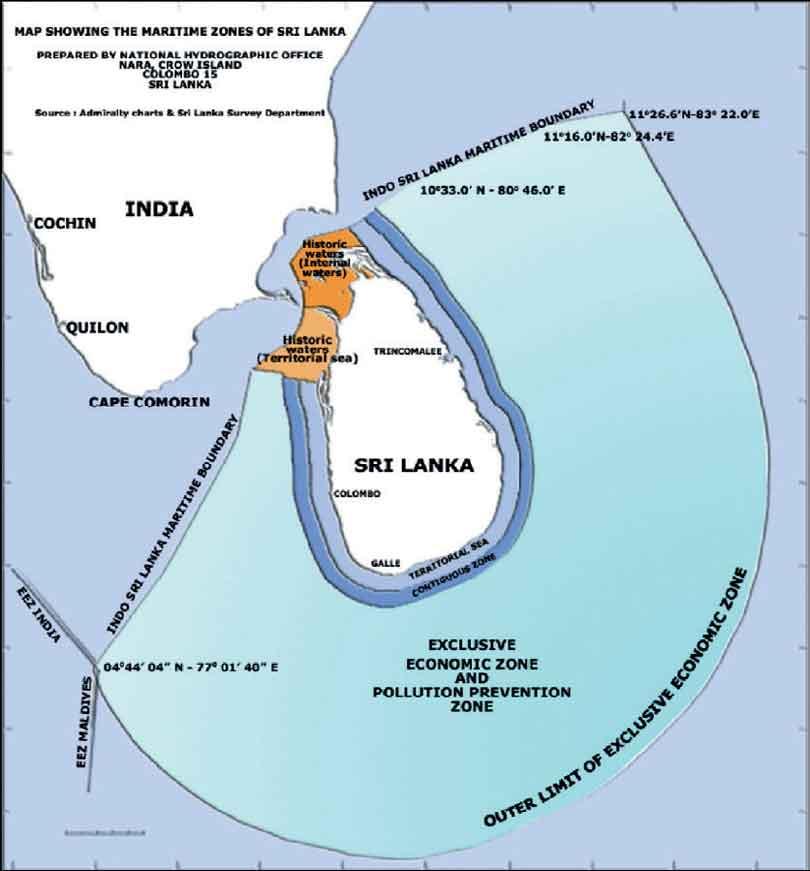
Speaking about the challenges and opportunities around the Indian Ocean, Rear Admiral (Retd) Y.N. Jayaratne, former Chief of Staff of the Sri Lanka Navy explained distinct differences in different areas of this extremely important maritime location. “For example, there’s competition in the Bay of Bengal for resources apart from regional tension, especially with India and Bangladesh. The Bay of Bengal is going to be a hotspot in near future as the regional dimensions are heading that way. But compared to the Arabian Sea, the Bay of Bengal is exclusively a private area. However, the Indian Ocean is already very crowded. Island nations on the western Indian Ocean too are crowded. This crowding itself presents opportunities and challenges in terms of sharing of resources, wealth and opportunities to collaborate and enhance each other’s standing. We will see the same in the Bay of Bengal and Maldivian archipelago and the Chagos archipelago. Coastal states including Sri Lanka should study about marine genetic resources and make preparations. If Sri Lankan fishermen engaged in high sea fishing lose their designated area it would be a social, political and international issue. When we talk about oceans it’s important to understand about the ocean space,” he underscored.
Formulating an effective policy on blue economy
When asked how Sri Lanka could formulate an effective policy on blue economy to work with the new legislation Dr. Ganeshan Wignaraja, Visiting Senior Fellow at ODI Global said that Sri Lanka has to take certain matters into consideration over the next two years. “Two years because we are facing debt policy uncertainty globally and we have a debt claim in two years where we have to start repaying the debt. The ocean economy has to exploit its positioning with these factors in order to succeed. It doesn’t matter if we talk about security, food security and fishermen. But there’s a fundamental issue we have to address if we want to succeed. We have to have more exports, tourists, FDIs and if we don’t do these we would be in a really bad state,” said Dr. Wignaraja.
He said that the ocean plays a role in this export-oriented mentality. “Firstly, we have to look for value addition in fishing. We have to look at new areas in the ocean which we haven’t exploited very much. For example, sea cucumbers, sea urchins are potential products. We also have to look at ocean-related services in this country. We have to look at shipping, insurance, logistics, trade-related banking and unleash the potential of these industries. We have to sign a rules-based international trade agreement. The Indian Ocean Rim Association (IORA) has to be a much greater economic arrangement. It has to be a cross link between Sri Lanka, Indian Ocean countries, Africa and the Middle East. Lastly we have to look at our ports. There’s KKS which could be linked to India and then we have Galle which becomes critical as an additional hub and we have to support sustainable private investment in ocean resources. These include wave, wind power and mineral resources. If we do these now, the ocean can play a critical role in Sri Lanka to come out of this crisis and move towards sustainable growth. Otherwise we would be a lot, lot poorer,” he warned.
Immediate need for reforms
While shedding light on the growing threat of invasive species moving towards the Atlantic Ocean via the Panama Canal, Rohan Masakorala, CEO and Director of the Shippers’ Academy said that the discharge of ballast water from ships is another disaster in the offing. “We have 55,000-60,000 merchant vessels going across oceans and discharging ballast water, carrying invasive species and destroying the ecosystem. It’s an anthropogenic factor that had caused this imbalance,” he added.
Speaking about Sri Lanka as a maritime hub Masakorala said that Sri Lanka is still a basic transshipment hub which was initiated back in 1978. “Sri Lanka became the first transshipment hub in South Asia. We remained to be the lead until very recently and we are having challenges for competition in that aspect as well. On the other hand, maritime geography in South Asia itself is changing. If we look at the global container shipping industry, this year we will reach a billion containers moving around the world. There are 30 million containers in the Indian subcontinent itself. Colombo handles 7 million containers as transshipment when compared to Dubai which handles close to 17-18 million containers and Singapore handling 41 million containers. We are legally very backward and need reforms in the merchant shipping division including implementation of some laws that have been ratified, bringing regulations and industry stakeholders and government institutions which are scattered,” he said.
He further said that the truth is that Sri Lanka is still lagging behind in several areas. “As a country that is sitting in the middle of the 70 million square kilometer Indian Ocean, Sri Lanka can play an important role provided we have the right human resources, technology and attitude towards managing the ocean,” he underscored.
Grooming stakeholders
Explaining the situation at hand, Ambassador Ravinatha Aryasinha, Executive Director of the Lakshman Kadirgamar Institute said that Sri Lankan stakeholders are being trained and educated about the BBNJ Agreement with the support of the Commonwealth and the Australian government. “We have so many laws governing little pieces that come under BBNJ. This process is to see whether there are conflicts in what is already there and to reconcile these matters prior to signing conventions. From what I sense, this process is well identified. This is a cleaning process to look at all that we have and update it to an international standard. If that is done by preparing to ratify the BBNJ Agreement, it would serve Sri Lanka well. We have to deal with the complexity of internally finding cohesion and trying to reconcile geopolitical rivalries and tensions from how to exploit the resource we have,” he added.
France and its engagement in the Indian Ocean
Despite its geographical distance, France considers itself as an Indian Ocean state having strategically located overseas territories in the region. These overseas territories give France one of the largest Exclusive Economic Zones (EEZs) in the world and also some extended continental shelf as well. French President Emmanuel Macron’s recent tour of the Indian Ocean Region (IOR) underscored the Indian Ocean’s importance to France’s broader Indo-Pacific strategy.
Shedding light on France’s engagement in the Indian Ocean domain, Rémi Lambert, Ambassador of France to Sri Lanka said that France faces the same challenges such as pollution, sea level rise, and effect of climate change, ocean governance and biodiversity issues. “To that respect we should contribute with our expertise and experience. So we setup RCMS with the objective of having an exchange of expertise and best practice to foster dialogue with navy experts, coastguards, scientists specializing in marine biodiversity to discuss and face this issue collectively. We are looking at working with regional partners and European partners as well. We are having talks with Indonesia, Bangladesh and if Thailand is interested we would be glad to have them on board. We are also working on a global coastal safety programme with the European Union,” the Ambassador said while adding that these initiatives are done together with Sri Lanka, hopefully with Maldives and other countries in the region.