Reply To:
Name - Reply Comment
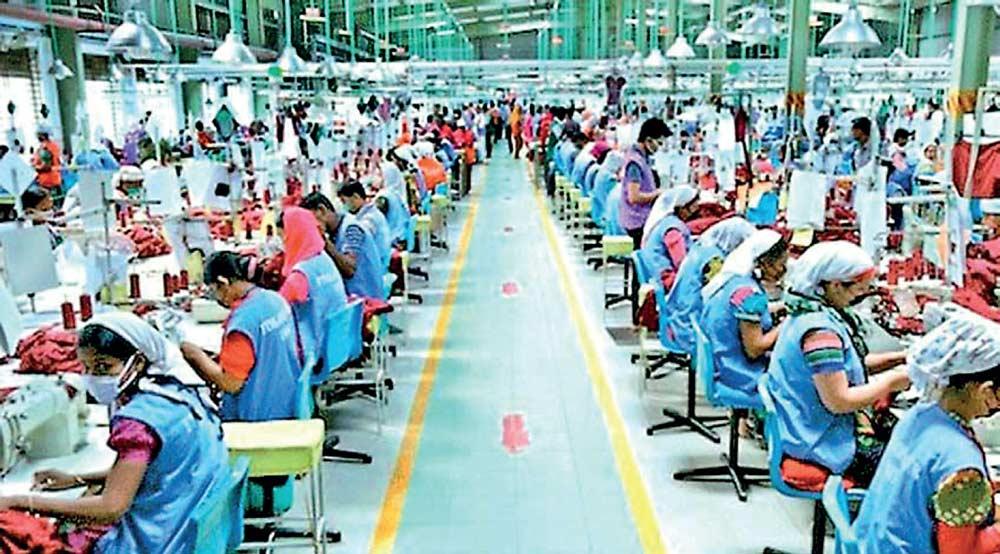
Semi-skilled labour dominates Sri Lanka’s exports
 While reduced Trump’s import tariffs on goods would not make Sri Lankan exports magically competitive, the steep decrease from an earlier 44% to the current 20% has provided them with a level playing field
 Last week, Sri Lanka secured a major reduction of Trump’s import tax on goods, placing it on par with its regional competitors. Sri Lanka’s revised tariff rate of 20% would put it on par with Cambodia 19%, Bangladesh 20%, Vietnam 20%, Philippines 19%, Thailand 19% and Pakistan 19%. India, which is still negotiating, is slapped with a 25% plus penalty over energy exports from Russia.
While reduced Trump’s import tariffs on goods would not make Sri Lankan exports magically competitive, the steep decrease from an earlier 44% to the current 20% has provided them with a level playing field.
The Trump administration in what it called reciprocal tariff was not particularly gung-ho against the smaller nations with a smaller trade volume in its trade with the US -- its main gripe was with some of its largest trading partners, which maintain a whopping trade surplus -- China US$ 270billion, Mexico US$157 billion, Vietnam US$ 113 billion, Ireland US$ 80 billion etc.
Sri Lanka’s trade surplus in its trade of goods with the US is US$2.6 billion, with Sri Lanka’s imports from the US being a meagre US$366 million in 2024. Despite relatively smaller bilateral trade volume, the US is Sri Lanka’s largest export market and buys 20% of its exports. What, however, could have been indefensible in the eyes of the Trump administration is Sri Lanka’s prohibitive import taxes, which though not specifically designed against the US imports, smack of as highly stifling of fair trade. An even closer scrutiny might reveal that such prohibitive import taxes have fed into predatory trade practices at our expense. For instance, in 2024, Sri Lanka’s trade deficit with China swelled to US$4 billion, more than Sri Lanka’s total tourism earnings. Total bilateral trade with China was $ 4.58 billion, and China imported goods from Sri Lanka for just $ 251.9 million, according to Sri Lankan Customs data cited by the Export Development Board.
Sri Lanka should negotiate to address this whopping trade anomaly, which has been increasing. During the Rajapaksa era, the consensus was that the growing trade deficit would somehow be addressed through the remittance from the then-growing influx of Chinese tourists. However, with China’s slowing economy, tourist arrivals have saturated, and the share has declined relative to other markets. The government should seek innovative means to address this trade deficit in consultation with China. Though insignificant in international comparison, growing one-way trade with China would pose future challenges to Sri Lanka’s standing with its key import markets in the US and EU in the evolving international regime of transactional trade practices.
Laissez-faire free market system
Trump tariffs may seem like an outlier of the laissez-faire free market international trading system of the post-World War II era, which America itself championed. But, Trump tariffs are more likely to denote the gradual end to the post-World War II free market order and shift to a more transactional nature of the international trading system.
The liberal trading regime of the last 80 years created enormous riches for America and Western Europe first, and later, at relative loss to the early benefactors, it transferred global power to Asia, turning China into the world’s second-largest trading economy and ushering in a large cohort of middle-income countries. However, the torch of industrialisation that was passed down from America, Western Europe, East Asia, and China, has stuck in the mainland, partly because given the size of the Chinese economy, it tends to have an all-absorbing property, rather than disbursing the industrialisation. Cheap Chinese exports and raw material imports have effectively led to de-industrialisation in smaller states, most notably in Africa.
The system could also be easily rigged, as the Trump administration has accused. This is likely to be true in some accounts, considering the swift rise of exports in Vietnam and Cambodia, owning as much as to the growing nexus of China-centric supply chains, but also due to the rerouting of exports from the mainland via alternative sources.
It is unlikely that even post-Trump America would make a complete U-turn from some of Trump’s economic policies unless they prove disastrous and deeply unpopular in the coming years.
It would help Sri Lanka prepare for this new geo-economic reality. One should give it to the government for defending Sri Lanka’s economic interests before the Americans, when our trade practices, hefty taxes, and non-monetary barriers appeared almost indefensible.
Diversifying the export basket
However, the recent experience and the evolving nature of the global trade regime should be more the reason for Sri Lanka to diversify its export basket, which the country has stuck with since the mid-1990s. More than anything else, stifling investment policies and crippling red tape are the main culprits of the three decades of stagnation. Garments have helped Sri Lanka put its workforce to work when there was a population bulge. However, garments have not created riches, nor has Sri Lanka succeeded in climbing up the manufacturing ladder as it was initially envisaged. The population growth is now hovering over replacement level, yet much of its workforce is still stuck in semi-skilled and unskilled labour, low-end manufacturing and inefficient farming.
Beyond Trump tariffs, Sri Lanka should use this opportunity to diversify its export basket and climb the manufacturing ladder, focusing on a few niche areas that offer it a competitive advantage.
One strategy that might help is to cultivate a technology-savvy workforce. When building ports and highways, the Rajapaksa administration believed infrastructure supply would bring in demand in terms of new investments. It did not happen for multiple reasons, primarily the failure of concurrent economic reforms to make the country an investment destination, but also the political instability and policy confusion post-2015.
To create a workforce that supports a niche base of critical industries, Sri Lanka can build a host of technological universities through private-public partnerships, structured similarly to the Indian Institute of Technology, which, amidst the vast ill-equipped Indian workforce, has provided a holdout for India in critical industries and lured in international capital.
This government has a momentous opportunity to revamp an underutilised and depleting workforce and give the country a real shot at prosperity. It should make use of this opportunity.
Follow @RangaJayasuriya on X