Reply To:
Name - Reply Comment
.jpg) In George Orwell’s classic work 1984, Winston Smith is an ordinary citizen who lives in permanent fear of Big Brother in a totalitarian state. Even thinking of rebellion is a serious crime. Arrested for anti-state activities, Smith is detained without trial for months.
In George Orwell’s classic work 1984, Winston Smith is an ordinary citizen who lives in permanent fear of Big Brother in a totalitarian state. Even thinking of rebellion is a serious crime. Arrested for anti-state activities, Smith is detained without trial for months.
When sophisticated brain-washing methods fail to breakdown Winston, his interrogator threatens him with torture. Discovering that his captive has a fear of rats, he forces Winston’s face into a cage where rapacious rats would devour it.
Rather than die a horrible death, Winston breaks down and betrays the woman he loves.
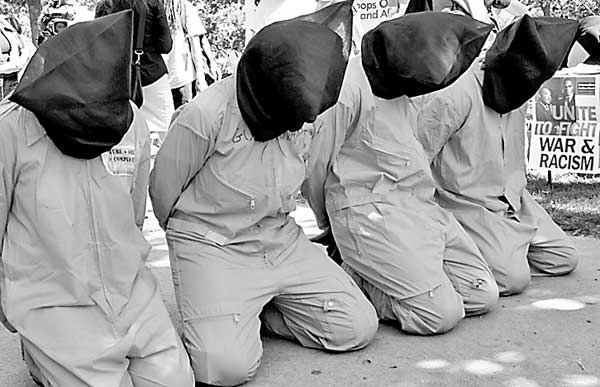
That torture is the easiest, and most effective, way to break people down and get information is something that every policeman knows. What is obscene is that the United States government, which lectures third world states about torture inflicted on detainees, turned a blind eye to what the CIA was doing in Guanatanamo Bay. It’s an outrageous and unacceptable instance of double standards and political hypocrisy.
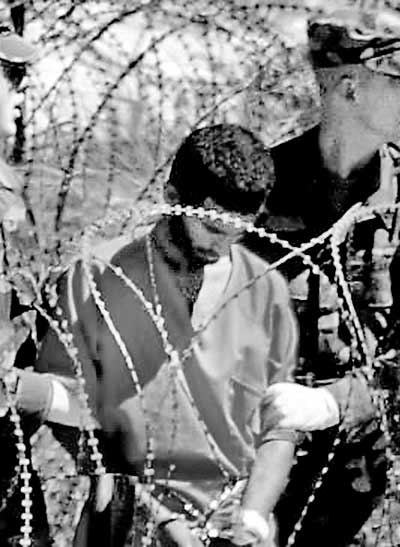 The Guantanamo Bay detainees are Muslims. Many are from the third world, while some are Westerners as far as their national identities and passports are concerned. They are British or European by nationality but their origins lie in the Islamic world. A very few are ethnic Europeans whose ancestry belongs in Europe. The criterion here was religion. Assuming that the detainees were Americans and non-Muslims, one could ask if the same brutal methods of interrogation would have been applied. One recalls a case where an American policeman was indicted several years ago for shoving the handle of a bathroom brush up the anus of an African immigrant. One wonders whether he would have done this to an American, even an African-American, leave alone a white man.
The racism apart, Another bleak result of this revelation is that, instead of encouraging repressive third world regimes to improve their human rights records, this could have a very negative impact on us. The signal could be interpreted as: “If it’s all right for the preachy Americans, what’s wrong with our doing it?”
In the third world, the stock excuse given for official torture (if any excuse is given at all) is that interrogators don’t have the time, the right kind of training and resources for scientific interrogation, to question relentlessly till the suspect breaks down and confesses. It’s much easier to hang the suspect from his feet and beat him unconscious, or use any method from electric shocks to extraction of nails and teeth to get results.
The developed world, on the other hand, has taken pride in a more ‘civilised’ approach. It has the science and the resources. But even a cursory glance at history would show approaches much less than civilized by Europeans during times of war and civil unrest during the 20th century.
During the days of empire, the common practice was to create brutal police forces from the colonized population to do the dirty work as ordered by their European masters. Examples abound from India to the Belgian Congo and South Africa. During the Vietnam War, Americans as well as their South Vietnamese allies routinely tortured Viet Cong suspects, often with appalling methods that made Guantanamo Bay look like kids’ stuff.
The French army used horrible torture to suppress the Algerian uprising in the early 1960s, and the Soviets used similar tactics in Afghanistan. All these are examples of ‘civilised’ nations using torture on third world populations. Nazi Germany took a different approach by inflicting brutal tortures on all occupied peoples in both Western Europe and Eastern Europe. The daughter of French painter Henry Matisse, a member of the French resistance, was horribly tortured by the Gestapo. Nor did the Nazis spare their own citizens who dared defy them.
On a lesser scale, the British army in Northern Ireland sometimes resorted to unacceptable methods, such as attempted suffocation of captured IRA men with plastic hoods and beating up captives. Israel is one modern state which regularly uses some of the torture methods used at Guantanamo Bay such as sleep deprivation on Palestinians. These methods leave no physical marks but damage the health and psychology of the victim.
Another reason given for the casual attitude towards Guantanamo Bay detainees is that they are terrorists and hence do not deserve to be treated as prisoners under the Geneva Convention. This is the standard excuse given by all armies fighting insurgencies and anti-terrorist wars, from South Africa in the 1970s to India in the Kashmir today and the US army in Iraq (vis. a vis. the infamous Abu Ghraib incident). This applied to both sides of the Sri Lankan civil war as long as it lasted, but one side remains permanently labelled as terrorists.
But the borderline between conventional warfare and terrorism thins out during volatile times. Jews practised terrorism (such as the bombing of the British army HQ in Palestine) before Israel was created. When the British created commando units to wage clandestine warfare against German targets, Hitler declared them to be terrorists and ordered all captured commandos to be shot.
The Al Qaeda tactic of using aircraft against American targets during 9/11 is similar, at least in tactical terms, to what the Japanese kamikaze units did in WWII, though the use of packed airliners against civilian targets makes the Al Qaeda case a particularly horrendous crime. But one can ask whether the use of a military pilot for a suicide mission against a military target is acceptable warfare while the use of civilians flying civilian aircraft against civilian targets remains absolute terrorism.
One could ask how the dropping of an atomic bomb on a defenseless civilian city (which Hiroshima was) of a defeated nation could be defended in terms of conventional warfare. For that matter, countries with atom bombs and a military readiness to use them in war should question themselves whether they have a moral right to use weapons of terror against civilian populations.
All these examples, barring Nazi Germany, British India and the Belgian Congo and the use of the atomic bomb happened after the Universal Declaration of Human Rights, which was adopted by the UN General Assembly on Dec. 10, 1948. Even a casual survey would show us that governments all over the world have spent more money on wars and fighting terrorism than on the eradication of poverty and education, while it can be statistically proven that these socio-economic factors fuel discontent and provide fertile breeding grounds for terrorists looking to recruit. Osama bin Laden, an engineer and the son of a wealthy man, is the exception that proves the rule. Torture isn’t going to deter terrorists. Eradication of terrorism and universally better standards of education may not totally eradicate terrorism, as there will be always be malcontents. But terrorism on a greatly reduced scale would minimise the need for another Guantanamo Bay and the brutish tactics employed there.