Reply To:
Name - Reply Comment
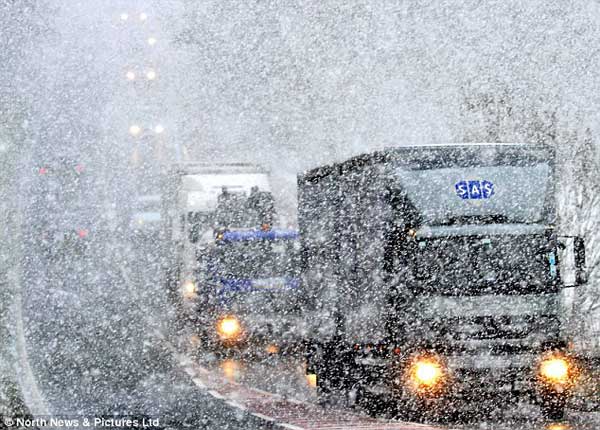
.jpg) In the western world, a white Christmas is a Christmas covered with snow. This time, countries in the North Pole experienced such a Christmas. A sudden winter storm swept Canada, the US, England and France on the same day and as a result rivers overflowed, trees were uprooted and electricity power supply lines were destroyed. Also, huge traffic congestions had left thousands stranded while millions were desperately seeking food, heating, water, sanitation and communication facilities. High-rise condominiums were seen as ghost towers, eventually reducing the modern living to a stone age.
In the western world, a white Christmas is a Christmas covered with snow. This time, countries in the North Pole experienced such a Christmas. A sudden winter storm swept Canada, the US, England and France on the same day and as a result rivers overflowed, trees were uprooted and electricity power supply lines were destroyed. Also, huge traffic congestions had left thousands stranded while millions were desperately seeking food, heating, water, sanitation and communication facilities. High-rise condominiums were seen as ghost towers, eventually reducing the modern living to a stone age.
The most tragic incident reported was the suffocation of a dozen of people due to breathing of toxic gases produced by electricity generators. Those victims died in their sleep. Won’t that tragedy be a nightmare to the seven billion people living in the world, unless the phenomenon of climate change is reversed?
Historians have two different views on Christmas Day where Christians, world over, celebrate the birth of Jesus Christ. One was to commemorate Sun God, Sol- Invictus (unconquered Sun) and in 274 AD, the Roman Emperor Aurelian made it an official cult. The Roman festival of ‘Dies Natalis Solis Invicts’ or the birthday of the unconquered Sun coincided with 25th December.
Professing Sun God was an ancient ritual and religions from Persia to Egypt Polytheist religions or ‘Pagans’ believed Sun God to be the creator of everything. The second view was the tradition that came from ancient Roman festival called ‘Saturnalia’ which was to honour the deity Saturn held between 17-23 December. Carnivals, gambling and all sorts of lawlessness prevailed during this week. The fourth century Christians imported Saturnalia to attract Pagans to their religion, under the patronage of Emperor Constantine who promulgated Christianity as the sole official religion of Rome. However, most of the Christians do not believe in these interpretations.
Whatever were the historical traditions, the last days of December were very important to North Pole nations. That was because, WINTER SOLSTICE occurred on 21st or 22nd December each year. It is an astronomical phenomenon where sun’s elevation with respect to North Pole is at its most negative (or furthest) value, relative to the previous year. Northern hemisphere has its longest night and the shortest day around the movement of solstice with 24 hour long nights for Arctic Pole nations. So, the sun is virtually dead and then reborn! What a date for the commemoration of Sun God!
Climate and weather are mostly determined by sun’s relative position and the obliquity of the earth. The self-spin and orbital movement generally condition ice caps, heat waves, monsoons and mean sea level.
One of the great scientists, Milan Kovitch predicted that there was 40k, 100k years of Milan Kovitch cycles where planet earth’s relative position to the sun becomes its closet position. Glaciation or ice age and De glaciation or terminations of ice ages happen due to this relative position and other parameters like carbon concentration of atmosphere etc. It has been decided that the last Glacial maximum (LGM) happened 20k years ago and at least five ice ages prevailed on our planet since billions of years of its life time.
It was also estimated the mean sea level to be 80-125 m below the modern level. De glaciation (between 20k to 6k years BP) caused by the aforementioned factors had dramatically contributed to rising of sea levels, submerging islands and rebounding ice-covered continents.
Our historical chronicle Mahawansa states that over 90 percent of the country had been submerged due to sea level rise. The famous Biblical story of Nova also had mentioned about an oceanic flood. Before this Deglaciation most of the islands prevailing today such as Indonesia and Japan may have had larger landmass compared to what they have today.
Milan Kovitch cycle may hit our planet in 20 k years to come. However, man-made activities tend to accelerate global warming, forcing prevailing ice caps to melt before that. All scientists are now accepting the fact that global warming is happening. Winter storms, tornados, earthquakes, tsunamis, hot and cold weather, droughts and floods, salinity intrusion, acidification of water bodies, rise of sea level and extinction of species are being experienced in every part of the world.
However, it is unfortunate that global leaders are yet to reach a consensus, related to issues of global warming. They all know that burning of fossil fuels is causing this carnage. However, from the USA to Canada, Britain to Japan, Philippines to India, Brazil to China, all desperately need fossil fuels to overcome their fiscal cliffs, accelerate economic growth and more importantly, to keep pace with the competitiveness in global markets.
In 2013, the CO2 concentration on atmosphere reached 400 ppm. That means, before the end of this century, the mean temperature of our Mother Earth will rise to 1.50c with respect to the pre-industrial era (1860 AD).
If not controlled, it may surpass the dangerous threshold of 20C and will remain a catalyst for a catastrophic environmental disaster. According to IPCC's recent situation report (2013), during the period 1860-2010, the planet’s mean temperature has risen by 0.70c. (In Sri Lanka, it is increasing at a rate of 0.01 to 0.036 centigrade per annum).
Temperature rise and melting of ice cap caused the sea level to rise. From 1901 to 2010, the planet's mean sea level had risen by 0.19m. (In Sri Lanka, it is 2.9 to 3.4 mm per annum). High mean temperature tends the atmosphere to absorb and sustain more water vapor in its own decreasing the rainfall. (In Sri Lanka from 1930 to 2010, the rainfall had been reduced by 10 to 35 mm, except in North -Western coastal belt)
So, it is absolutely clear that the world in general and Sri Lanka in particular are heading towards water stress situations. So, sooner or later, floods, droughts, erratic monsoon patterns, acidification, salinity intrusion and typhoons may cause immense hardships to island nations like Sri Lanka. Therefore, our top priority should be to conserve and not to pollute our precious water resources. The second priority should be energy security and not to rely on fossil fuels and unpredictable hydro power. These are the vital lessons we have to learn from the recent winter storms in white Christmas.