AI SUMMARY GENERATED ONLY FROM THIS ARTICLE'S TEXT.
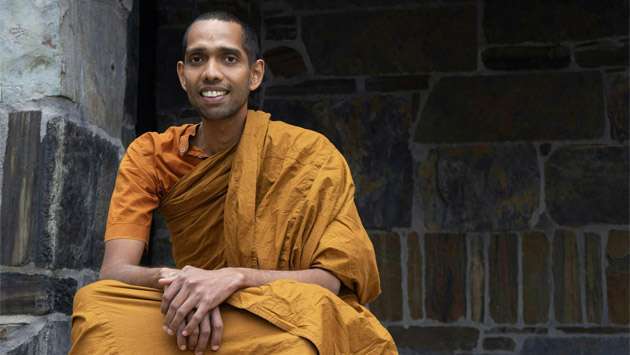
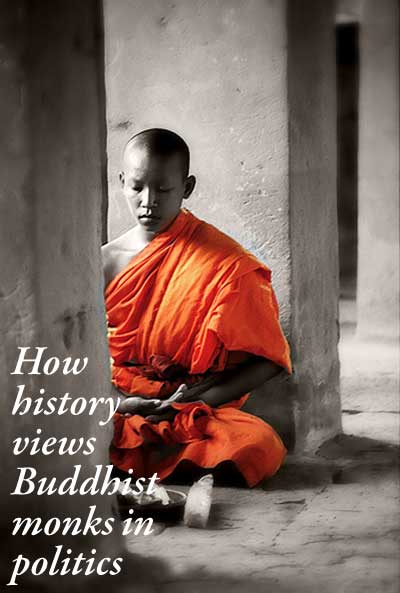
topic that is being discussed today is being reviewed in the light of the Theravada monastic discipline and the 2600 year history of this country. Primarily a Buddhist monk is a full time student of spiritual quest and as such the rules of moral behaviour binding him are much more rigorous. It has been observed that a good many number of young Buddhist monks and a few older ones seem to engage in politics of this country. They seem to express the view that the secular matters of the country are also a part of Buddhist social philosophy and it is their right to safeguard society by getting involved in secular activities like any other member of the democratic society we live in.
In psychological terms, attitudes whether wholesome or unwholesome are mental build-ups formed on their own in our minds mainly based upon the way in which our minds react in the presence of stimuli. In the Alagaddupama Sutta the Buddha says the concept formation in the process of education is comparable to a task of catching a water sanke. if it is caught wrongly it would turn back and bite the hand that took it.
According to the Buddha, identities of man whether ideological, cultural, racial or social are all man made. They are mere projections of mundane minds. Therefore identities according to the Buddhist view result from the unenlightened of perception.
The teachings of the Buddha are primarily meant to show mankind the way to deliverance from the sorrows and tribulations of this worldly existence and since much of mans ills are conditioned by the society in which he is born, it was necessary to indicate how best social life could be adjusted to minimise the attendant miseries of living.
Hence right view is the beginning of true education. Therefore education considered in its complete sense, is the zenith of experience born of correct perception.
The human mind is comparable to a prison, and for that matter most of us are prisoners in it. It is a psychological cell of our own making. The ten fetters that fortify this cell are . 1. Attachment to the idea of self 2. Doubt 3. Rites and rituals 4. Sense gratification 5. Malice 6. Desire for world of forms 7. Desire for world without forms 8. Pride 9. Excitement 10. Ignorance. The above mentioned psychological obsessions obstruct the mind from experiencing true freedom.
The Buddhist scheme of education lay in its emphasis on the gradual removal of age old wrong attitudes about man, his philosophy of life, social norms and social behaviour.
According to the Buddha the process of education should be used to motivate the recipient to understand his own personality in its totality. This is the beginning of education indeed. According to the Buddhist view, all teaching and learning arises from inward discipline. It is only when the total personality has been set on doing what is proper that inner peace and tranquility blossom out fully. In the Buddhist view education is enlightenment, and the three- fold behavioural activities associated with it are 1. Learning 2. Practice 3. Penetration or comprehension. Constant reflection of what has been learnt is fundamental to true learning. It is said that the Buddha admonished his son Rahula to regularly reflect upon what is learnt in order to improve the memory and deepen his comprehension. He says a monk should educate himself gradually, train himself gradually and tread the path himself gradually, since there is no abruptness with regard to penetration of profound knowledge.
From the Buddhist point of view, one is considered educated only if one is in possession of the following moral qualities 1. Well controlled mind, 2. Even mindedness towards all beings, 3. With thoughts under control 4. Steal not what is not given 5. Tell no lies. 6. Restrain towards all beings 7. Speak no hard words. 8. Allure not towards pleasure 9. Pure fairing 10. Settled mind 11. Endowed with good conduct and 12. Fond of meditation
No politician in the world has been or is found to be 100% honest. therefore one who is 100% honest without an ulterior motive cannot be a politician. Therefore a politician is not and will not be a bodhisatva . A Buddhist priest is expected to cultivate and develop Bodhisatva qualities in his quest for final liberation.
If one who is in the process of destroying his defilements enters the field of secular power politics, by this very act. he breaks the 4th precept musavada, or abstain from lying of the five precepts. In terms of Theravada vinaya (code of discipline) he has commited an offence which qualified him for punishment. In an article on the subject of ‘’The Buddhist ideal in politics” the late professor OHDA Wijesekara (Emeritus prof of sanskrit) says “At least a few students of Buddhism would be aware that the earliest dialogues of the Buddha contains not only doctrines of religious or spiritual value but also a number of important socio – ethical , political, juristic , and economical views whose significance for the modern world can not be denied . Of course the main purpose of these dialogues is not to outline any political philosophy as such, but political and economical matters came to be discussed in so far as they are aspects of the social ethic that the master considered so very essential for the worldly progress and welfare of his lay disciples .
The teachings of the Buddha are primarily meant to show mankind the way to deliverance from the sorrows and tribulations of this worldly existence and since much of mans ills are conditioned by the society in which he is born, it was necessary to indicate how best social life could be adjusted to minimise the attendant miseries of living.
The Buddha always considered the psychological or subjective aspect at this social ethic as of greater importance of the mere externals of government and juristic behaviour……… in the ancient world the teaching of the Buddha was the only one that emphasised and quietly, the economic aspect of social life …… the alternate physiological significance of this Dhamma or the social ethic of Buddhism is brought out clearly when it is defined in practical social life as the cultivation of benevolence……….to bring happiness to some at the cost of happiness, or at times lives of some others is not only against morality or Dhamma but also indicates the worship of veritable social vice. From the point of view of the Dhamma there are no majorities or minorities for happiness, for the amelioration of worldly Dukka is the birthright of all beings born into this world whether they are rich or poor, high or low, powerfect or powerless Dhamma indeed, protects him who parties it.
Historical records of this country do not show a single instance of a Bhuddist priest in robes ,while still subjecting himself to the vinaya rules (223 Rules of conduct meant for a monk) of having ascended to the throne remaining in robes and governing this country
Mahawansa records in the Anuradapura period, a monk by the name Dathusena residing in digha-sanda senapathi pirivena, where his uncle disrobed and waged war, united the country and ruled the country as king Dathusena for many years.
No politician in the world has been or is found to be 100% honest. therefore one who is 100% honest without an ulterior motive cannot be a politician. Therefore a politician is not and will not be a bodhisatva . A Buddhist priest is expected to cultivate and develop Bodhisatva qualities in his quest for final liberation. If one who is in the process of destroying his defilements enters the field of secular power politics, by this very act. he breaks the 4th precept musavada, or abstain from lying of the five precepts.
Theraputthabaya a Buddhist monk, disrobed and joined king Dutugamunu’s army and become one of the ten generals who fought the war, upon victory he left the king and the army and ordained himself as a Buddhist monk.
In the Kandiyan period , following the death of king Wimaladharmasuriya his cousin (some say step brother) who was the chief monk at the Sri Pada Temple disrobed and married the widow Dona Catherina and ascended to the throne as king Senarath and ruled the country.
The Buddha in his very life time when he became aware of the annihilation of his own race the Sakyans by the king Vadudaba , he did not opt to exploit his royal heritage and inheritance to organise and lead the Sakyan people against the invading king. The Buddha only preached the Dhamma, since he had given up secular power for spiritual power.
Comments - 0
Comments - Spiritual power to secular power
222
Add comment
Comments will be edited (grammar, spelling and slang) and authorized at the discretion of Daily Mirror online. The website also has the right not to publish selected comments.



.jpg)
.jpg) topic that is being discussed today is being reviewed in the light of the Theravada monastic discipline and the 2600 year history of this country. Primarily a Buddhist monk is a full time student of spiritual quest and as such the rules of moral behaviour binding him are much more rigorous. It has been observed that a good many number of young Buddhist monks and a few older ones seem to engage in politics of this country. They seem to express the view that the secular matters of the country are also a part of Buddhist social philosophy and it is their right to safeguard society by getting involved in secular activities like any other member of the democratic society we live in.
topic that is being discussed today is being reviewed in the light of the Theravada monastic discipline and the 2600 year history of this country. Primarily a Buddhist monk is a full time student of spiritual quest and as such the rules of moral behaviour binding him are much more rigorous. It has been observed that a good many number of young Buddhist monks and a few older ones seem to engage in politics of this country. They seem to express the view that the secular matters of the country are also a part of Buddhist social philosophy and it is their right to safeguard society by getting involved in secular activities like any other member of the democratic society we live in.(1)(97).jpg)
 Hence right view is the beginning of true education. Therefore education considered in its complete sense, is the zenith of experience born of correct perception.