Reply To:
Name - Reply Comment
 The European short films shown at the German Cultural Institute on recently were a real eye opener to the possibilities of this medium. Unfortunately, in a country where the huge expense and trouble of making features is supposed to have oriented many aspiring film makers to the short film medium, they were conspicuous by their absence to judge by the small audience. What a pity, because several of these films were a treat to watch.
Due to a busy schedule, I regretfully arrived half an hour late. But the four films I saw (barring one) were all very thought-provoking. The Polish entry (all these films have nominated for recent European festivals) shows a son making a documentary about his father, a diplomat. The filmmaker is never shown. He follows his father with a hand-held, often shaky, camera – in the car, into the office, even during a morning’s physical exercise. The exasperated father often objects. The mother is shown briefly. In the end, the father simply asks the son to meet him for breakfast at the office, without his camera. You are the camera, the son is told. I want to talk to you, not the camera, because I need you. This is a much understated short film about father-son emotions.
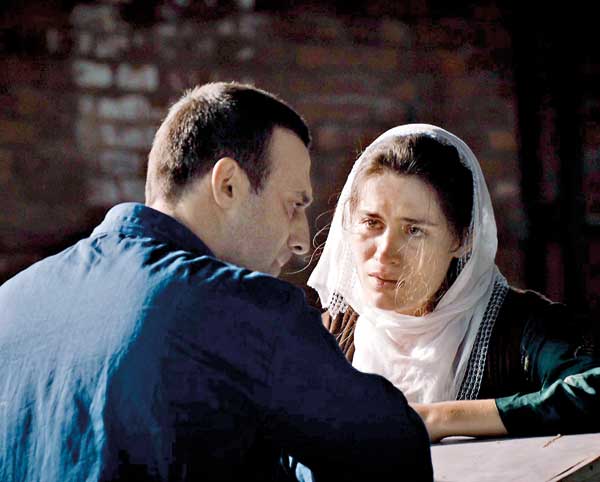
From Turkey, Rezan Yesbias’ fictional entry ‘Silent’ tells the story of the young wife of a Kurdish political prisoner. It takes us through her routine – shopping, bathing her son, dressing for a prison visit. She and her husband can’t talk to each other, because she can’t speak Turkish or Kurdish and not being allowed by the Intimacy is impossible under the circumstances. But, in a silent sequence which speaks volumes for the couple’s pathetic desire for love, the camera goes below eye level to show them bring their feet together in a moving ‘embrace.’
.jpg) The Latvian-Estonian entry, Villa Antropov, is an animation film by Kaspar Jancis and Vladimir Leschiov, which tells the story of a dark-skinned Moroccan who dreams of escape to prosperous Europe
The Latvian-Estonian entry, Villa Antropov, is an animation film by Kaspar Jancis and Vladimir Leschiov, which tells the story of a dark-skinned Moroccan who dreams of escape to prosperous Europe
The Latvian-Estonian entry, Villa Antropov, is an animation film by Kaspar Jancis and Vladimir Leschiov, which tells the story of a dark-skinned Moroccan who dreams of escape to prosperous Europe. He ‘sails away’ in a wooden crate box. Parallel to this, we see a wedding in progress. It’s a ‘filthy rich’ wedding between a cocaine-snorting mafia-style entrepreneur and his ‘dream bride’ with all the right proportions. Inside the church, the priest lusts after the bride. During the nuptial dinner at a beachside inn, the groom steals away to the men’s room, snorts too much cocaine, and is ‘blown up.’ His bodyguard discovers the empty suit.
All guests, including the bodyguard, flee. The priest arrives to make love to the bride. In the meantime, the exhausted Moroccan arrives to discover an empty table full of leftovers. After a technical mishap with the air-conditioning, the inn is blown up and the Moroccan finds himself back where he started from. It’s a darkly brilliant, expressionist film in striking monochrome images about greed, lust and widely different dreams of happiness.
The Swiss entry, Objection VI by Rolando Colig, too, was about illegal immigrants, showing the overriding importance of this theme to Europeans right now. It’s told from the point of view of a young Algerian immigrant seeking political asylum. It shows us, sometimes from the protagonist’s point of view, his routine in an official shelter – the bureaucracy, the accommodation, the food, other immigrants, and a middle-aged Swiss woman who gives him food in exchange of sex. Finally, his 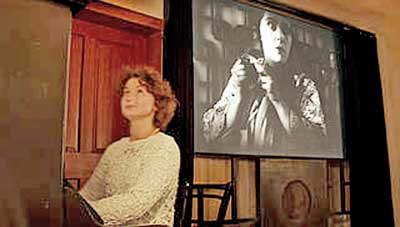 asylum application is rejected. Depression sets in when he knows he will be deported to face jail and perhaps torture back in Algeria. The film shows in harrowing detail the horror of ‘level IV’ deportation, when deportees are expected to be violent and are transported from the cells to the airport bound to wheelchairs, their heads enclosed in weird protective helmets. This film is based on a true story where the asylum seeker died of a heart attack while waiting for his flight. It’s not a film for the squeamish.
On Thursday, German pianist, composer and teacher Karen Schlimp presented ‘silent movies with live piano.’ Georges Melies’ ‘Trip to the Moon’ and Robert Wiene’s expressionist horror film ‘The Cabinet of Dr. Caligari’ were screened while she played accompanying music, shifting from the chromatic scale to the diatonic, from harmonious chords to dissonant ones, according to the films’ shifting moods. Wiene’s film with its asymmetrical angles and expressionist setting called for a very different approach.
While acknowledging influences by modern composers such as John Cage, she has created a unique performance style whereby the piano’s ‘inner world’ is exposed as she plucks the strings with her hand. In this case, the audience could not see the strings, but in her ‘Pianopyramid’ performances (as seen from her website) the piano with its open top is sometimes set at odd angles so that we can see into it. It’s a pity that the audience wasn’t larger since we rarely get to see performances of this kind.