AI SUMMARY GENERATED ONLY FROM THIS ARTICLE'S TEXT.
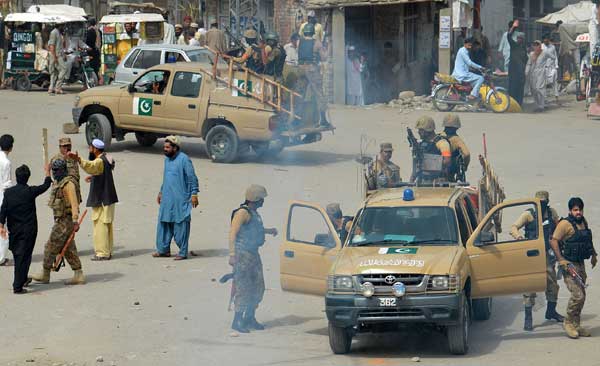
early half a million civilians have been displaced and more than 360 suspected rebels killed in Pakistan’s two-week-old war in North Waziristan. It is the biggest military operation in Pakistan’s history and the Pakistani military appears to be determined to wipe out extremism once and for all and save the country and the generations to come from religious fanatics and their injurious ideology.
Codenamed Operation Zarb-e-Azb (or sharp and cutting strike), the war in Waziristan, Pakistan’s northwest tribal areas, is a necessary evil which the Pakistani military has been forced to undertake to eradicate a bigger evil – religious fanaticism. Those who promote fanaticism are a bunch of irrational fools with a confused vision. They hijack religion to suit their agendas. Little do they realise that they only enable enemies of the State to use them as pawns in their games. Little do they understand that Pakistan’s friends and foes alike seek to destabilise the country with a view to snatching its nuclear weapons.
With foreign money, weapons and an ideology to romanticize, jobless and under-educated youths are drawn into extremism and causing harm to their country and the religion.
Neither during the ten-year Soviet occupation of Afghanistan, nor during the five year reign of the Taliban, had Pakistan felt so vulnerable as it is today to internal and external forces that seek to achieve their agendas at the expense of Pakistan’s instability and misery.
The more destabilised Pakistan becomes, the stronger the case for the United States and its allies to call for the dismantling of Pakistan’s nuclear weapons. Even before the 9/11 attacks, Pakistan’s nuclear weapons had been a major concern for the United States, Israel and, of course, India. Their main worry was the worst case scenario – the capture of power by Islamic extremists, like the Taliban. Some say such a situation will not come about since, a large majority of Pakistanis do not subscribe to the extremists’ interpretation of Islam. But external forces can manipulate events and create a political climate for the extremists to march towards Islamabad. Such a spectacle is happening in Iraq. Who would have thought a couple of months ago that a radical Sunni Muslim group would be knocking at the gates of Baghdad?
It is naïve to assume that Washington and Israel have no plans to destroy Pakistan’s nuclear weapons. The time for it will be when Pakistan is plunged into anarchy and chaos with Islamic extremists and their cells in the military tring to take control of the country’s nuclear facilities. In such a situation, the United States will intervene and take control of the facilities to prevent the nukes from falling into the extremists’ hands.
Many Pakistanis believe that the war in Afghanistan was not aimed at fighting the Taliban or Islamic extremists, but rather dismantling Pakistan’s nuclear arsenal.
Since Pakistan was created in 1947, it has been beset with hostile relations with India, military coups, lawlessness in the tribal areas, separatism in Balochistan and ethnic and sectarian violence in Karachi and other places. Yet a majority of the people stood by the founding ideology of Pakistan and pulled together as a unit. This was more so, in the face of threats to its sovereignty and territorial integrity from India.
In comparison to the new crises that have cropped up in Pakistan after the 2001 US occupation of Afghanistan, the Indian threat – the main factor that held the Pakistanis together – pales into insignificance or has become weak or vague, especially in view of the two countries not resorting to war following their nuclear show-off in 1998.
Neither during the ten-year Soviet occupation of Afghanistan, nor during the five year reign of the Taliban, had Pakistan been so vulnerable as it is today to internal and external forces that seek to achieve their agendas at the expense of Pakistan’s instability and misery.
It is such a realisation that has compelled Pakistan’s military to launch an all-out war against the Pakistani Taliban or the Teherik-e-Taliban Pakistan (TTP) which emerged in 2006 as a support force for the Afghan Taliban. The two Taliban derive their strength from the Pashtun tribe which lives on both sides of the Pakistan-Afghan border. Many were the attempts by successive governments to hold talks with the Pakistani Taliban. The rebels mistook the government’s willingness to talk as a sign of weakness and placed outlandish demands.
Prime Minister Nawaz Sharif, upon assuming office in June last year, also tried to placate the TTP and invited them to talks. After a few rounds of talks, the Taliban spurned the offer of peace and demonstrated they had no intention to give up terrorism.
The military had been a silent opponent of the peace talks the Sharif government had with the Taliban. Frustrated that the Taliban had not grabbed his offer of peace, Sharif has given his full blessings to the ongoing military operation.
Since the US forces occupied neighbouring Afghanistan, Pakistan has been dealing with the worst kind of terrorism. Some 50,000 Pakistanis have been killed and more than 5,000 Pakistani soldiers have died in violence related to the war in Afghanistan or the so-called US war on terror. In fact, more Pakistani soldiers have died in the war on terror than the US soldiers killed in Afghanistan and Iraq.
The toll is also much bigger than the number of Pakistani soldiers who died in the three wars with India.
Yet Pakistan has often come under flak for not doing enough to fight terrorism in the country -- with top US military officials accusing some elements in Pakistan’s intelligence agency ISI (Inter-services Intelligence) of pampering the Taliban or playing double games. Similar allegations have also been made by Afghanistan’s outgoing President Hamid Karzai.
On the other hand, Pakistani analysts frown upon the large Indian presence in Afghanistan and question whether it is linked to secret programmes aimed at destabilising Pakistan and helping the separatists’ cause in Pakistan’s Balochistan province.
Those who promote fanaticism are a bunch of irrational fools with a confused vision. They hijack religion to suit their agendas. Little do they realise that they only enable enemies of the State to use them as pawns in their games
The Pakistani military must be regretting that it had not continued its previous Waziristan operation in 2009 and finished off the Taliban. That operation, confined to South Waziristan, succeeded to some extent in eradicating terrorism. The Taliban fled to North Waziristan, which during the Soviet occupation of Afghanistan was the hub of mujahideen fighters who came from all parts of the world.
Making Pakistan’s war against the Taliban difficult were US drone attacks in which more innocent people died than Taliban fighters. Every drone attack helped the Taliban to swell their ranks and made the task of the Pakistani military difficult. Among those who join the Taliban are jihadi groups from Uzbekistan and other Central Asian countries. The Taliban see the Pakistani military as a legitimate target and have launched several attacks on Pakistani military posts in South Waziristan, Swat and other places. In fact, the Pakistani Taliban have largely killed only fellow Pakistanis. They have very few trophies, if any, to show that they also attack Nato targets.
Pakistan’s latest war against the extremists came days after the TTP launched a daring attack on the Karachi international airport on June 8. The terrorist attack was another indicator that the country’s national interest was not a concern for the Pakistani Taliban or they are in cahoots with anti-Pakistani forces. In yet another attack, the terrorists opened fire at the Peshawar international airport yesterday, killing one passenger and wounding several others. These attacks have raised serious questions about the safety of aircraft and airports in Pakistan. The pattern is evident. The terrorists seek to isolate Pakistan internationally and thereby hurt the country’s economy. In March 2009 in Lahore, the terrorists attacked a bus carrying Sri Lankan cricketers. Since then, Pakistan has not seen international cricket. Similarly, the airport attacks, the terrorists probably hope, will hurt the economy as such attacks send the message that tourists and investors should not fly to Pakistan.
For Pakistan, there is another urgency to take on the Taliban. That is the withdrawal of the US troops from Afghanistan by December this year. Although at least 10,000 US troops will remain in Afghanistan even after December 31, uncertainty looms as to the future of Afghanistan.
The International Crisis Group in a chilling report last month said, “the overall trend (in Afghanistan) is one of escalating violence and insurgent attacks”. The report observed that the insurgents “are blocking roads, capturing rural territory and trying to overwhelm district administration centres.”
In the light of the ground realities in Afghanistan, even the US has sounded out that it is not shying away from holding talks with the Afghan Taliban.
Thus it is in the best interests of Pakistan that it takes control of the situation in Waziristan and other tribal areas before the emerging situation after the US withdrawal places it in a disadvantaged position. But any military operation should not prolong the suffering of the displaced people who are living in squalid condition in government or UN-run camps and facing food shortages, lest it change the people’s anger into support for the Taliban.
Comments - 0
Comments - Pakistan’s full-scale war on extremism
222
Add comment
Comments will be edited (grammar, spelling and slang) and authorized at the discretion of Daily Mirror online. The website also has the right not to publish selected comments.



.jpg)
.jpg) early half a million civilians have been displaced and more than 360 suspected rebels killed in Pakistan’s two-week-old war in North Waziristan. It is the biggest military operation in Pakistan’s history and the Pakistani military appears to be determined to wipe out extremism once and for all and save the country and the generations to come from religious fanatics and their injurious ideology.
early half a million civilians have been displaced and more than 360 suspected rebels killed in Pakistan’s two-week-old war in North Waziristan. It is the biggest military operation in Pakistan’s history and the Pakistani military appears to be determined to wipe out extremism once and for all and save the country and the generations to come from religious fanatics and their injurious ideology.(1)(62).jpg)
.jpg)