Reply To:
Name - Reply Comment
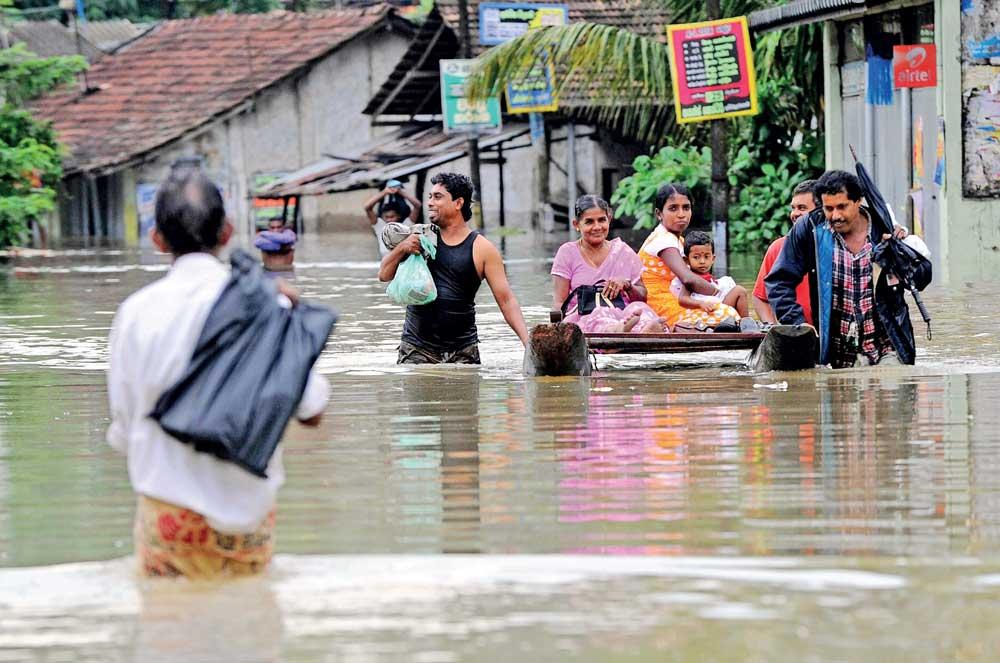
Integrating climate education topics like changing weather patterns, impacts of deforestation on local climate, and sustainable land use practices in current curricula can help prevent the damage done by floods, for instance
By Ravi Pratap Singh
In an article titled How Education Systems Have Always Created Our Futures by Sal Gordon, Head of Teaching & Learning at Green School Bali, some of the questions raised by him prompted me to analyse them further, where he says, “Are you teaching only about the past—or learning for the future? Are learning programs reflective of the needs of today and tomorrow?”
One would argue that many schools now adopt this approach, as they are aware of the need to prepare children for the 21st century. However, the disheartening fact is that such progressive educational pedagogy is being adopted by schools serving a small proportion of more privileged children, who can afford to pay high fees in private schools. The public education system in South Asian countries falls short of this expectation.
In South Asia, approximately 75.6% of the population is estimated to be living in poverty, according to a World Bank report. This figure is significantly higher than the global average of 43.6% for the same period. The region also accounts for a substantial portion of the world’s extreme poor, with around 29% of the global total residing in South Asia.
If we extrapolate this information, one can confidently assume that a huge proportion of at least three-fourths of the children in South Asian countries are being served by the public education system or recently mushroomed, poor-quality private schools.
This article is an effort to analyse the policy frameworks in the South Asian countries through the review of national education policies of the countries of the South Asia Region, except Afghanistan, the gaps thereof and possible innovations to address those gaps. The idea is not just to improve the quality of learning in public schools, but also to build a generation of environmentally conscious and climate-aware children, comprising all children. This would ensure that a large number of children of this generation become a force to reverse the impact of climate change, care for their environment and preserve biodiversity.
Education: Its Power
and Challenges
Education empowers individuals with knowledge, skills, and values, fostering critical thinking, problem-solving, and adaptability. This, in turn, enables them to participate more effectively in society, make informed decisions, and contribute to positive changes. Holistic education that includes life skills alongside academic learning is crucial for creating well-rounded individuals who can successfully navigate a complex world.
The increased competition for jobs and constantly shrinking livelihood spaces has reduced education to be merely a mere means to acquire a performance scorecard of academic knowledge. As we entered the new millennium, education lost focus on its purpose. And, education or the educational system without a purpose needs a rethink. However, passionate educators around the world are bringing back hope by reflecting on the needs of now and the future, sharing those ideas, and helping schools and schooling systems evolve.
National Education Policies
National Education Policies across South Asia show a growing emphasis on environmental and climate education, with varying degrees of integration and specific approaches. While all recognise the importance of sustainability, the policies of Sri Lanka, India and the Maldives stand out with more comprehensive and formalised integration of environmental education into the curriculum, while others are making efforts in strengthening climate-related content.
What is still needed?
As evident from the description above, all these National Education Policies of the South Asian countries recognise the importance of environmental education, including climate change, and some of them aim for its integration into the curriculum. However, designing a locally relevant environmental or climate education programme for school children and more so for underprivileged children, is crucial to develop a generation that would be aware of and take required actions towards climate resilience and demonstrate environmental stewardship.
a) Customised Context-specific Content: These policies provide an overarching national framework for environmental and climate education, which is very broad. Children lack interest and do not absorb such generic content about EVS topics, particularly related to climate change. Climate change impacts are highly localised. Children living in cities like Colombo, New Delhi and Islamabad experience climate change differently from children in rural areas, coastal regions or the Himalayan region. Their vulnerabilities are tied to the specific conditions related to poor waste management, increasing water crisis, neighbouring industrial setups creating pollution and other local ecosystems.
A customised climate education programme, therefore, is crucial, which would incorporate examples and case studies from the local settings and their neighbourhood. Children would learn about local practices or initiatives related to water conservation or the reduction of industrial and farm waste. This would make learning more context-specific and inspiring, because children would easily relate it to their daily lives.
Such environmental and climate education would equip these children with the knowledge and skills to adapt to these changes, participate in finding solutions, and build resilient communities. Their early exposure to climate issues would develop a sense of environmental responsibility among these children, and they can become agents of change within their families and communities, promoting sustainable practices and climate resilience.
b) Initiating STREAM Education: STREAM education is an evolved form of a more popular STEM education. STEM education (Science, Technology, Engineering and Mathematics) is fundamental in preparing students for tech, engineering, medicine, and other high-demand careers. It fosters analytical thinking, problem-solving, and innovation, all of which are important for professional success.
While practising STEM education, the educationists realised that something significant was lacking among students following STEM education. It was noticed that creativity was generally missing among the students of STEM.
Since the Arts nurtures creativity, self-expression, and an appreciation for aesthetics, fostering exploration of human imagination and emotions, the inclusion of A (for Arts) became important, and STEM became STEAM. Visual arts, music, drama, and literature are all essential components of an all-round education. The shift from STEM to STEAM highlighted the synergy between science, technology, engineering, mathematics, and the arts. This integration harnesses scientific and artistic perspectives to have a better understanding of the world.
The integration of the Arts into the STEM Program has enhanced:
In today’s fast-changing world, it is more important than ever to equip children with the skills they need to succeed. One of those skills important for the acquisition of knowledge is reading and writing. That’s where STREAM comes in, where R for Reading is added to STEAM. Each of the STREAM subjects brings a unique set of skills and perspectives to the learning experience:
i) Science & Engineering helps develop critical thinking and problem-solving skills
ii) Technology teaches them how to use various (digital) tools and information.
iii) Reading promotes literacy and communication skills
iv) Arts foster creativity and self-expression
v) Mathematics provides a foundation for quantitative reasoning and analysis.
STREAM education, by combining these subjects, provides a comprehensive and engaging learning experience that prepares students for a wide range of careers and challenges in a fast-changing world today. Another advantage of STREAM is that it helps remove the traditional barriers between different subjects. It integrates science, technology, reading, engineering, arts and maths to provide students a more holistic view of the world. By this, it helps them to understand the interconnected nature of these subjects. This kind of interdisciplinary learning could be very powerful, as it allows children to see how their studies in one area can be applied in another, and can help them gain a deeper appreciation for the subjects they are studying.
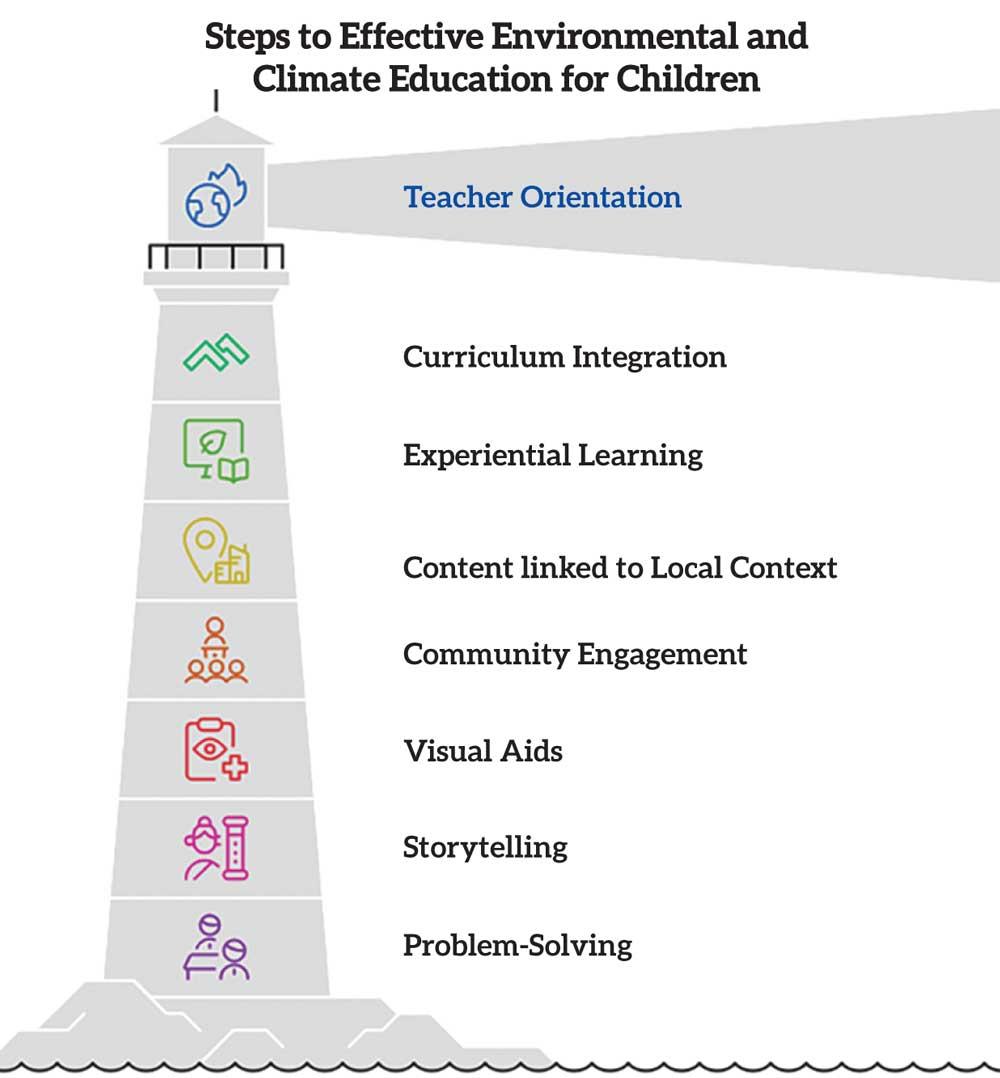
c) Teachers’ Orientation: One of the most crucial and initial aspects to incorporate effective environmental and climate education among underprivileged children would be teachers’ orientation. Equipping them with the necessary knowledge, skills, and resources to effectively teach climate change would be needed. This could be achieved through orientation cum training workshops and by supporting them to have access to relevant materials. A multi-faceted approach could be adopted by the teachers, which goes beyond traditional textbook learning and connects with the community and children’s lived experiences.
d) Integrating Climate Change into the Curriculum: Instead of treating it as a separate subject, climate-related concepts could be woven into existing subjects like science, social studies, geography, and even language/literature. For example:
i) Science: Discuss the water cycle in the context of changing rainfall patterns, the impact of temperature on plant growth, and the science behind greenhouse gases.
ii) Social Studies: Explore how climate change affects communities, migration patterns, and traditional livelihoods.
iii) Geography: Study changing weather patterns, the impact of deforestation on local climate, and sustainable land use practices.
iv) Languages: Use stories, poems, and essays to discuss environmental issues and inspire action.
e) Experiential Learning: Hands-on activities and real-world experiences that would generate interest among children and engage them in learning such subjects. These may include:
i) School Gardens: Create and maintain a school garden (in the pots and troughs, if there is no physical space in urban schools) to teach about sustainable urban agriculture, water conservation, and the impact of weather on plant growth.
ii) Field Trips: Organise visits to local farms, water bodies, parks and gardens, and any other natural habitats.
iii) Waste Management Projects: Implement school-wide initiatives for waste segregation, composting, and reducing plastic use (which has already been initiated by many schools across various countries of the South Asia region, but needs to be systematically integrated).
iv) Water Conservation Activities: Engage students in rainwater harvesting projects or simple experiments demonstrating water conservation techniques. Working around the existing degraded water bodies by introducing water conservation and waste management activities.
v) Observation and Data Collection: Encourage students to observe local weather patterns, record rainfall, or monitor plant growth and discuss any changes they notice in the plant growth or retardation.
vi) Energy Conservation Habits: Inculcate (among children as well as teachers themselves) the habit to switch off the lights and fans while leaving a particular place, classroom or toilet in the school premises or at home. Demonstrate the significance of impact by calculating the savings made in a month or year through such an action.
vii) Local Context and Language: Use local examples, case studies, and local idioms to make the concepts relatable and understandable. Connect climate change impacts to children’s immediate surroundings and the experiences of their families.
viii) Community Engagement: Involve parents, local farmers, and community leaders in the education process through:
f) Use of Visual Aids and Technology: Utilise posters, charts, videos, and age-appropriate digital resources to make learning engaging and interactive. Even simple mobile phone-based resources can be effective.
g) Storytelling and Traditional Knowledge: Incorporate local stories, folklore, and traditional knowledge related to weather patterns, agriculture, and resource management. This can provide a valuable context for understanding current changes.
h) Developing Problem-Solving and Critical Thinking Skills: Encourage students to analyse information, identify problems related to climate change in their local area, and brainstorm potential solutions. These solutions could be organised and presented by children to the local governance body to seek their commitment to invest in the proposed solutions and take appropriate actions, as suggested. This action would also build confidence and leadership skills among the underprivileged children as they start proposing solutions and getting recognised as problem solvers in their village or area.
If we are looking for an effective climate action to reverse the phenomenon of climate change, it can be achieved only by preparing and engaging this generation of children. Building such a generation of children is possible if and only if our schooling system and teachers are ready with various innovative strategies to translate progressive educational policies into action.
The writer is a global public policy expert and Managing Director of iLEAD International Academy, Sri Lanka, which is promoting sustained youth engagement for environmental conservation & climate resilience at the local level.