Reply To:
Name - Reply Comment
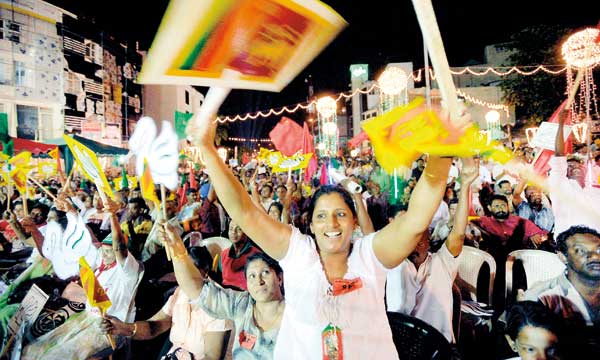
.jpg) Considering events endured at past elections, the expectation of ‘free and fair’ selections is premature
Considering events endured at past elections, the expectation of ‘free and fair’ selections is premature
The 'democracy gap' in our politics and elections spells a deep sense of powerlessness by people who drop out, do not vote, or listlessly vote for the 'least worst' every four years and then wonder why after every cycle the 'least worst' gets worse -
Ralph Nader
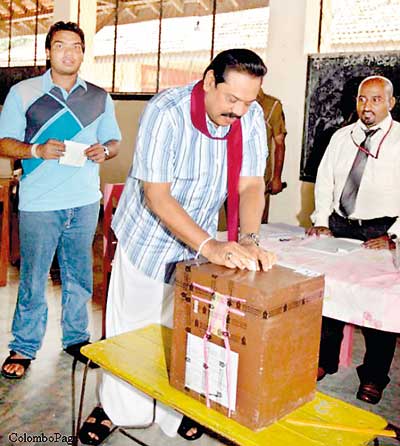 With the dissolving of the Southern and Western Provincial Councils (PCs) Sri Lanka is again getting ready for another election. The term time of the Southern Provincial Council was supposed to come to an end in October 2014 while the Western Provincial Council was supposed to come to an end in 2014 May. Nevertheless, the government has decided to continue with its scattered election system by conducting one now and then but also in a series. The rate the government is having elections in Sri Lanka is similar to our country’s ever increasing jumbo cabinet which has ministers for the most surprisingly planned ministries: The Ministry of Sugar and Ministry of Botanical Gardens and Recreation can be considered as good examples for this tendency. However, when considering the recently held elections, the manner in which public and state resources, funds and property have been used for election campaigns is shocking.
Transparency International report
According to the report ‘Electoral integrity: a review of the abuse of state resources and selected integrity issues during the 2013 Provincial Council Election in Sri Lanka’ issued by one of the main election monitoring organisations of the nation, Transparency International Sri Lanka, it is pointed out that ‘the abuse of public resources has become the norm during elections rather than an offence in Sri Lanka’.
In the chapter ‘Misuse of public resources during the 2013 Provincial Council Elections’ in the Transparency International report, it is revealed that the Programme for the Protection of Public Resources (PPPR) received 176 complaints regarding the abuse of state property during the period 2nd August to 21st September 2013. Over 75% of these complaints were from the North Western and Central Provinces and more than 95% of these complaints were verified either through field visits to the specific locations or through investigations. According to these missions the total number of state-owned buildings used for election campaigns were 46, use of state-owned vehicles used for campaigns 56, use of personnel in public office 42, use of welfare programmes 5, use of public funds for election campaigns 10, use of state authority 4, other complaints 4. The reported cases are categorised in this report as ‘misuse of state- owned vehicles’, ‘use of public officials for electioneering’, ‘misuse of state- owned property and public spaces’, and ‘irregular use of funds and the use of development programmes’.
.jpg)
Gaining a mandate
Holding elections can be considered as a mark of democracy in a country, while holding scattered elections are considered as a step to establish democracy in a country. This is the conventional norm. Yet, in Sri Lanka, elections prompt corruption. The Front Line Socialists Party (FLSP) Propaganda Secretary Pubudu Jayagoda speaking about this situation told the ‘Daily Mirror’ that in Sri Lanka elections are used to further a viewpoint and gain a mandate instead of using them to represent the will of the public.
“Today, viewpoints are created using money and power. It is the politicians that spend the most amount of money on their election campaigns that ultimately win them at contests. According to the current political system, policies and principles in a political party have lost their value today. Consequently, the United People’s Freedom Alliance (UPFA) and the main opposition the United National Party (UNP) appear as one party because there is no ideological difference between the two. So, since both these parties have no fresh policies or principles to market during elections, they are marketing superstars to win votes. They also turn thugs and goons into new stars and market them too during elections. This shows that more than indicating the people’s choice through elections, the people’s choice is constructed using money. As a result, the concept and objectives of elections have changed. That is why the government is having scattered elections–it is for their political advantages. In cultivating that approach, the government is destroying a basic concept of democracy,” Jayagoda said.
Following fathers’ footsteps
Apart from election malpractice and corruption, this particular election has also topped the charts for transferring political power from one family member to another. According to media reports, it transpires that in the Western Province, Malsha Kumaratunga the daughter of Minister Jeewan Kumaratunga, Rohan Abeygunawardena brother of Special Project’s Minister Rohita Abegunawardena and Senal Welgama brother of Transport Minister Kumara Wellgama are planning to contest under the UPFA ticket. Meanwhile from the Southern Province the late southern chief minister Amarasiri Dodangoda’s son Isuru Dodangoda and former deputy minister Noel Padmasiri Kariyawasam’s son Dulshan Padmasiri Kariyawasam are planning to contest under the UPFA ticket in Galle.
The Janatha Vimukthi Peramuna (JVP) parliamentarian Vijitha Herath commenting about this scene said it proves that there is no democracy in our electoral system today and that it is still working according to a feudal system. “This shows that politicians don’t like power moving away from their families. This is because politics is a gold mine to those associated with it directly and indirectly. Today politics is an investment. For democracy to be established free and fair elections should take place. But free and fair elections are not possible if the government holds election only to hang on to power and increase it. They can use resources from all over the country and from every ministry for these scattered elections. In a way it is as if the government is running a marathon after consuming prohibited drugs to make them run faster than the other parties,” Herath said.
'Pretty faces' in politics
The other prominent feature in these PC elections is the list of superstars and artistes that are coming forward to contest from both the government side and the opposition. Already there are many Sri Lankan superstars engaged in parliamentary [centre] politics and local government politics. What is regrettable is that though most of these ‘acting politicians’ got elected through people’s votes, they have hardly worked for the benefit of their voters. It is a known fact that some of these politicians have not spoken a word in the PCs they represented throughout the four or five years they ‘served’ them. Sri Lankan politics carry many pretty faces that are like empty vessels in reality. Neither are they versed in politics nor do they have an idea how to serve the public. It is as if the elections have turned into ‘a beauty contest’ or a ‘fashion show’ because political parties are issuing tickets to every smiling actor without actually evaluating their capacity to serve the people.
The Daily Mirror also sought the views of Tissa Attanayake MP of the UNP, a party that also shares the practice of having pretty faces representing it at elections. “This is the trend at elections in Sri Lanka. Though we expect voters to use their votes sensibly, in today’s political culture the contestants can either sing a song or act in a teledrama or a film and win votes. That is why successful people’s representatives are not created today; political parties have started to cater to what the people want. I’m not saying that this trend is a good one, but unfortunately this is what we have to work with today. Also, with the preferential voting system the value of political candidates and the value of political parties have decreased. This shows that the preferential voting system deters knowledgeable candidates dedicated to work for the public good, from entering politics,” Attanayake explained.
Meanwhile Minister of Youth Affairs Dullas Alahapperuma speaking to the Daily Mirror about all of these views said that elections are the best friend of democracy while terrorism or dictatorship can be considered as its worst enemies. “Corruption during elections has started to decrease with the years.
When considering kith and kin coming from political backgrounds to contest, who can say it is a disqualification? And if they are rejected based on that reason, then it becomes a violation of their human rights. However if coming from a political family is the only qualification that a candidate possesses, then that is wrong. However concerning this election, I think more than superstars it is media personnel who are contesting. Nevertheless, if some political party is using the popularity of a superstar to hide their political bankruptcy that is unacceptable. If there are politicians who fail to deliver, it is the responsibility of the voters not to elect them again as their representatives. At the same time a political party too has a responsibility to take necessary measures against such candidates,” Alahapperuma said.
The year 2014 is known to be an election year. After the PC elections of the Southern and Western provinces, Uva PC is waiting to be dissolved while talks of a Presidential Election are also in the picture. The question that remains in the hearts of many is whether elections in the country strengthens and affirms democracy as is usually expected in a democratic country?
.jpg)