AI SUMMARY GENERATED ONLY FROM THIS ARTICLE'S TEXT.
One of the leading educationists and social activists in the country, Mrs. Jezima Ismail is also the Commissioner at the Sri Lanka Human Rights Commission. She has over three decades of experience working in the education sector. She was the principal of Muslim Ladies College and later was a Chancellor at university level. She was also nominated as one of the 500 most influential Muslims in the World and is a key personality in the inter-religious peace dialogues in Sri Lanka representing the Muslim community and a leading voice in women’s issues.
In a recent interview, Mrs. Ismail spoke to Daily Mirror about current issues effecting the education sector and also expressed her views on the recent violence which flared up in Aluthgama and Beruwala
Let’s start with a widely discussed and highly relevant topic. What are your thoughts about discipline amongst school children in today’s society?
Well, the custodians and those in charge of the total development of children are completely abusing the system. The rapid decline in discipline amongst school children is due to this. The teaching and learning process is in the hands of the educationists in these schools which is an enabling environment for children to learn. In other words, a school is not just an environment to teach but it are an environment to learn. And if this is the way that teachers are going to deal with children, the learning is going to be hard.
I have not seen the kind of cruel punishment that is being bractised on school going kids these days in the past. Those days, students were called up to the principals’ office for a caning. But it is just a caning. It doesn’t serve to humiliate or degrade the child. It doesn’t destroy the child’s dignity. But now, all the rights of the child are shattered by the way these educationists are behaving. To go through such an experience is the worst kind of thing that can happen to a child and can have a long-lasting effect on the child. That scar, that stigma, never goes off.
An interview is not going to reveal what kind of a person a teacher is, but there needs to be some process with more emphasis on psychological, personality, spiritual and moral development of teachers. It seems to me that some teachers do not know how to deal with human beings.
I am of course not someone who believes in the confrontational path. I would think it would be better to have an ‘assertive woman’ rather than an ‘aggressive woman.’ This is my idea of women and I think having worked as a social activist, as human rights activist and as someone who has worked at grassroots levels for the last 50 years, I believe what has made the difference is the path of building relationships and the conciliatory path.
As someone who has been a past principal of a leading school, what do you think the role of a principal in the educational system should be?
Education-wise I feel that a principal should assume more responsibility and more than a resource and financial manager, a principal should an effective leader. I believe that a principal has to teach. Otherwise he or she cannot have their finger on the pulse of the school. When you teach, you build a direct relationship with the children. So even if it is only for a few hours, principals should invest their time in teaching. Of course, a principal has to be in very close touch with the prefects as well.
Also, continual study and action research is necessary for a principal. A principal cannot give excuses and shy away from this responsibility. If the principal doesn’t continuously engage in the research process, the system will fall apart.
Another important thing is school based management. Now they have introduced the process of school based management. But how far is the principal responsible and accountable? Teachers are appointed by the Ministry – the principal has control. So it leaves a question mark as to how much in control the principal actually has in this management process.
A common complaint made by both children and parents is that there is too much homework given by teachers in schools today. Do you agree?
Yes, the homework given is often too much for the child to bear. This is evident by the physical burden they carry – how heavy their book bags are. Children simply don’t have any leisure time today. Also, parents are very ambitious when it comes to the child’s schoolwork. It is as if they are not even considering a human being. It is good to be a professional but how do you become a decent human being if you don’t have the time to develop? Therefore, leisure time is very, very important. Now they don’t even have time to play outside. Most children don’t even know our traditional, national games. Children are just fed up because they simply can’t keep up with the homework. I think most of this work needs to be done at school, not at home.
Another thing that adds to the pressure is tuition classes. Some children don’t have to go but the parents are not happy until they do. So it is very worrying to think what will become of these children. It is an all-round matter. Of course it is the responsibility of teachers and principals but even parents need to be more responsible and aware. They need to look at them and decide on what they want their children to be.
Another issue that is much debated is the increased use of technology among children. What are your feelings about this phenomenon?
It is certainly very worrying. The reading habit is completely gone because of computers, phones and other gadgets. The use of literature in schools is not fully exploited. Because of computers, they have lost the art of writing. Because of the mobile phones oral communication is lost completely. I detect a lack of skill such as aesthetic appreciation, understanding of morals and values, comprehension, motivation and language amongst our children.
I think that technology can be used beautifully for many things; it is irreplaceable. The only thing is the human hand, the human mind and the human heart also should get a chance to develop.
Do you believe that the present curriculum needs to be changed or revamped?
No, I don’t think there needs to be any changes in the curriculum but what needs to be changed is the way it is taught. Preparation is very important. Whether you have been a teacher for 40 years or just a few months, you need to prepare for the class every single day – from your basic lesson plan to even the joke you are going to tell in class. But how many teachers actually do that? How many of them take their classes seriously?
I can tell you with my 35 years plus experience teaching that if a class is taught in a proper way, children would never miss a single lesson. Teaching can be made into a living exercise but it is in the hands of the teacher. Another thing
I believe is that you don’t teach the lesson; you teach the child. And unless you know the child, it is very difficult to teach. So the first thing the teacher needs to do is get to know the child. There is a lot of responsibility on the teacher but it is mainly a process of building relationships.
You have been a Chancellor at the university level. What do you think about the violence in universities and how do we curtail this situation?
This is a symptom. It is mainly due to the politicization in universities which needs to be minimized. Education is highly politicized and I don’t think eliminating that is possible but it needs to be minimized. I also think that education should be left in the hands of educationists. You can’t have people experimenting with education. Education is not just about literacy – reading and writing. It is the utilization of knowledge and this knowledge needs to be utilized correctly. If you tie a lot of books on the back of a donkey – that is education without knowledge.
Let’s switch gears here. You are someone who is actively involved in women’s issues and promotes women’s empowerment. What do you think is the best way to resolve the gender based problems faced by women in our society and to protect women’s rights?
We used to have women’s organisations where women dealt with women. But I think what is necessary is a partnership process. It should be a very inclusive process with the men. Issues like gender equality and gender based violence cannot be resolved unless we have a process which includes men. I am of course not someone who believes in the confrontational path. I would think it would be better to have an ‘assertive woman’ rather than an ‘aggressive woman.’ This is my idea of women and I think having worked as a social activist, as human rights activist and as someone who has worked at grassroots levels for the last 50 years, I believe what has made the difference is the path of building relationships and the conciliatory path.
As a Muslim, what do you have to say about the religious violence that erupted recently? In your opinion, what should be done to prevent such incidents from taking place and to promote religious harmony in the country?
I think there is something wrong definitely in our relationship - between Muslims and the Sinhalese - but I don’ think having demonstrations and protests is going to fix it. I am a Muslim, but I don’t think of myself as just a Muslim. I am a Sri Lankan Muslim. How do I socially integrate? So, I would rather turn the searchlight inwards into the community and see why there is all this antagonism. Are we responsible or is someone else responsible? If someone else is responsible, how do we meet with them, how we have a dialogue with them? For instance, when I went to Beruwala and Aluthgama, through the commission, we felt that there was a need for dialogues and discussions to bring the communities together but at the same time we need to look at what really happened and the concrete steps that need to be taken in the aftermath of the violence, whether it is the building of houses, money or compensation. Now if that is not being done, how do we get it done? When we have interfaith / intra-faith programmes it is not just enough to talk about values and religion and so on. We need to make sure that their basic needs are met.
When we investigate, most of the time, the primary cause for these negative movements is economic. Economic problems lead to scape-goating, discrimination, stereotyping and such social issues. I am very concerned because we have never had religious violence – it was only ethnic disharmony but never this. We have to nip it in the bud and we all have to behave responsibly. We all have to do small, practical group campaigns in our capacity.
I find that the hardest thing in this reconciliation and co-existence process is building relationships and communication among communities. Yes, the language programme is progressing but it by itself is not enough. Far more has to be done. Together with that, we also have to look at poverty alleviation because not having your basic needs met is what causes problems. I believe in not giving the fish but giving the net to catch the fish. It is difficult but we have to first look at this bread-and-butter question. Now when you look at this religious violence, the places that it strikes are the commercial centers.
Why? Because they feel like everything is grabbed by one particular race and nothing is left for them. It is not a question of ethnic or religious animosity, it is sheer fear. They feel threatened and then they come to the question of ownership. Then the minority-majority issue arises. This is how conflicts are started. So we have to first look at how to stop that from happening. It is the state’s responsibility but equally it is also ours. We can’t leave everything to the state; we also have to play a part.
Pix by Nisal Baduge
Comments - 0
Comments - Custodians of children are abusing the system
222
Add comment
Comments will be edited (grammar, spelling and slang) and authorized at the discretion of Daily Mirror online. The website also has the right not to publish selected comments.



.jpg)
.jpg)
 One of the leading educationists and social activists in the country, Mrs. Jezima Ismail is also the Commissioner at the Sri Lanka Human Rights Commission. She has over three decades of experience working in the education sector. She was the principal of Muslim Ladies College and later was a Chancellor at university level. She was also nominated as one of the 500 most influential Muslims in the World and is a key personality in the inter-religious peace dialogues in Sri Lanka representing the Muslim community and a leading voice in women’s issues.
.jpg) Let’s start with a widely discussed and highly relevant topic. What are your thoughts about discipline amongst school children in today’s society?
Let’s start with a widely discussed and highly relevant topic. What are your thoughts about discipline amongst school children in today’s society?(1)(128).jpg)
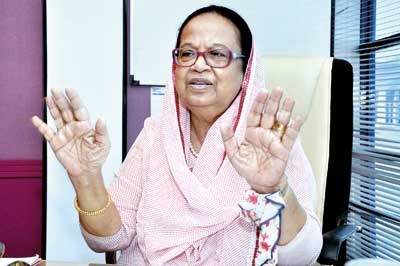 I think that technology can be used beautifully for many things; it is irreplaceable. The only thing is the human hand, the human mind and the human heart also should get a chance to develop.