Reply To:
Name - Reply Comment
 Colombo Art Biennale 2014 started on Thursday Jan. 30. But I was able to attend only from Tuesday Feb. 04. So here we go, in diary form, trying to comprehend a packed, sometimes dazzling, occasionally boring, mostly very interesting week of activity which tried to bring almost every major art form into focus.
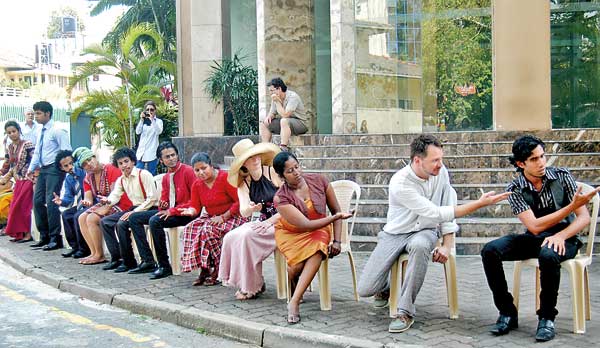
Feb 04 -- It's noon. People are thinking of lunch, not art. But Italian Adrian Schvarzstein (he's a theatre personality but prefers to describe himself as an artist) and his fourteen volunteers have other ideas. Inside a warehouse converted into gallery at Park Street Mews, he has arranged 14 plastic chairs in a circle, with 14 brooms leaning on them. Now he asks these seven men and seven women (Sri Lankans including foreigners, young to middle-aged) to sit and carry out a 'live art performance.
Before commencing, he remarks that, during a week spent in Sri Lanka, he noticed that we were very fond of sweeping. He calls it a national sport. What he actually means is that we are a nation of people breaking our backs in servility. Sweeping, in our cultural context, is not a dignified activity. Therefore, his 'live art performance' becomes a summing up of what people must go through in life A. as Sri Lankans B. people in general.
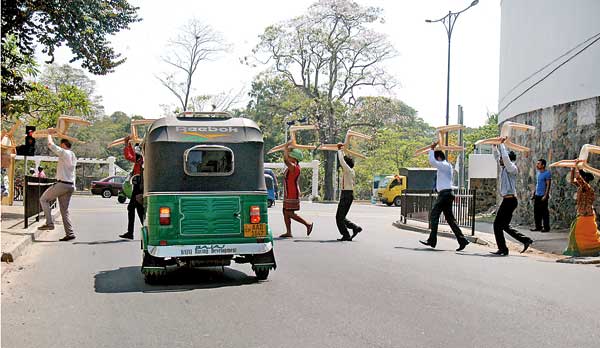
In the second part of the performance, he tells us that his performers are cabaret singers who have lost their jobs. All they have now are their bodies and the plastic chair each is sitting on. Therefore, they move through life carrying those chairs on their backs. They risk their lives in the street, obstructing traffic (this being Independence Day, traffic was slight. One could have imagined the chaos on Park Street on a week day at lunch time as they stand in a line across the street, making faces, gestures and singing "Happy birthday to you').
There was even more tension when his group did this in front of the Park Street Buddhist shrine. They stood near its parapet wall with their brooms, making faces, twisting their hips and making odd gestures with their hands. It was quite tense. A thuggish looking three-wheeler driver looked on with increasing displeasure. A group of women worshippers within the shrine looked puzzled. I began wondering when someone would start to object.
Fortunately, no one did. As the group moved away, some of the women worshippers began smiling. I asked the artist if he was testing the limits of religious tolerance. He said no. But he was clearly testing the limits of cultural tolerance, of which traffic and religion are but two different manifestations. As one performer happened to be a Western woman in a short frock, the situation could have become ugly. I like this performance because it tests the limits of our tolerance (for once, it passed) and presents a secular view of art which we are increasingly unable to grasp. It tells us that we should use art to challenge convention. Art has to be irreverent, or it risks being official and banal, which is what much Sri Lankan art is.
The same evening, I visited the J. D. A. Perera gallery at the University of Aesthetic Studies. On the first floor, there was a medium-sized aluminium kitchen pot hung from the ceiling, a section cut away from its top and a visor attached to the top of this open section. A piece of black rexin leather hung down from the rear.
On the floor immediately below was a circle of sand, with bare cement stone sitting on its centre. It's a depressing construction at first sight; the battered, dull black aluminium pot, the matt black rexin, the grey cement stone and the dull ochre of sand. And then it hits you; hanging from the ceiling is a riot policeman's helmet, and below it are a grave and a tombstone. Seen at night, it's ominous, making one wary of getting too close, just as one wouldn't want to approach a tense riot policeman (seen in daylight, the construction loses some of that ominous potency).
The entire construction is full of agonizing possibilities, like a silent scream from the nightmarish painting by Edvard Munch.
A section of the floor is hidden from view by curtains. You hear a voice recording. Inside, there is a slide presentation of Sri Lankan women talking about diverse topics - race, religion, gender discrimination etc. They represent all ages, religions and ethnicities. But there is an audience. The mostly young crowd is watching a performance by a young Briton in the neighbouring gallery. You hear a lot of laughter. There seems to be another stark message in that; given a choice, people would much rather go for something more 'entertaining' than women talking about their problems. The empty video chamber becomes a symbol of the loneliness of women who can carry out reality checks about themselves and their society.
Colombo Art Biennale is important because it brings us into contact with new ideas, and shows us a new way of looking at art. For Sri Lankans, an art exhibition means looking at pictures hanging from walls. This is true from pre-school to the art galleries. Here, we are confronted with different spatial and temporal relationships.
Wednesday Feb 05 - one p.m. 'Every Good Painting' cracks.' Not the kind of headline to draw crowds, so it was a gathering of those concerned with art conservation at the Goethe Institut, with conservator Renate Kant speaking on that somewhat esoteric subject. With wide ranging experience on restoration of paintings in Europe and Asia, she dwelt in detail about the technology, chemistry and the compassionate labour of bringing back to life a work of art mauled by centuries of dust, humidity, neglect and even bullets. The lecture was followed by a documentary which showed her and her team of young restorers restoring a huge painting of the last supper which belongs to a church in Kolkotta.
Equally fascinating was the slide presentation which depicted, among other things, an even bigger Hindu religious painting on cotton cloth by Kobot, commissioned by the last prince of Bali in 1952, and later cut into two pieces by his wife. The restorers put the painting back together as it was. This was an awesome reminder that, while painters (and owners of famous paintings) get all the glory, much of the world's fine art heritage would be unpresentable, perhaps lost forever, without the monumental patience and loving labour of the expert restorer.
Wed Feb. 05, six thirty pm: 'The Other Kwai' by Kit Mead is shown at the Goethe Institut. This documentary is about David Lean's film. But it's something more; it's about what life is like now to people who remember the 'other' Kwai Bridge at Kitulgala, the film took two years in the making. It is as much about Samuel Perera, a poverty-stricken Kithulgala village mason who, as a ten-year-old boy, 'starred' in the film. He and his wife are the only living link in the area now with the film and its making. But Mead's work, while getting off to an excellent, almost surreal start with shots of a crow hopping about inside an empty railway carriage, is punctuated with shots of passing scenery etc. which are simply too long, so that the punctuation marks threaten to become narrative. But 'The Other Kwai' is well worth watching because of its main 'star', Samuel Perera, plus the valuable archival footage of the bridge's construction and the film's behind-the-camera scenes.
To be continued