Reply To:
Name - Reply Comment
(1)(1).jpg)
A Canadian parliamentarian of Sri Lankan origin is the latest visitor to the country to undertake a tour of the previously war- torn Northern Province, attempting to evaluate rehabilitation and reconciliation efforts in the region.
The visit of Rathika Sitsabaiesan follows the high profile ‘fly in, fly out’ visit of British Prime Minister David Cameron to the North during the Commonwealth Heads of Government Meeting (CHOGM) last November which had acrimonious undertones.
On that visit, after visiting a newspaper office that had been attacked and speaking to a few persons whose relatives have been reported missing, Cameron claimed that he found sufficient grounds to call for an ‘independent inquiry’ into events leading to the conclusion of the Eelam war in May 2009.
Prior to Cameron’s visit, United Nations Human Rights Commissioner Navaneethan Pillay undertook a similar visit. Her visit was more comprehensive but she too was critical of Sri Lanka’s post-war efforts and the impartiality of her observations was questioned.
Sitsabaiesan does not carry the clout of either Cameron or Pillay. However, her views of the prevailing circumstances in Sri Lanka will be keenly watched as the country gears itself to face another session of the United Nations Human Rights Council (UNHRC) in March.
Her views will have added significance because it was Canadian Prime Minister Stephen Harper who led the unsuccessful call to boycott the CHOGM in Colombo. Harper was thought to be catering to his domestic political audience which has a significant ethnic Tamil component.
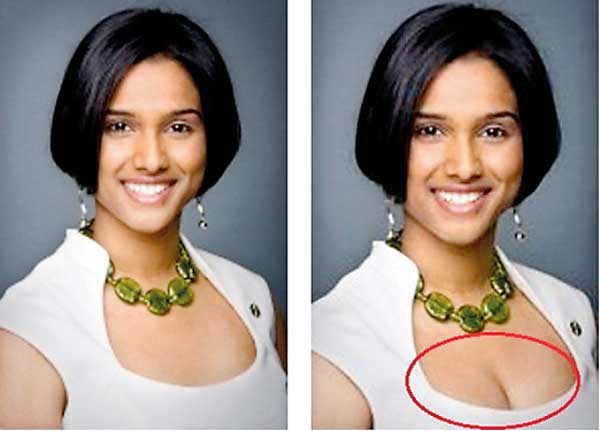
.jpg) She made international headlines when her photograph on the official Canadian Parliament website was found to be photo-shopped to hide her cleavage and make her features appear more striking
She made international headlines when her photograph on the official Canadian Parliament website was found to be photo-shopped to hide her cleavage and make her features appear more striking
Rathika Sitsabaiesan, now thirty two years of age, is a member of the House of Commons of Canada for the New Democratic Party, representing the constituency of Scarborough—Rouge River in Greater Toronto. She is the first person of Tamil-origin to be elected to the federal parliament in Canada.
She was born in Jaffna but her family migrated to Canada in 1986, when she was five when there was an exodus of Sri Lankan Tamils to western countries in the aftermath of the July 1983 race riots and the escalation of the war with the Liberation Tigers of Tamil Eelam (LTTE).
Sitsabaiesan was raised in Mississauga, west of Toronto and had a modest upbringing with her parents having to raise a family of four girls-where Sitsabaiesan was the youngest-with her father unable to work because of an accidental injury. She attended the University of Toronto for the first two years of her undergraduate studies, where she was the Vice-President of the Tamil Students’ Association. She then transferred to Carleton University, where she completed her Bachelor of Commerce degree.
She proceeded to obtain a Master’s Degree in Industrial Relations from Queen’s University, where she worked with the Service Employees’ International Union as a researcher and helped the organisation to successfully launch the “Justice 4 Janitors” Campaign.
Sitsabaiesan’s interest in politics began with her involvement with the New Democratic Party (NDP) in 2004 when she worked as a party volunteer for the federal election campaign. She later served in various roles in the NDP including as a canvasser and campaign manager during the 2008 election.
She was also an advisor on Tamil issues to NDP leader Jack Layton. Layton made his final campaigning stop at Sitsabaiesan’s electorate of Scarborough—Rouge River a day before the 2011 federal election, helping her win the seat. Scarborough—Rouge River was considered a safe Liberal seat since its creation 1988 but Sitsabaiesan was returned in 2011, securing over 40 per cent of the vote, becoming the first Tamil Canadian to be elected to the Canadian Parliament. She is only the second Tamil woman to be elected to any federal parliament outside India or Sri Lanka. She has since been appointed to the official shadow cabinet overseeing the subject of post-secondary education.
Interestingly, Sitsabeisan’s previous claim to fame was on an entirely different issue: she made international headlines when her photograph on the official Canadian Parliament website was found to be photo-shopped to hide her cleavage and make her features appear more striking. It was not known whether the alteration was requested by Sitsabaeisan herself, her party, her office, or by the Parliament.
However it caused considerable controversy with critics arguing that the alteration was anti-feminist, and that that the cleavage was removed to make Sitsabaiesan appear less womanly.
Although not overtly endorsing the LTTE or its actions, her views on Sri Lanka have been articulated on several occasions and appear to reflect the views of the Tamil Diaspora which has a heavy presence in the Greater Toronto area.
Sitsabaiesan has said that she will take the initiative to form a Canadian All Party Parliamentary Committee (APPC) to look into alleged war crimes in Sri Lanka during the last stages of the Eealm war in 2009.
She has also said she would urge such an APPC to ‘research and come up with recommendations’ for the Canadian government, based on the report by the Experts Panel appointed by United Nations Secretary General Ban Ki Moon which studied the Sri Lankan conflict.
‘For me the focus is people being treated with fairness, equality, dignity and justice... it is important for the culprits to be identified as a move towards genuine reconciliation’, she has said, suggesting that she is likely to be one more voice against Sri Lanka in the coming months.
At the time of writing, Sitsabeisan has visited camps for displaced persons in the North and held discussions with several organisations. She is also due to meet with prominent personalities of the Tamil National Alliance (TNA).
The Tamil Diaspora and the Eelamist lobby will expect that Sitsabeisan’s visit would benefit its agenda. However, the Sri Lankan government has allowed Sitsabeisan free access to the North in attempt to convince the visiting parliamentarian that ‘it has nothing to hide’.
With the UNHRC meeting in Geneva to be held in a dozen weeks to assess Sri Lanka’s compliance with resolutions passed by the Council in the last two years, (1)(1)(1).jpg) Rathika Sitsabeisan may well earn more than her fair share of publicity with her visit to Sri Lanka
Rathika Sitsabeisan may well earn more than her fair share of publicity with her visit to Sri Lanka