Reply To:
Name - Reply Comment
(1)(1)(1)(1)(3).jpg)
A presidential election may not be on the political calendar of the country just yet as the government is preoccupied with the elections in the Western and Southern provinces as well as the upcoming sessions of the United Nations Human Rights Council (UNHRC) in Geneva.
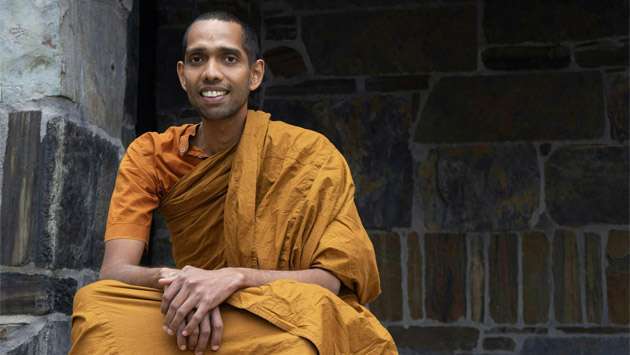
Last week however, prominent Buddhist monk Maduluwave Sobhitha Thera raised many eyebrows by stating that he was willing to become a candidate at the next presidential election on a platform of abolishing the Executive Presidency and reverting to a Parliamentary system of governance.
“Yes, I am ready to stand as a ‘single issue’ presidential candidate, but if a former Chief Justice or a former President is interested, I am happy to step aside” Rev. Sobhitha Thera reportedly told the Sunday Thinakkural, a Tamil language newspaper.
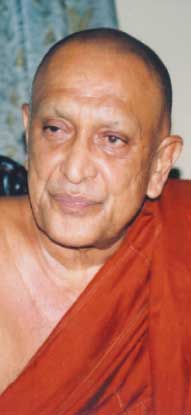 “I will serve for six months only within which time I will abolish the Executive Presidency and institute a parliamentary system through constitutional methods. The roots of bribery, corruption, nepotism and bad governance lie in the Executive Presidency,” the leading monk has been quoted as saying.
In the interview, the monk also made another startling statement. In comments that could run contrary to popular sentiment, he declared that Sri Lanka should not be concerned about investigations into alleged war crimes committed during the final phase of the Eelam war.
“If there is a call for an international investigation, I have no problem in agreeing. If we have done nothing wrong we can go before an international investigation and vindicate ourselves,” Rev. Sobhitha Thera is reported as saying.
For months, Sobhitha Thera’s name had been bandied about as a potential candidate, but the learned monk had refrained from making any commitment. Last week’s announcement was therefore significant and would have both the government and the opposition rethinking their options.
The Chief Incumbent of the historic Naga Viharaya in Kotte, Rev. Sobhitha Thera is popular first and foremost as a Buddhist preacher. He is much sought after for dhamma sermons where he is known to mix religious teaching and practical advice in day-to-day life with a unique style of preaching.
Rev. Sobhitha Thera has in recent years become increasingly critical of the presidential system of governance and sees this as the cause of most conflicts in the country. This is a view he has held consistently for many years, long before President Mahinda Rajapakasa assumed office.
He has also been a leading personality involved in political events over the past few years, opting to play a proactive and very public role in shaping such events. In so doing, he has also emerged as a vocal critic of the government, though not of any particular personality.
This is in his capacity as head of the National Movement for Social Justice (NMSJ), an organisation campaigning for issues of public interest. The NMSJ has taken up many controversial matters in the past few years, often in direct conflict with the government’s policies.
For instance, Rev. Sobhitha Thera was among those Buddhist monks who voiced unqualified support for former Army Commander Sarath Fonseka when he was sent to jail. He offered to go to jail instead of the retired General, claiming that the punishment meted out to the war hero was too harsh.
Rev. Sobhitha Thera was also known to be involved in attempting to reconcile the two warring factions of the opposition United National Party (UNP). Those efforts have had only partial success, with the appointment of a Leadership Council for the UNP where bitter infighting still continues.
More recently Rev. Sobhitha Thera raised eyebrows when he held discussions with United States Ambassador in Colombo Michele J. Sison at the Naga Viharaya. Relations between Colombo and Washington are at a low ebb and this meeting led to wild speculation in the media.
The latest controversy that Rev. Sobhitha Thera chose to dabble in was to voice support against the creation of casinos, a task in which he was supported by the Jathika Hela Urumaya (JHU), a coalition partner of the ruling United People's Freedom Alliance (UPFA).With such a record of involvement in a series of high-profile issues, the possibility of Rev. Sobhitha Thera contesting presidential elections as an opposition candidate sets an interesting poser both to the government and the opposition.
For the opposition, it is correct to say that there is no credible candidate in sight; all potential aspirants–Sarath Fonseka, Chandrika Kumaratunga, Karu Jayasuriya and Sajith Premadasa- have significant handicaps that weaken their prospects of victory in a poll.
Mr. Fonseka does not have his civic rights and will have to contest by proxy. Ms Kumaratunga, though enjoying her party’s support, is burdened by the omissions and commissions of her eleven years in power. Mr. Jayasuriya and Mr. Premadasa are both unlikely to command total support from their own party.
It is in these circumstances that Rev. Sobhitha Thera's candidacy becomes an attractive proposition. He is not allied to any particular political party and commands sufficient respect in the community as a religious leader of integrity who has stood for the principles he believes in.
Rev. Sobhitha Thera could also be reasonably confident of being able to muster votes from the country’s Sinhala Buddhist majority as well as the rural vote, segments of the population from which the UPFA and President Mahinda Rajapaksa in particular derive significant support.From the government 's perspective too, the candidature of Rev. Sobhitha Thera creates an interesting scenario. Presidential elections are often personality contests and the opposition candidate could expect a barrage of criticism from the state media. Sarath Fonseka had to counter the full brunt of this in 2010.
Such a media assault would become difficult if Sobhitha Thera were to become the opposition candidate on account of his standing as a Buddhist monk, for that would amount to insulting the Buddhist clergy. Prime Minister D.M. Jayaratne is already in hot water for attempting a similar tactic.
There is still a long way to go for Maduluwave Sobhitha Thera to become an opposition presidential candidate. The divisive and treacherous nature of opposition (1)(1)(1)(1)(1)(3).jpg) politics means that this is still only a remote prospect. Yet, the possibility adds colour and hope to the country’s political discourse.
politics means that this is still only a remote prospect. Yet, the possibility adds colour and hope to the country’s political discourse.