AI SUMMARY GENERATED ONLY FROM THIS ARTICLE'S TEXT.
Important policy dynamics are missed in disaster assessment
Chief among them is a lack of understanding of why some households suffer more losses than others not just in terms of lives and property but also livelihoods, education, health outcomes and long-term wellbeing
Consider the recent floods. What exactly was its cost to livelihoods and how much of that loss was due to flood-depth as opposed to poor housing quality, physical ability or financial fragility?
As Sri Lanka continues to grapple with the growing frequency and severity of natural hazards—from landslides in the central highlands to floods in the south and droughts in the north—a hard truth persists. Despite policy dialogue and institutional effort, our disaster management systems fall short in protecting the most vulnerable.
The issue is not a lack of intent. National frameworks have evolved, and coordination mechanisms have improved. But critical gaps persist. Chief among them is a lack of understanding of why some households suffer more losses than others not just in terms of lives and property but also livelihoods, education, health outcomes and long-term wellbeing. Are these disparities simply a function of varying hazard intensity? Or do they reflect deeper structural, social, household and individual asymmetries that predate the disaster itself?
A case for disaggregated risk analysis
Consider the recent floods. What exactly was its cost to livelihoods and how much of that loss was due to flood-depth as opposed to poor housing quality, physical ability or financial fragility? This understanding is critical to designing disaster relief and recovery efforts that allow for cost-effective smarter targeting and faster recovery. Most importantly, it is crucial to design efforts that can be implemented before the next flood happens, through addressing the underlying causes that exacerbate the impacts. Without individual and household-level data— collected both before and after an event—such insights remain elusive. Only with this granularity can we construct meaningful counterfactuals and establish causal relationships that guide future preparedness.
Most disaster assessments in Sri Lanka, as in many economies, rely heavily on aggregate indicators: fatalities, physical damage, and GDP-level losses. These are vital metrics. But in overlooking how individuals and households experience, survive, and recover from disasters, important policy relevant dynamics are missed. Research I conducted on the 2006 Yogyakarta earthquake in Indonesia illustrates this point. Using pre- and post-disaster household panel data, we observed long-lasting health effects two years after the event: reduced physical functioning, increased chronic illness, and rising medication dependency. These health impacts, in turn, limited the capacity to work and eroded future income and life expectancy. This suggests that disaster relief should look beyond the emergency phase.
In the case of the 2004 tsunami, the group that faced the highest disruptions to schooling in Aceh were adolescent males, who had to join the labour market to support themselves and families. These outcomes were not simply consequences of the disaster; they were shaped by pre-existing social norms and economic patterns—patterns only quantifiable through disaggregated, rich, individual and household-level panel data.
Understanding such patterns and quantifying their monetary and non-monetary impacts, support targeted assistance as well as preventative investments, not just reactive spending. For example, household-level analysis helped to unravel the optimal timing of cash transfers to mitigate effects of floods in Bangladesh, and the best way to help households manage risk, given pre-existing vulnerabilities.
The lesson is clear: Post-disaster needs assessment and emergency response is not enough. Effective mitigation begins not after the shock, but before it—with better understanding of household vulnerabilities, coping mechanisms and responses.
Data doesn’t have to be expensive
Collecting household-level disaster data need not be costly or logistically prohibitive. Sri Lanka already conducts multiple national surveys such as the Labour Force Survey and the Household Income and Expenditure Survey. Integrating a simple module on hazard exposure and household-level risk would unlock a rich vein of insight. Sharing geo-location codes—at a suitably anonymised scale—can further connect social data with environmental and remote sensing data, enabling smarter spatial policy interventions.
The National Disaster Management Plan needs recalibration
Household-based analysis should be incorporated into Sri Lanka’s National Disaster Management Plan (NDMP) 2023–2030. Although the NDMP makes the right noises on inclusion, stakeholder engagement and climate resilience, its operational orientation remains too coarse.
Its approach to hazard and vulnerability assessments focuses on mapping physical assets and population aggregates—not the lived realities of households.
Its ambition to build shock-responsive social safety nets lacks the mechanisms to assess and respond to household-specific needs.
Strategic goals to expand safety nets are not matched by detail on how targeting will be improved or eligibility determined.
The emphasis on community-based risk management, while laudable, risks obscuring intra-community disparities—particularly those faced by female-headed or disabled households. It also ignores intra-household disparities that can be systematic, disfavouring some groups over others.
Most critically, the plan still treats emergency relief as the primary policy lever, rather than investing in upstream risk reduction grounded in household-level data.
What’s at stake
This is not just a call for better equity—it is a case for economic and fiscal prudence. As climate risk converges with social vulnerability, governments can no longer afford inefficient spending cycles or reactive relief models.
If Sri Lanka wants to build a disaster management system that is not only responsive but anticipatory, not only inclusive but effective, the next step is clear: integrate the household into the heart of its disaster planning framework.
Rozana Himaz is an Associate Professor in Economics at University College London (UCL), UK, and a Global Academic Fellow at Verité Research. Research Assistance was provided by Sajini Wickramasinghe, Research Analyst at Verité Research
Comments - 1
Comments - Why Households Must Be at the Heart of Disaster Risk Mitigation
Pramiska Friday, 22 August 2025 12:50 AM
Issa big kwekshun?
02
222
Add comment
Comments will be edited (grammar, spelling and slang) and authorized at the discretion of Daily Mirror online. The website also has the right not to publish selected comments.



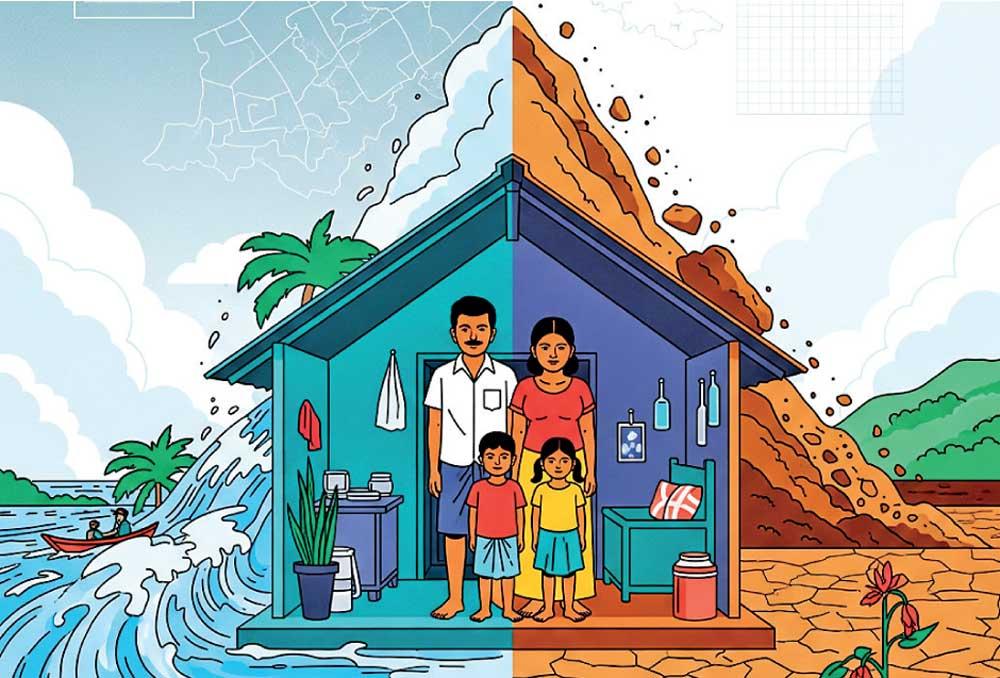
 As Sri Lanka continues to grapple with the growing frequency and severity of natural hazards—from landslides in the central highlands to floods in the south and droughts in the north—a hard truth persists. Despite policy dialogue and institutional effort, our disaster management systems fall short in protecting the most vulnerable.