Reply To:
Name - Reply Comment
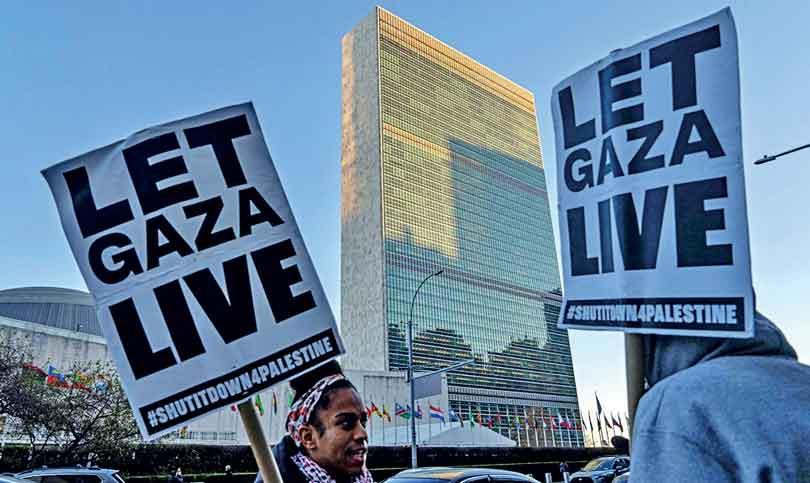
Pro-Palestinian demonstrators gather outside United Nations headquarters in New York before UN Security Council members meet to vote on a draft resolution on Gaza on Monday. AFP
On the elusive path towards peace in Palestine, any development that seems to trigger hope is hailed as significant, even if it is an outright subterfuge disguised as a peace proposal to prolong the Palestinian plight under Israeli occupation.
One such hope-stirring ‘subterfuge’ was Monday’s United Nations Security Council resolution. Presented by the United States, it was adopted with 13 members voting in favour, while China and Russia—both veto powers—abstained. Russia proposed an alternative draft emphasising Palestinian statehood. That draft rejected the so-called Board of Peace—the centrepiece of the US motion—and called for a greater UN role in the Gaza peace process. Yet the credulous Arab and Muslim nations dismissed it and backed the US resolution after Washington yielded to their pressure and agreed to insert at least a vague reference to a credible path toward Palestinian self-determination and statehood—whatever that means.
China said that it abstained because the US resolution was ambiguous regarding Palestinian governance of Gaza and the two-state solution.
Following the adoption of the resolution, the United States’ European, Arab, and Muslim allies hailed it as a major step towards permanent peace for peace-parched Palestine. Yet, in their elation, Arab and Muslim leaders seemed to forget the truism that successive UN resolutions passed since the UN General Assembly’s partition resolution of November 29, 1947, have failed to deliver justice to the Palestinian people. Rather, they have turned out to be toothless documents that only prolonged Israel’s illegal occupation of Palestine, leaving the despondent Palestinians in the lurch until another hope-filled subterfuge is offered as a supposed path to peace and statehood.
Monday’s resolution is no different. Missing from the text was any reference to the two-state solution, endorsed only two months ago by about 160 countries—including France and Britain—at a landmark UN conference.
Colonial undercurrents were writ large in the resolution, as was the case with US President Donald Trump’s 20-point peace plan that, six weeks ago, brought a fragile ceasefire into the genocide-torn Gaza Strip—a ceasefire Israel has since violated by killing more than 300 Palestinians. In its latest air attack on Gaza on Wednesday, Israel killed some 28 people, including children. It justified the assault by citing a fake Hamas skirmish. Ceasefire or not, the nature of the Zionist state is killing. In neighbouring Lebanon, the ceasefire exists only on paper, as Israel regularly launches attacks on what it calls Hezbollah positions, often resulting in civilian deaths, including children.
Yes, the US resolution is a colonial surrender document. Paradoxically, it was adopted with the support of the international community at the UN—the very organisation that, in 1960, adopted a resolution described as the Magna Carta of decolonisation, denouncing colonialism in all its forms. There was no Palestinian input in the making of the resolution; they were not consulted, and their views were dismissed.
The resolution and the Trump plan assume and assert that the Palestinians are incapable of governing themselves. This assertion echoes a mantra the so-called liberal West used to justify the colonisation of weaker but resource-rich nations in Asia, Africa, and America: ‘They are incapable of governing themselves; therefore, they should be governed.’ Even Western liberal thinkers such as John Stuart Mill sometimes argued that ‘barbarous’ societies required governance by ‘civilised’ nations until they were deemed ‘ready’ for self-government.
With the Palestinians, who are often scorned by Zionist leaders as barbarians, Amalekites, and animals, being condemned as ‘incapable of governing themselves’, the resolution seeks to set up a Palestinian administration comprising technocrats—a body answerable not to the Palestinian people, as democratic principles demand, but to the so-called board of peace headed by Trump, Imperial America’s business-minded president for whom global justice and peace matter only when they are transactional.
This was how colonial Britain ruled its colonies, giving the colonised a limited say, while ultimate authority lay with the British.
The resolution, in effect, outsources occupation, on behalf of Israel, to the Trump-led Board of Peace. It authorises Israel and Egypt to determine the composition of the so-called international stabilisation force, tasked with supervising the disarming of Hamas, training a new Palestinian police force, and ensuring the demilitarisation of the territory.
Effectively, the resolution was a subterfuge to strip Palestinians of their right to resist Israel’s unlawful occupation of their territory. Hamas has refused to accept the resolution and is likely to resist any move to disarm the organisation. In interviews with regional television channels, many Palestinians have said they see the implementation of the resolution as problematic.
Experts say Resolution 2803, adopted on Monday, will be remembered—just like the 1947 UN resolution that partitioned Palestine—for its failure to do justice to the Palestinian people.
“The Board of Peace and the International Stabilisation Force will consequently lack legitimacy in the eyes of many Palestinians and will be perceived as instruments of coercion and occupation. They are likely to be met with Palestinian resistance, including violent resistance. This is not a viable path to peace, security, and stability,” Laurie Nathan, professor of the practice of mediation at the University of Notre Dame, told PassBlue, a New York-based women-led publication that covers foreign affairs.
Expressing serious concerns about the resolution, Francesca Albanese, Special Rapporteur on the situation of human rights in the Palestinian territories, said, “Rather than charting a pathway toward ending the occupation and ensuring Palestinian protection, the resolution risks entrenching external control over Gaza’s governance, borders, security, and reconstruction. The resolution betrays the people it claims to protect.”
Israel’s hawkish Prime Minister Benjamin Netanyahu has declared that whatever resolution the international community may adopt, a Palestinian state will never become a reality. He remains determined to annex Gaza and the West Bank, not only through ethnic cleansing or genocide but also via one-way human smuggling—as seen in the incident of sending some 150 Palestinians to South Africa via Kenya on a chartered flight.
The Palestinian issue also came up during Saudi Crown Prince Muhammad Bin Salman’s state visit this week to Washington, where Trump gave him a lavish welcome. Some analysts believe that a Saudi-Israel Abrahamic Accord—or a normalisation deal, which the Saudis insist must be contingent on the establishment of an independent Palestinian state—may be signed on a solid US assurance that such a state will be created. But can the US be trusted? After all, it has supplied Israel with whatever weapons it demanded to carry out the genocide in Palestine.
The Saudi crown prince secured numerous concessions from the US by dangling US$1 trillion in investment—up from the US$600 billion pledged during Trump’s visit to Riyadh in May. Amid Trump’s bonhomie, largely linked to US efforts to thwart Saudi Arabia’s tilt towards China, the most prized concession was Trump’s willingness to sell the highly advanced F-35 fighter jet to the Saudis, disregarding Israel’s objections.
Whether Saudi Arabia’s high-octane diplomacy has also brought about a shift in US policy in favour of a Palestinian state, despite Israel’s objections, only time will tell.