Reply To:
Name - Reply Comment
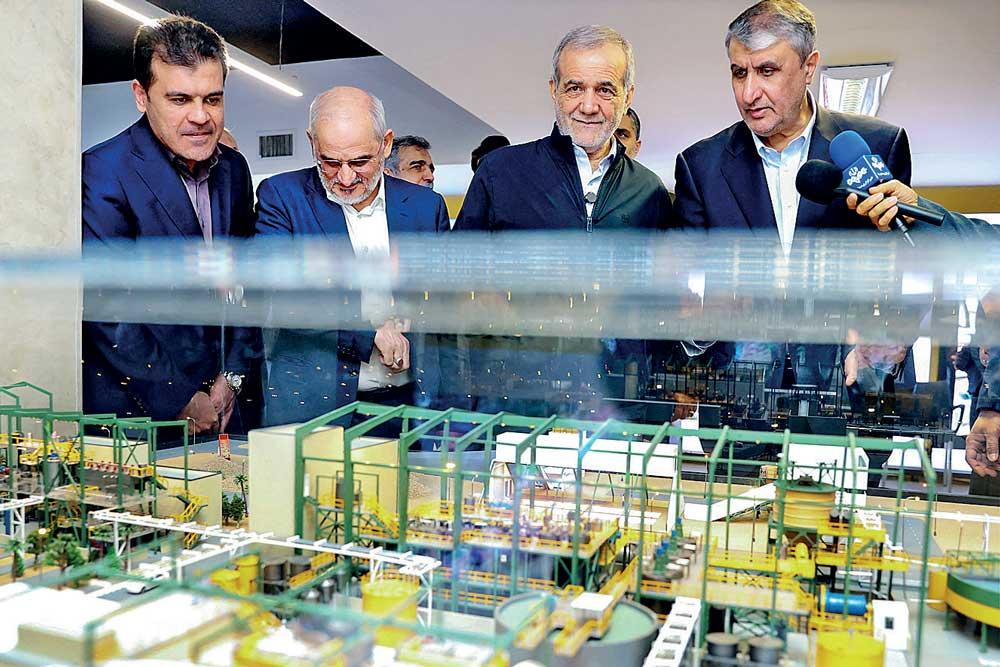
Iranian President Masoud Pezeshkian (2nd R) inspecting an energy plant as the country marked the
“National Day of Nuclear Technology” in Tehran on April 9.
 While the world’s attention is on the tariff war unleashed by United States President Donald Trump, causing major turbulence in the global economy, an equally dangerous situation is looming in the Middle East over Iran’s nuclear programme, with Israel all out to drag the United States into a war against Iran. But Trump is playing his cards close to his chest in a game of war and peace.
To placate Israel, Trump, an avowed Zionist, has threatened to bomb Iran, but will he really walk the talk? The answer is yes and no. A confirmed maverick, he handles war and peace on his own terms.
Two Mondays ago, Israeli Prime Minister and International Criminal Court war crime suspect Benjamin Netanyahu, alias the butcher of Gaza, was in the White House to convince Trump that the only way to make Iran abandon its nuclear programme is to bomb all its nuclear facilities or force it to dismantle all its nuclear facilities under US supervision. He calls for total surrender, which Iran will not accept even if it means it has to face the US bombs.
But Trump did not swallow Netanyahu’s bait. The hardline Israeli premier tried to convince Trump that diplomacy would be futile in dealing with Iran, and therefore the US must go for a military solution.
But Trump surprised and disappointed Netanyahu when he told reporters while seated next to Netanyahu at the Oval Office that the US would hold direct talks with Iran. The announcement came weeks after he sent a letter to Iran’s Supreme Leader Ayatollah Ali Khamenei advising him to dismantle the country’s nuclear programme. But Iran held on to its nuclear sovereignty, insisting it has the right to pursue a peaceful nuclear programme.
Trump had been reading the riot act on Iran since then. His message to Iran went like this: Hold direct talks with the US government on the process to dismantle your nuclear programme. If you fail to do so, we will bomb you. He also warned Iran over the resumption of attacks on ships, including US warships, in the Red Sea by Houthis, Yemen’s de facto rulers. He said Iran would face devastating consequences if the Houthis continued their attacks on US warships and other vessels in the Red Sea. But the Houthis continue their attack, despite regular US air attacks on Yemen.
During the joint media briefing with Netanyahu, who heads a nation with some 400 nuclear warheads, Trump again warned Tehran, saying, “Iran is going to be in great danger ” if it does not comply. The warning came with a rider—a one-sided surprise announcement that the United States and Iran were poised to begin direct talks on Tehran’s nuclear programme in Oman. It was egg on the face for Netanyahu. He was forced to grin and bear the announcement.
The high-level talks between Iran’s foreign minister Abbas Araghchi and Trump’s Middle East envoy Steve Witkoff went on well according to Iran’s agenda in Oman last week. The US wanted direct talks, but Iran insisted on indirect talks and had its way. More talks are scheduled for tomorrow in Rome, with Oman once again playing the mediator’s role.
But, ahead of tomorrow’s talks, the US has upped the ante by bringing into talks not only the nuclear programme but also Iran’s powerful nuclear-weapon-capable missile stockpiles. How the two sides will overcome the issues is a guessing game, but given Iran’s mastery in negotiations and Trump’s apprehension about initiating a war, the talks are likely to continue.
Trump is not naïve to start a war at Israel’s behest and without assessing the consequences. There is little altruism in his foreign policy. If war brings money, he will declare war. He and his hawkish Republicans know well that a war with Iran could send oil prices soaring and bring about an economic and political disaster for the United States.
It was President Barack Obama who successfully negotiated talks with Iran on its nuclear programme in 2015. Formally known as the Joint Comprehensive Plan of Action (JCPOA), the agreement, which restricted Iran’s uranium enrichment levels and brought Iran’s nuclear facilities under International Atomic Energy Agency (IAEA) supervision, was signed by Iran and six big powers. They included China, France, Russia, the United Kingdom, and the United States—plus Germany. Trump during his first term revoked the deal.
Nuclear programme watchers say Iran has reached the capability to enrich uranium up to 60 per percent—well above the 3.6 percent level required for peaceful purposes. To make a bomb, uranium needs to be enriched up to 90 percent. IAEA experts believe it is only a matter of weeks for a nation that has the capability to achieve a 60 percent level to reach the 90 percent level. But Iran has said it has no intention to make a nuclear weapon, which it says is against the state policy. But given the existential threats it faces from Israel and the United States, military analysts believe Iran will have to go for nuclear deterrence to neutralise threats from the US and its allies, just as North Korea has done with its nuclear arsenal.
However, unlike the talks Iran held with previous US administrations over its nuclear programme, this time around the talks are being held against the backdrop of intimidating military manoeuvres by the US. The US has sent the most advanced B-2 bombers and mid-air fuel pumping aircraft to its Indian Ocean military base in Diego Garcia.
What are Iran’s other options? It certainly lacks capabilities to initiate a preemptive strike on Diego Garcia and destroy the B-2 bombers which are capable of carrying bunker busters that could penetrate and pulverise Iran’s underground nuclear facilities. But Iran certainly has striking-back capabilities, including what its spokesmen often refer to as secret weapons that will make the enemy regret starting the war.
A US attack on Iranian underground nuclear facilities will draw an Iranian response targeting US military bases in Bahrain, Iraq, Qatar, Kuwait and other countries in the region. Of course, Israel will be more than willing to join the war, while Iran, which has studied Israel’s anti-missile defence systems during its attacks last year, believes its response would be more destructive than in 2024 when Iran and Israel were involved in tit-for-tat attacks that many feared could trigger a major regional conflict, disrupt oil supplies, and trigger a global economic recession.
Trump, during his first term, revoked the JCPOA agreement and imposed crippling sanctions on Iran and almost triggered a war with Iran by assassinating its topmost Revolutionary Guard Commander, Qassem Soleimani. Iran retaliated but only after sending adequate warnings through backdoor channels to minimise the damage. However, the attack demonstrated Iran’s ability to strike US bases in the region.
Iran may be weakened by the ouster of the Assad regime in Syria and the battering the Lebanon-based and Iranian-backed Hezbollah militia suffered in its war with Israel last year, but it has not lost all its trump cards.