Reply To:
Name - Reply Comment
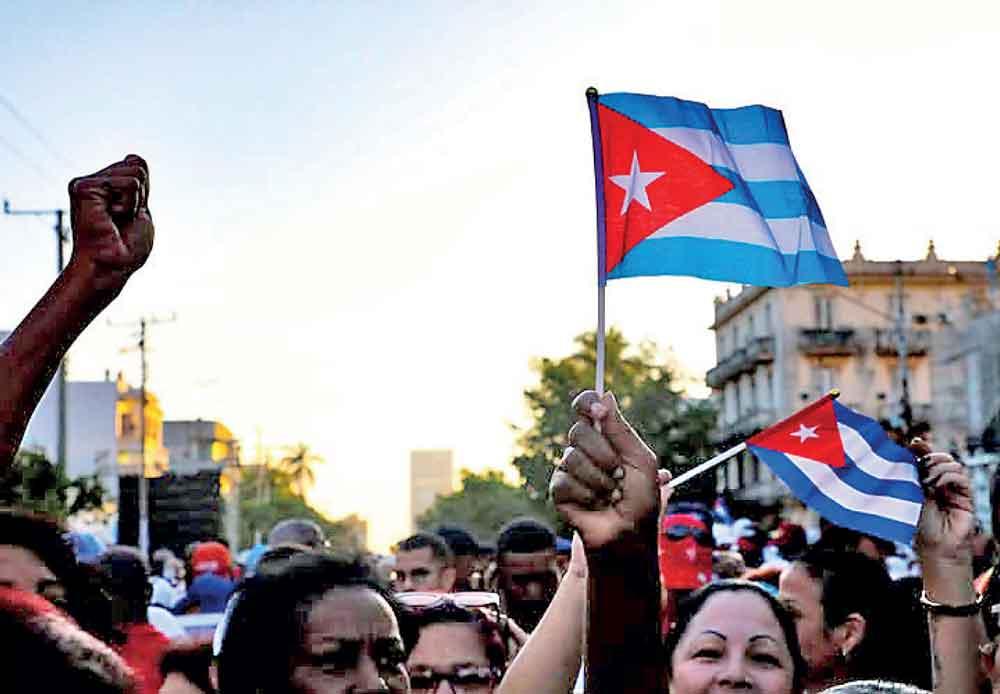
Cuban Americans in Miami participate in a demonstration to show support for protesters in Cuba (Cristóbal Herrera/EPA)
Some of Cuba’s economic woes are due to the ruling party’s mistakes, but American intransigence and sanctions have played a very destructive part. There are no grounds at all in the post-Soviet era to view Cuba as a ‘communist threat.’ Russia and Cuba are no longer political buddies, and have undertaken no military adventures since Angola. The Cubans have never attempted any covert military operations or assassinations in the US, while the US has undertaken many in Cuba, including the failed Bay of Pigs invasion and attempts to kill Fidel Castro
 Last week, we looked at the international political game of regime change, and how it has evolved over the centuries to its present shape, with the world’s only remaining superpower, the United States, assuming the dubious status of the world’s top ‘regime changer’ under President Donald Trump.
While currently attempting a dangerous regime change operation in Iran through open warfare, he has other countries on his list, including Nicaragua and Cuba. If Trump is successful with Iran, Cuba could easily be the next on his list. He could attempt it even if he fails with Iran. In the current American view, Cuba is a much softer target.
It is also a country deeply in crisis. It’s economic troubles are obvious, marked by 18-hour daily power cuts, severe food/fuel shortages, decreased tourism, over 10 percent lower GDP than in 2018 and high inflation (over 30 percent) which has triggered mass emigration.
Since Donald Trump was re-elected as President of the US, this crisis has deepened. Oil imports from Venezuela ceased altogether, though shipments resumed again in March 2026. Immigration to the US, too, has been severely curtailed, with the US terminating key parole programmes such as the Cuban Family Reunification Parole programme, ending major legal avenues.
Cuba is classified as upper middle income country, with GDP per capita estimated at $7,381 in 2024. But with the economy shrinking at minus 1.1 percent, these statistics are misleading when an outsider tries to form a clear picture of what daily life in Cuba is like.
Many Cubans face severe shortages, depending highly on government rations, informal ‘moonshine’ economies and remittances from abroad. Just what percentage of Cuba’s 11.5 million people remain loyal to the regime? It’s hard to guess from an outsider point of view. For several decades, Cuban loyalty to their government rested on their reverence of Fidel Castro. But does the new X gen generation have the same regard for Castro and his legacy? What do they think of Ernesto Guvara? Many of them have relations or friends in the US. What regard would they have for dogma when they can’t afford a mobile phone?
But Donald Trump is not contemplating regime change in Cuba to improve Cuban living standards. Communist Cuba has been seen as a dangerous enemy by American presidents long before Trump came along. But Barack Obama mended ties with Cuba in 2014 and the cash-strapped country seemed ready to turn a new chapter after the dismantling of the Soviet Union in 1991 left Cuba stranded.
The sugar for oil barter deal initiated in 1960 between the ex-USSR and Cuba was highly favourable to Cuba. This highly subsidised, long-term trade deal primarily exchanged Soviet oil for Cuban sugar, buying Cuban sugar at prices often 3 to 5 times higher than the world market rate while supplying oil and machinery at favourable rates, allowing Cuba to re-export excess oil for hard currency. But, post-1991, Russia was no longer able to afford this largesse, and Cuba was forced to look for other avenues, such as tourism, for foreign exchange.
Hence, Obama’s diplomatic breakthrough came as a lifesaver. In 2017, about 650,000 Americans visited the Caribbean island. In 2016, a total of 4 million tourists visited Cuba and in 2017 Cuba earned $3.5 billion from tourism. In the mid 1990s, tourism earned more foreign exchange for Cuba than sugar.
But those good old days are now gone, mainly due to increased American sanctions. Cuba had no big mechanical industries, but its medical research sector made great strides. Cuban doctors are known for their excellence all over the world, and Cuba exports pharmaceuticals. Raw sugar, rolled tobacco and nickel mattes are Cuba’s top exports while poultry products, wheat, refined petroleum, concentrated milk and corn are among major imports.
This list shows an imbalanced economy. Need to import food products happened because of poor policy planning and lack of investment in agriculture. The banking sector is not well developed and many Cubans can’t access credit facilities. Why did this happen in a country that looks progressive in many key areas?
Now Donald Trump wants to end communism in Cuba.
That’s up to the Cubans to decide, not Trump.
In the 1960s and 70s, a decade after Fidel Castro’s revolution succeeded in ending decades of American-backed dictatorial rule, Cuba looked like a fairy-tale Communist success story. Along with the romanticised narrative of Fidel Castro, Ernesto Guevara and other bearded, young revolutionaries, ordinary Cubans – workers in cities and peasants in the countryside – could send their children to school, get free medicare and other social benefits.
It was communist one party rule but not a one-man show, with the president acting in accordance with the politburo. There were rights abuses but, compared to the right-wing military dictatorships prevalent in Latin America, Castro’s rule looked benign. Fidel Castro finally stepped down in 2008.
But, wrapped up in the almost mythical aura of the Cuban revolution, and insulated from international economic pressure by Soviet generosity (Moscow saw Cuba as its pet project and most reliable ally abroad. Cuba agreed to have Soviet ICBMs on its soil in 1962, almost starting a nuclear war. Again, from 1975-91, Cubans fought a proxy war for the Soviets in Angola, helping its Marxist Government fight the South African-backed rebels of Jonas Savimbi), the Cuban leadership failed to notice how the world was changing since the 1970s, with left-wing governments almost everywhere swept away by a wave of neo-liberalism.
In China, Deng Xiaoping saw this and ushered in necessary economic reforms. In the ex-USSR, the far-sighed Mikhail Gorbachev saw it, too, but his reforms programme was sabotaged by hardliners in the politburo. In the end, Gorbachev had no choice but to dismantle the Soviet Union.
Cuban leaders disagreed with Gorbachev’s economic reforms. It is astonishing to learn that Cubans were not allowed to own mobile phones till 2008, when Raul Castro finally lifted restrictions of the Castro era. Ordinary Cubans can now own mobile phones, but high service costs make it a luxury item. This is just one indicator of Cuba’s relative backwardness in the modern world.
Cuba’s economy is not considered liberal. It is transitioning toward a mixed economy, allowing limited private enterprise. Items like rice, meat (especially beef), spices, and consistent electricity are considered luxuries, with basic food rations often insufficient. As of 2024-2025, private businesses (up to 100 employees) are permitted, and the private sector has grown to account for over half of retail sales. But it looks like too little too late.
American sanctions are the other side of the story. Cuba being an island, fishing should guarantee sufficient proteins. But fish too, is a luxury item for many Cubans. State enterprises export lobster and shrimp, but artisanal fishing caters to the local population and local fresh fish is scarce due to overfishing and lack of equipment. Here, one must consider the damage done by American sanctions. Virtually all items, including fishing gear and outboard motors, require a licence for export to Cuba, with a general policy of denial. US regulations prohibit vessels from entering Cuba for trade or to transport goods. Applications for temporary visits by fishing vehicles are typically denied. It’s hard to develop a fishing industry under such draconian conditions.
Some of Cuba’s economic woes are due to the ruling party’s mistakes, but American intransigence and sanctions have played a very destructive part. There are no grounds at all in the post-Soviet era to view Cuba as a ‘communist threat.’ Russia and Cuba are no longer political buddies, and have undertaken no military adventures since Angola. The Cubans have never attempted any covert military operations or assassinations in the US, while the US has undertaken many in Cuba, including the failed Bay of Pigs invasion and attempts to kill Fidel Castro.
If Trump makes good his threat to invade Cuba, the result will be much bloodshed while bringing in neoliberal politics and economics, resulting in massive corruption and huge inequalities. If Cuba needs regime change, it’s the Cubans who should decide, not Donald Trump.