Reply To:
Name - Reply Comment
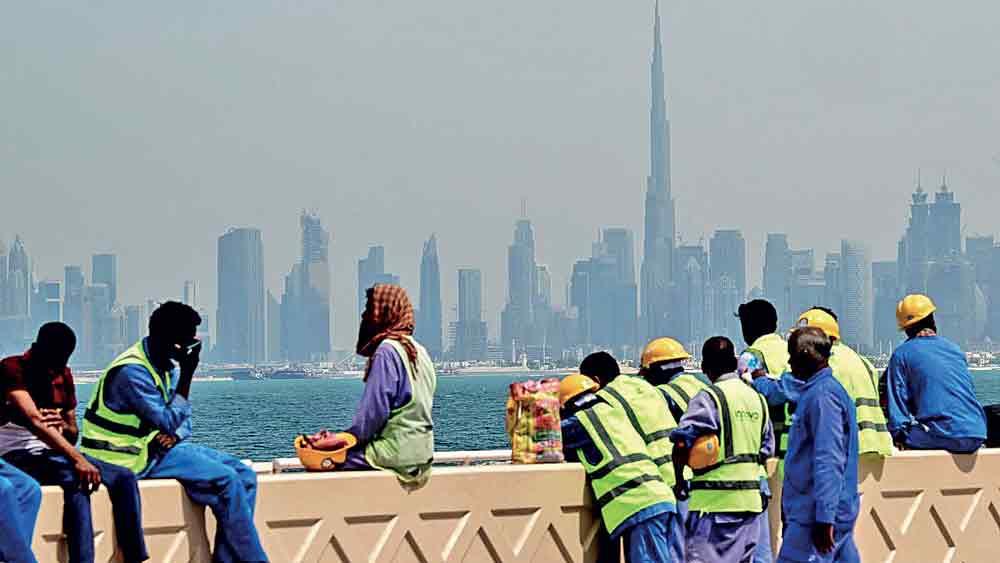
Migrant workers in Dubai taking a break
 For several decades, Dubai was a fantasy come true for people ranging from wealthy to very rich. That fantasy was visible from air as airliners circled to land in Dubai
A visiting Dutch journalist called the building complexes which house construction workers ‘prisons’ because many boundary walls, high or low, have barbed wire on them
 Last week, we looked at Dubai’s spectacular rise as a mega service and tourism hub, and the reasons why it began unravelling, and why the just-concluded Mideast war can’t be blamed for all of Dubai’s present woes.
Visitors to Dubai see a futuristic city built on desert sand. Soviet filmmaker Andrei Tarkovsky filmed part of his 1972 science fiction classic Solaris in Tokyo -- the extended, futuristic highway scene was filmed on location there. If present day Dubai had been available in 1972, Tarkovsky would have without doubt chosen it as his location.
For several decades, Dubai was a fantasy come true for people ranging from wealthy to very rich. That fantasy was visible from air as airliners circled to land in Dubai. By 2025, Dubai recorded almost 20 million visitors, outnumbering the local population by more than four to one.
But there was another side visitors and residents didn’t get to see – the tens of thousands of workers, technicians and labourers, mostly South Asian, who toiled to build the mega structures such as the 288 metre tall Burj Khalifa, which impressed and drew the world’s richest to Dubai.
Then there are the women, South Asians and Filipinas and also from other poor countries, who came to work as hotel cleaners and housemaids. But let’s look at the construction workers first.
This is the dark side of Dubai – called modern slavery by commentators. But there are several tiers of employment in Dubai. On top, there are the engineers and middle managers who earn between US$5,400 to $16,300 a month. Then there are the professionals who earn between $2,200 and $4,900 a month, followed by service and retail workers who earn between $330 and $680 a month. Finally, at the bottom are unskilled south Asian workers earning between $220 to $400 a month, creating an income gap of 50 times between the high and low.
It’s the latter who fall into the category of modern day slaves. They may have rights on paper, but none in practise.
But let’s take a brief look at what their labour created on desert sand. Let’s look at Burj Al Arab, one of Dubai’s principal architectural marvels. It stands on an artificial island. Shaped like a sail, it has a helipad and a restaurant entered through simulated submarine travel. Tiger Woods and Roger Federer have performed on the helipad.
Equipped with 192 duplex suites, Burj Al Arab’s accommodation costs $1800 for one night at entry level. Catering to the super rich, it gave them all that they could ask for, including gold leaf on walls and ceilings and charged $100 per person for a tour of the hotel.
But what about the people – labourers, drillers, crane operators, electricians, plumbers, drivers etc. – who worked in blistering heat to construct this colossus? Seventy per cent of the workers in Dubai are from India, Pakistan, and Bangladesh. Sri Lankans and Nepalis represent smaller numbers. Decades ago, people were hired not only for construction but also to transport human waste, because Dubai didn’t have a proper sewage system back then.
Foreign workers are hired under the Kafala system, beneficial to workers in the traditional way. But Dubai construction companies have never functioned in the traditional way, and now Kafala is 100% pro-employer.
Workers seeking to escape poverty at home get into serious debt to get jobs in the UAE, Kuwait or Saudi Arabia. Companies and agencies take big recruitment fees. Dubai’s government has banned this multiple times, but such bans have been ignored. Workers sell or mortgage property, pawn jewellery and borrow money at exorbitant rates to get jobs which pay $200 to $400 a month. Cramped accommodation, sometimes up to eight to a room, is given, but workers have to pay for their own meals. As food prices went up in the Gulf, this left them with little to send home to frantic family members and relatives. The worst part is that salaries aren’t paid for months in many cases.
The workers’ lives are hidden from visitors’ eyes. Not that affluent visitors show any interest and concern in finding them out. Surveillance cameras in Dubai’s affluent neighbourhoods watch out for ‘undesirables, ’ and the police are alerted in such cases.
Workers’ passports are confiscated on arrival by the employer. The stock excuse is that this is done for safekeeping and processing, but workers do not get them back till they leave. This means they can’t change employment – they are stuck for the duration of the contract.
Under Dubai’s laws, a 4m by 4m space is allocated to each worker. The toilets and washrooms are common. In some cases, there are no showers, and buckets are used to bathe. Washing machines are provided but a fee is charged. Workers face a deadly monotony of commute, work and sleep. A visiting Dutch journalist called the building complexes which house construction workers ‘prisons’ because many boundary walls, high or low, have barbed wire on them.
He interviewed a group of Indian visitors who said workers should be OK because they were making more money than they would at home. This is the other side of the problem – the countries of origin of these migrant workers, while they are happy to get the remittances (Sri Lanka received a record $8 billion in 2025) they pay scant attention to the abuse and maltreatment of migrant workers, both male and female.
Protests are seen as sabotage. Protests or running away results in detention, fines and deportation. Free health care given to Dubai citizens is not available for migrant workers. The Dutch journalist, who said a large beer in the city cost him 40 euros (34.35 USD) interviewed a Bangladeshi worker making 250 euros a month working 12 hour days. While a 2-3 hour midday break is mandatory for construction workers because of the heat, this rule is not always observed.
At least 10 migrant workers died every day from 2012-18 from accidents, illness or suicide. Over 100 Indians reportedly commit suicide every year in the UAE, and nearly 15% of Nepali deaths in Dubai are self-inflicted. But hardly anyone talks about them, about families left broke back home. What visitors see are the glittering buildings these workers have built.
The story of housemaids and female hotel minor staff is even more harrowing. Our papers were once full of stories of abuse, of women beaten, whipped, burnt and packed home without with injuries and without compensation. These stories are rare now because this traffic from Sri Lanka has thinned.
Female hotel workers too, mostly Filipinas, live eight to a room. The agency can even confiscate their phones. Housemaids are ‘bought’ by their employers, and many face abuse. They are called donkeys and idiots, and they too, go unpaid for months.
But some sort of karmic retribution seems to have befallen Dubai, now struggling to maintain its status as a top destination for fun seekers and those running from taxes.