Reply To:
Name - Reply Comment
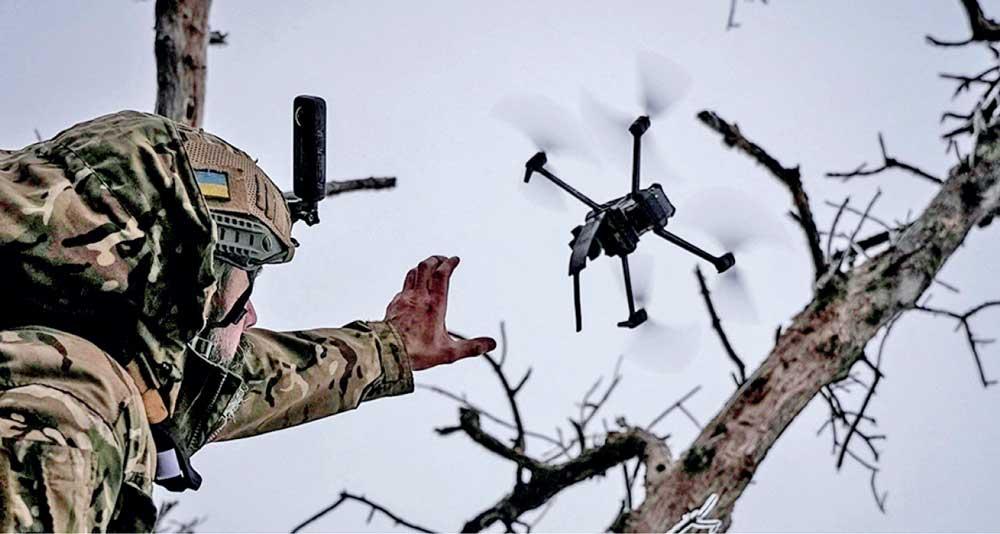
The ongoing war in Ukraine has further underscored the transformative role of drones
 In an exclusive discussion with former President Ranil Wickremesinghe, a compelling picture emerged of a leader with a formidable command of Sri Lanka’s national security, economic and political domains. The discussion, which formed the basis for this report, revealed an astonishing and commendable depth of knowledge regarding national security—a testament to his strategic mindset. As one of the country’s most senior and experienced political figures, Wickremesinghe’s track record speaks for itself. His leadership during the 2022 recession, which effectively rescued the nation from economic collapse, stands as irrefutable proof of his capacity and strategic skill. This article, “The dawn of a new Era: Missiles and Drones Reshape the Battlefield”, is drawn directly from that pivotal conversation, underscoring the vital importance of a leader whose proven actions and strategic depth have been instrumental in navigating the nation through its most severe crises.
Nature of modern warfare
The nature of modern warfare is undergoing a fundamental transformation. For decades, military might was measured by the size of navies, the sophistication of fighter jets and the number of troops. However, recent conflicts have proven that this traditional calculus is no longer the sole determinant of success. The proliferation and increasing sophistication of missiles and drones have levelled the playing field, making them indispensable components of modern defence strategy and presenting a new paradigm for national security. This shift has forced nations, particularly smaller ones like Sri Lanka, to re-evaluate their defence priorities.
A Shift in Military Strategy: Lessons from Recent Conflicts
The military encounters of the 21st century offer compelling evidence of this new reality. The conventional wisdom of air superiority, once the cornerstone of military doctrine, is now being challenged by the effectiveness of relatively low-cost, high-impact unmanned systems and advanced missile technology.
Iran-Israel Conflict: The Age-Old Battle of Air Superiority vs. Missile Barrages
The recent conflict between Iran and Israel serves as a classic case study. Israel, with its advanced military and air superiority, has traditionally relied on its formidable air force to project power and deter threats. Iran, conversely, has invested heavily in a diverse arsenal of ballistic missiles and drones. During the conflict, Iran launched a massive, coordinated attack involving hundreds of drones and missiles. Israel’s highly sophisticated, multi-layered air defence systems, including the Iron Dome and the Arrow, were able to intercept a significant majority of the incoming threats.
However, this encounter revealed a critical vulnerability. The sheer volume and low cost of the Iranian drones and missiles meant that Iran could overwhelm Israel’s expensive defense systems through a strategy of attrition. While a $10,000 drone might be shot down by a $1 million interceptor missile, the economic and logistical sustainability of this defense model becomes questionable over time. This exchange highlighted that even a technologically superior force with a strong air defense network can be strained by the persistent, asymmetric threat of a well-resourced missile and drone programme. The lesson for a small nation like Sri Lanka is clear: a high-tech, traditional air force may be economically prohibitive, but a robust air defence system is non-negotiable in the age of missile and drone proliferation.
Ukraine-Russia War: The Drone as the New ‘Eyes and Ears’ of the Battlefield
The ongoing war in Ukraine has further underscored the transformative role of drones. Both sides have used drones extensively, not just for reconnaissance, but also as offensive weapons. Small, commercially available quadcopters, once a hobbyist’s toy, have been weaponised to drop grenades on enemy positions, while larger, more sophisticated drones conduct surveillance, direct artillery fire, and carry out precision strikes on high-value targets. Ukraine, in particular, has leveraged drones to great effect, compensating for its smaller military and limited air force. The use of First-Person View (FPV) drones for pinpoint strikes has become a hallmark of this conflict. This has demonstrated that a nation can achieve significant tactical advantages and strike deep within enemy territory without the need for expensive manned aircraft. The war has also shown the importance of counter-drone technology, including jamming, signal spoofing, and directed energy weapons, as a crucial component of modern defence.
India-Pakistan Border Clashes: Asymmetric Warfare and the Rise of Asymmetric Technology
The recent limited conflict between India and Pakistan in May 2025 showcased the effectiveness of modern missile technology, particularly the use of Chinese-supplied missiles by Pakistan. Reports indicated that during the clashes, Chinese-made missiles, possibly including the PL-15, were used to shoot down Indian aircraft. This incident highlighted a significant shift: a traditionally less-advanced military could effectively challenge the air superiority of a more powerful neighbour by acquiring and deploying advanced, off-the-shelf missile technology. The cost-effectiveness of these missiles compared to the multi-million dollar fighter jets they can destroy presents a compelling argument against over-investing in conventional, expensive airframes. This demonstrates that a nation’s military strength is no longer solely a function of its industrial base or spending power, but also its ability to acquire and integrate disruptive technologies.
The New National Security Imperative for Sri Lanka
As an island nation with a vital geostrategic location, Sri Lanka’s national security is inextricably linked to its ability to control its surrounding sea and airspace. Traditionally, this would necessitate a powerful navy and air force. However, the lessons from recent wars suggest a different path, one that is both more cost-effective and more aligned with the realities of modern warfare.
Sri Lanka, with its limited defence budget, cannot afford to engage in an arms race with regional powers. Spending billions of dollars on aircraft carriers or fleets of advanced fighter jets would be fiscally unsustainable and strategically inefficient. Instead, Sri Lanka should focus on developing an asymmetric defence capability centred on missiles and drones.
Key strategic imperatives for Sri Lanka
Investment in Anti-Access/Area Denial (A2/AD) Systems: Sri Lanka’s primary focus should be on building a robust network of coastal and land-based missile systems. These A2/AD systems, equipped with anti-ship and surface-to-air missiles, can effectively deny an aggressor access to its territorial waters and airspace, making any potential invasion a high-risk and costly endeavour. This is a far more effective deterrent than a small, vulnerable surface fleet.
Development of a Domestic Drone Programme: Instead of purchasing expensive, foreign-made manned aircraft, Sri Lanka should invest in developing its own fleet of military and surveillance drones. A domestic drone programme would not only provide real-time intelligence and reconnaissance capabilities but also offer a low-cost, high-impact platform for offensive operations, including targeted strikes and swarm attacks. This would also foster local technological expertise and create jobs.
Integration of a Comprehensive Air Defence Network: While expensive, high-end systems may be out of reach, Sri Lanka can develop a layered air defence network. This should combine medium and short-range surface-to-air missile systems with a comprehensive network of radar and sensor technology to detect and track incoming threats. The system should also incorporate counter-drone capabilities, such as jammers and signal spoofers, to neutralise smaller, low-flying threats.
Focus on Cybersecurity and Information Warfare: The increasing reliance on missiles and drones makes the control of the electromagnetic spectrum and information a critical battleground. Sri Lanka must invest in cybersecurity to protect its own command and control systems from enemy attacks and to develop the capability to disrupt enemy networks.
The future of Sri Lanka’s national security does not lie in emulating the traditional military structures of larger nations. Instead, it lies in a smart, agile, and technologically-driven approach that recognises the new realities of the modern battlefield. By prioritising investment in missiles and drones, Sri Lanka can build an indispensable foundation for its survival and prosperity in an increasingly complex and volatile world. The time for change is now.
The writer is an Infantry officer who served the Sri Lanka Army for over 36 years, a former Security Forces Commander of the Wanni Region and Eastern Province, and he holds a PhD in economics. He can be reached at:[email protected]