Reply To:
Name - Reply Comment
However, there is a glaring discrepancy between the promise and reality. The government has so far failed to convert its realist foreign policy and favourable international context into a long-term economic advantage, attracting new investment, technology, and leapfrogging economic modernisation
 One year since the election of President Anura Kumara Dissanayake, the NPP is still on a political honeymoon. The disunited opposition offers little challenge, and whenever Sajith Premadasa opens his mouth, Sri Lankans are reminded of why the NPP is in power.
It is probably still premature to assess the foreign policy acumen or lack thereof of the NPP government. However, if you look back over the past fifteen years or so, each of its predecessors had done much to damage, rather than manage, foreign relations within their first year. Each of them started off by throwing a wrecking ball into the evolving foreign policy consensus.
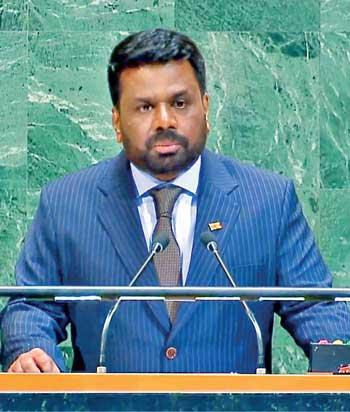 |
| President Anura Kumara Dissanayake addresses the UN-General-Assembly |
That might make the first year of the NPP government the least damaging to the country’s foreign policy. If you don’t see a major momentum, that is partly because it still has a lot to do to clear up the mess left by a succession of predecessors. I am not even a fan of this government to say this!
Let’s leave out the heydays of the war in the first decade of 2000, when the Mahinda Rajapaksa administration strived hard to manage its competing foreign relations, and keep India informed and satiated, while procuring weapons from China to fight a nihilistic terrorist group. However, all that foreign policy common sense was lost soon after the government won the war. Mahinda Rajapaksa reneged on the promise to implement the 13th Amendment, and then took an outright pro-Chinese turn at the expense of relations with India and Western partners, and shamelessly exploited the military victory to cultivate a political dynasty. The skewed foreign policy choices effectively hardened Western antipathy, leading to a series of adverse resolutions in the UN Human Rights Council.
Then came Yahapalanaya which, as the first thing in the morning, suspended the signature Chinese-funded Port City and many other foreign loan-funded development projects.
Many ignore the full scope of the adverse effects of that shortsighted folly. However, that marked thein flexion point in the reversal of the economic fortunes of the country. Investor confidence lost as a result never recovered. The pervasive culture of policy uncertainty persists to this day.
No plausible excuse was offered about the suspension of the Port City, though the shortsighted decision was guided by domestic calculation to assuage a plethora of good-for-nothing local groups -- same types who are now protesting against a wind power plant in Mannar island - and the Americans, whom Ranil Wickremesinghe whimsically thought would come to pay the country’s loans to China.
Yahapalanaya left the economy in tatters; all that Gotabaya Rajapaksa had to do was to give a mild push with a series of egoistic decisions mishandling the economy, driving it down the precipice.
The Gotabaya Rajapaksa administration, which succeeded Yahapalanaya, followed the Sri Lankan political tradition of dismantling the legacy of its predecessor, including its foreign policy. So it abolished the Japanese-funded monorail, again under a similarly whimsical pretext -- an overly generous repayment period of 40 years at an annual interest rate of 0.1% --and gave a cold shoulder to the US$480 million Millennium Challenge grant.
With one megalomaniacal stroke, Gotabaya Rajapaksa deprived this country of$ 2 billion, all the while his economic cavemen were burning through the country’s foreign reserves to keep the rupee below LKR 200 to the US dollar.
The Ranil Wickremesinghe presidency, which followed, was left with little to dismantle but to pick up pieces of a crumbling economy. However, without Yahapalanaya dismantling the economic consensus in 2015, which had grown at an annualised rate of 6.5% over the previous decade, Sri Lanka would not have been in this dire state. In retrospect, a third term for Mahinda Rajapaksa could have placed the country in a better economic footing, though the political system might have become overly authoritarian and dynastic. We picked penury over autocracy.
Foreign policy is not a discipline that stands alone; it is an amalgam of concerns that range from security and diplomacy to shared values, international trade, investment, and economic cooperation. However, among all these concerns, economic diplomacy looms largest,except for countries that share concerns over intense security and geopolitical challenges. Greater economic cooperation better integrates a small state into the international system, making its survival deeply intertwined with the well-being of the international system, or at least an emerging pole within it. However, successive Sri Lankan governments have sought to dismantle whatever economic consensus their predecessors established, effectively reducing not just the economic well-being of the people, but also its place in the international system.
Many old-timers speak with a hint of nostalgia about S.W.R.D. Bandaranaike’s silver tongue or Sirimavo’s provocative anti-Western foreign policy, though neither of them had really produced tangible benefits for the country. This practice of foreign policy being an accessory of the leader’s ideological preference and personal political calculations went on, largely without much harm, until J.R. Jayawardene grew bigger than his size and tried to be cocky with Indira Gandhi’s India, then the main non-Warsaw bloc ally of the Soviet Union. The rest is history.
The NPP-JVP carries its own albatross -- the very identification with Marxist-Leninism denotes a negative connotation.It should take extra care not to stir the hornet’s nest. So far, it has acted with restraint and has also eschewed the temptation to preach morality and foreign policy idealism from rooftops. A case in point is its measured approach to the Gaza conflict, which any other political party might have been tempted to make a public show, import an intractable international problem, probably unleashing a wave of Salafism in the country, offending Donald Trump’s America and possibly inviting punitive tariffs on Sri Lankan exports.
Instead, the NPP had navigated the competing interests of its competing international partners. The President visited India, China, Japan, and Germany, seeking to rebuild strained economic relations, also demonstrating a willingness to assume security responsibilities in the evolving geopolitics of the Asia-Pacific region.
However, there is a glaring discrepancy between the promise and reality. The government has so far failed to convert its realist foreign policy and favourable international context into a long-term economic advantage, attracting new investment, technology, and leapfrogging economic modernisation.
It is not difficult to understand what is holding the country back. To begin with, JVP/NPP’s economic dogmas — ranging from opposition to restructuring SOEs to structural economic reforms — are a major turn-off for prospective investors. The same dogmas have kept the economy in shackles, preventing it from reaching its full potential.
The recent US State Department report on Sri Lanka’s investment climate explains why the country has failed to attract investment.
“Regulatory unpredictability, bureaucratic hurdles, and selective transparency continue to limit broader participation,” it states.
“The government’s institutional capacity to encourage an open investment environment remains limited despite positive rhetoric.Overall, investors report that doing business remains difficult, frequently citing concerns about project reversals, regulatory shifts, decision-making, and inadequate support for established businesses.The IMF and local business chambers stress the need for comprehensive structural reforms, including trade facilitation, digitisation, and stronger governance mechanisms.”
No matter the government’s good intentions, internal constraints for development remain unchanged.BOI’s one-stop shop has failed due to the fragmented authority across the government agencies.Until the government opts for concerted domestic reforms, cuts down bureaucratic red tape, and reforms or dismantles state regulatory frameworks that serve its own existence, much less investment, Sri Lanka’s economic modernisation will remain an unfulfilled prophecy.
Also, no matter how hard you tried, the rot runs deep in the state institutions and is not easy to clean up.Therefore, a parallel approach, such as allowing the private sector to operate export zones, similar to those in countries like Vietnam and Cambodia, would be a good starting point.The Chamber of Commerce’s budgetary proposals submitted to the President call for similar measures.Similarly, Sri Lanka could offer countries such as Japan, India, and China land on long-term lease and regulatory clarity to establish export zones, effectively enticing many investors who had been deterred by the heavy regulatory burden in Sri Lanka.
One year on, the government has done much to mend the strained ties with foreign partners.It should now convert these relations into avenues of growth for leapfrogging economic modernisation.
Follow @RangaJayasuriya on X