Reply To:
Name - Reply Comment
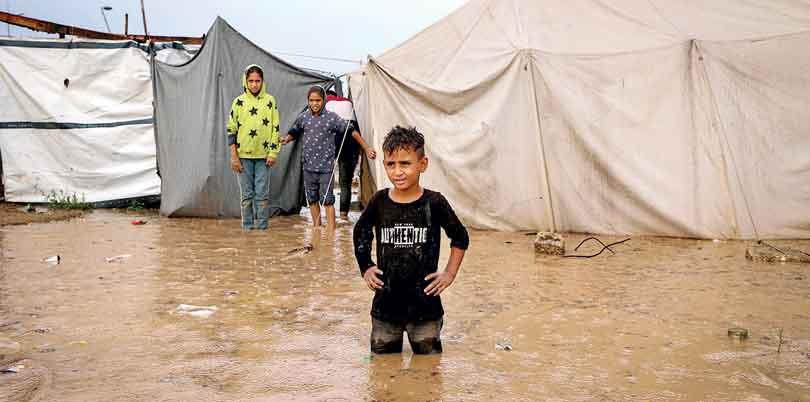
As the UN marks International Day of Solidarity with Palestinian people, in the war-ravaged Gaza, children are seen standing outside their tents after heavy rain flooded their makeshift camp. AFP.
 Tomorrow is the United Nations Day of Solidarity with Palestine. Diplomatically, it delivers a powerful message, urging the world community to take the measures necessary to end Israel’s occupation of Palestinian territory. Yet, in practice, the day passes without bringing any tangible change on the ground.
In the early years, the Non-Aligned Movement (NAM) and Arab and Islamic states carried the Palestinian torch, burning with the zeal that fuelled the 1954 Afro-Asian Solidarity Conference in Bandung, Indonesia, and reignited at every NAM summit. But with the international order changing after the collapse of the Cold War in 1991, the Palestinian cause came to be sacrificed at the altar of unprincipled foreign policies that most NAM nations—save a few—adopted.
The biggest loss was when India, once the global voice of the NAM, began to sideline the Palestinian cause it had unwaveringly championed. Today, under the Hindu fundamentalist Bharatiya Janatha Party government, India has become a powerful ally of Israel, acting like Zionism’s South Asian agent or viceroy. Palestinian activism, which was once regarded as part of India’s state policy, is today an irritation that activists fear may lead to state harassment or even arrests.
The erstwhile NAM nations—save a few that still resist the imperialist and neo-colonialist agendas of the United States and other powerful nations—make no effort to mark the UN Solidarity Day that became part of international diplomacy since its passage in the General Assembly on December 2, 1977. Resolution 32/40B, which they sponsored during NAM’s active days, declares November 29 as the International Day of Solidarity with the Palestinian People.
The day was fixed as November 29 because it was on that day the UN General Assembly in 1947 passed Resolution 181 to partition Palestine, which the British were ruling then under a League of Nations Mandate after they captured it from the Ottoman Empire during World War I. That was one of the most unjust partitions and a revolting stain on the UN system.
Don’t blame the UN, for the UN is only a tool. The biggest culprit was the United States, which used its diplomatic clout to arm-twist weaker UN members—like Liberia and the Philippines, to name a few—to change their stance against the resolution and vote for it. Strangely, Britain abstained, even though it had planted the seed of the invasive plant—Israel—in Palestine by issuing the infamous Balfour Declaration in November 1917. Britain’s abstention stemmed from opposition to the division of Palestine by its colonies, which were on the cusp of independence and demonstrating solidarity with freedom struggles across the world. This included India and Sri Lanka, or Ceylon as it was then known.
One of the reasons why activists worldwide slam the partition resolution as the most unjust is that it gave 55 percent of Palestine to the Jews—most of them migrant European Jews with doubtful lineage to trace back to Palestine—even though they formed only about 30 percent of the population. The 70 percent indigenous Palestinians were given 45 percent of the land.
The territory to be given to the Palestinians—the West Bank and the Gaza Strip—was about 93 km apart, with a narrow corridor going through Israeli territory linking the two. The powers—the Western nations and even the Soviet Union—that worked on the text knew very well that such an unfair division would only lead to conflict. And conflict it did lead. A major war erupted within a year between the newly set-up Israel, backed by Western nations with arms and ammunition, and the equally newly formed, ill-equipped Arab states. In the first Arab-Israel war, Israel annexed 28 percent of the Palestinian territory. Following more wars in 1967 and 1973, Israel captured more of Palestine. Today Palestine is left with less than 17 percent of historic Palestine. And whatever territory the Palestinian Authority—established under the 1993 Oslo Accord—holds is a collection of Bantustans with illegal Israeli settlements sprawling across Palestinian lands.
It was not only the UN system that the imperialist powers manipulated to install Israel. The process began in the League of Nations—the UN’s predecessor set up after World War I.
Dr. Ralph Wilde, Senior Counsel retained by the Arab League in South Africa’s 2024 genocide case against Israel, rightly pointed out in his submission to the International Court of Justice that the legal right of self-determination of the Palestinian people originated in the “sacred trust” obligations of Article 22 of the League Covenant, part of the Versailles Treaty.
The international law expert noted that Palestine—an “A” class Mandate under British colonial rule—was, after World War I, supposed to have its existence as an independent state “provisionally recognised”—a sui generis right of self-determination. The United Kingdom and other members of the League Council attempted to bypass this, incorporating the 1917 Balfour Declaration commitment to establishing a national home for the Jewish people in Palestine into the Mandate instrument that defined its operation.
The court is still deliberating the case, and its verdict is expected in the coming months.
In the meantime, the UN continues to mark the day in the hope that it will serve as an annual reminder of the unresolved question of Palestine and the rights of the Palestinian people. A subsequent resolution (60/37), adopted on December 1, 2005, requested the Committee on the Exercise of the Inalienable Rights of the Palestinian People, of which Sri Lanka is a member—as part of the November 29 observance of the International Day of Solidarity with the Palestinian People—to organise an annual exhibit on Palestinian rights or to hold a cultural event in cooperation with the Permanent Observer Mission of Palestine to the United Nations.
Tomorrow’s UN Day of Solidarity with the Palestinian People is marked on a solemn note, with the plight of the Palestinian people in both the Gaza Strip and the West Bank worsening by the day. A ceasefire exists only on paper, with Israel continuing to kill Palestinians on a daily basis. Some 500 people have been killed during the seven-week-old ceasefire, which US President Donald Trump announced in the Egyptian resort city of Sharm al-Sheikh on October 13 amidst a big diplomatic fanfare, as scores of world leaders invited to witness the peace tamasha stood like school prefects for a long time behind the signing table, grinning through the pain in their hips, knees, and heels.
With hardly any protest against Israel over ceasefire violations and its failure to send an unrestricted flow of food and essentials to Palestine as it had agreed, the Palestinians are largely left to fend for themselves amid Israeli attacks and worsening floods due to inclement weather.
The Sri Lanka Committee for Solidarity with Palestine will hold a public event to mark the United Nations Day of Solidarity with Palestine on December 3, 2025, at the Duncan White Auditorium, Sports Ministry Complex, Race Course, Colombo 7, from 4:00 p.m. to 6:00 p.m.
The keynote address will be delivered by South Africa’s High Commissioner and Chief Guest Sandile Edwin Shalk. Guests of honour addressing the gathering will include Opposition Leader Sajith Premadasa and Cultural and Buddha Sasana Minister Hiniduma Sunil Senevi, who also serves as President of the Sri Lanka–Palestine Parliamentary Friendship Association.