Reply To:
Name - Reply Comment
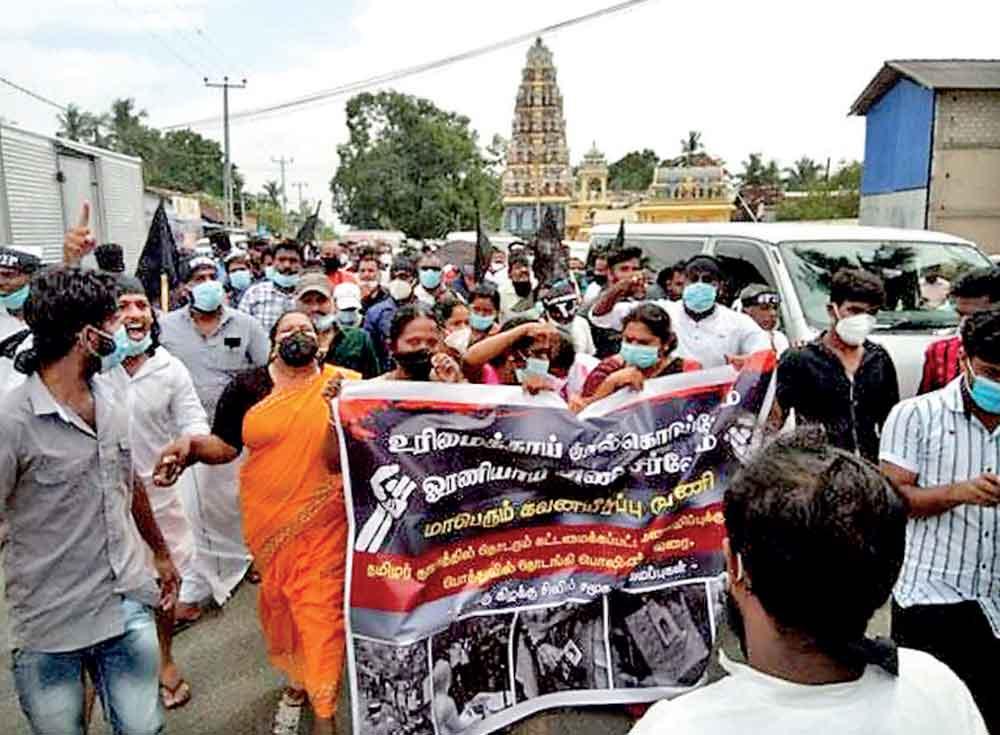
The very formation of Tamil and Muslim political parties in Sri Lanka over the years since 1939 has been prompted by the distrust of minorities towards the leaders of the majority community
 The platform formed days ago by six political parties representing minority communities – Tamils of Northern and Eastern Provinces, Malayaga Tamils and Muslims – is nothing but a renewal of the indictment against the major national parties for failing those three communities.
The six parties consist of two representatives from each community - Ilankai Tamil Arasu Kachchi (ITAK), and the Democratic Tamil National Alliance (DTNA) from the Northern and Eastern Tamils, Ceylon Workers Congress and Tamil Progressive Alliance (TPA) from the Malayaga Tamils, Sri Lanka Muslim Congress (SLMC) and All Ceylon Makkal Congress (ACMC) from the Muslims.
They announced on Monday that they launched this platform to address common concerns of Tamil-speaking communities living in the Northern, Eastern, Western provinces and plantation regions.
We describe the launch of this “platform”, as it is called by the media, as a renewal of an indictment against the major parties dominated by Sinhalese because the very formation of Tamil and Muslim political parties in Sri Lanka over the years since 1939 has been prompted by the distrust of minorities towards the leaders of the majority community. The chances of any of these minority parties being formed would have been minimal, had these communities had faith in Sinhalese leaders that the latter would stand by their rights and wellbeing.
Yet, the minority parties later formed alliances with the same major parties for strategic, opportunistic, or survival-driven purposes. The CWC, an entity formed in 1939 as a trade union in the plantation sector, on the instruction of Jawaharlal Nehru who later became Prime Minister of India, had been a partner in government with almost all ruling parties since 1977.
ITAK and federalism
ITAK, a party working separately on the grounds that no other party in the country was committed to its cause - a federal form of government – ironically formed a government in 1965 with the United National Party (UNP) led by Prime Minister Dudley Senanayake.
Three out of these six parties – TPA, SLMC and ACMC - are currently constituents of the Samagi Jana Sandhanaya (SJS) led by Sajith Premadasa’s Samagi Jana Balawegaya (SJB). The CWC contested the last Parliamentary election in alliance with UNP led by Ranil Wickremesinghe while the ITAK supported the SJB, despite the latter did not agree to its conditions or policies.
The Muslim and Malaiyaga parties are still representing their communities in Parliament as members of the SJB and the UNP/NDF. Yet, their formation of the latest “platform” is an indication of their apparent understanding that the SJB and the UNP/NDF are also not addressing “concerns of Tamil-speaking communities living in the Northern, Eastern, Western provinces and plantation regions.” If they still have faith in those parties, the new “platform” should be an attempt at gaining visibility, or, in other words, to show their communities that they are still a force to be reckoned with.
If they have taken this step on the grounds that the major parties which they are aligned with now are not addressing the concerns of the Tamil-speaking communities, in fact, it is justifiable. These alignments are strategical arrangements during elections without agreements on policies, but with a view to keep your head above water or to have one or two seats more in Parliament.
At the Monday’s inaugural press briefing, the six parties insisted on holding provincial council elections and introducing a new constitution, as pledged by the ruling National People’s Power (NPP) during the last elections. These demands are not concerns affecting only Tamil-speaking communities. And it must be recalled that it was the so-called Yahapalana government that created an impasse in the process of provincial council elections in 2017, with the assistance of these Tamil-speaking parties.
However, their current position on the matter is well-founded, despite the possibility of its realisation is remote. The NPP government seems to view the provincial council elections as a political slippery slope that would end up in their defeat at the next Presidential and Parliamentary elections, in spite of its argument that legal snags prevent those elections prevailing. They also seem to be not so interested in expediting the process to remove those snags.
Two contradictory demands
Besides, the two demands put forward by the six parties on Monday are contradictory, since the solution to the ethnic problem within a new Constitution would necessarily be different from the current provincial council system. Holding elections for a system that they are demanding to change is unfounded. If the two demands are to be logical, emphasis on a new Constitution with a focus on a solution to the ethnic problem is sufficient. Alternatively, holding the elections must be conditional upon a protracted delay in adopting the new Constitution.
Nevertheless, their loss of hope in the major parties is not without basis. And many of their concerns, especially those of the Tamils of Northern and Eastern Provinces have been viewed by the major parties as impractical and suicidal. They are unprepared to bring in a federal system of government, for fear of backlash in the south, in spite of the Supreme Court having ruled that federalism is a far cry from the division of the country.
Besides, an amalgamation of the Northern and Eastern Provinces again – another demand by the Tamils of that region - by a party that was instrumental to the separation of the two provinces two decades ago, is also highly unlikely to materialise. The situation would be no different under a government formed by any other major party, particularly now that the Indian government has publicly dropped its insistence on the provincial merger. Also, Tamil and Muslim parties do not see eye to eye in this regard.
Accountability for the alleged human rights violations perpetrated during the last lap of the war between the armed forces and the LTTE is another tricky issue that has to be resolved by the government as well as Tamil parties. There are no signs of change in the decades old status quo in this regard as well, although a party that faced two brutal crackdowns has come to power. Therefore, it is justifiable for the Tamil-speaking parties to take their destiny into their own hands.
Yet, it remains unclear how these six Tamil-speaking parties plan to achieve their political demands while remaining independent of major parties and forming their own alliance. Hence, the question remains whether they are searching for a black cat in a dark room.
Although they have preempted any possible allegation that this is a racist group, they will most probably be branded as racist once they put forward specific demands, especially demands pertaining to the northern Tamils. In fact, there are already signs of this sort on social media.