Reply To:
Name - Reply Comment
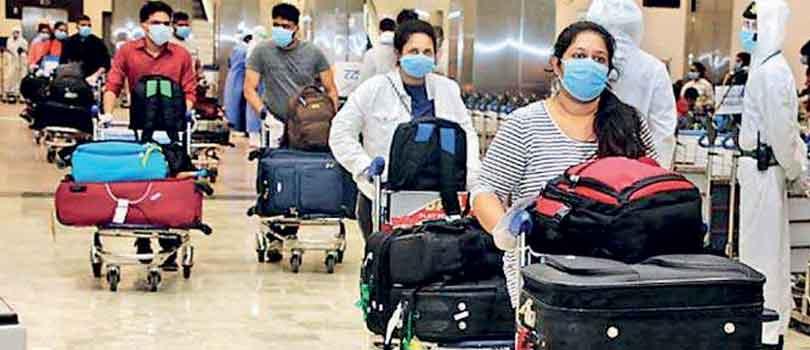
Nothing can be done to prevent non-residents whose names are on the electoral register from paying the airfare to cast their vote
 Good or bad outcomes may result from actions taken by politicians, government officials, businesspeople, or voters. Under ideal conditions, they will share in the rewards and in the losses. In many instances, actors enjoy the rewards but suffer no losses. This is called having no skin in the game

In January, a Cabinet appointed committee published a call for views and suggestions on a mechanism to enable citizens living abroad to vote in Sri Lankan elections. The closing date is the 15th of February. Several organisations have already responded, suggesting among other things that the more urgent problems are the difficulties experienced by the bed-ridden and the disabled, and by groups such as hospital and security employees who live in this country but are unable to vote.
In 2020, amidst the COVID-19 lockdowns and fears that voters congregating in polling booths would pose dangers, I supervised research on how other countries had addressed the challenges of remote voting. voting at a location other than a traditional polling booth. The analysis and recommendations shared with the Elections Commission are publicly available. They were also shared with the current committee and the Dep Commission appointed by President Wickremesinghe.
Any remote voting mechanism must satisfy the following criteria:
1. Correctness of the results
a. Only eligible users vote
b. They only vote once
c. All votes counted are valid votes, and all valid votes are counted.
2. Verifiability of results by involved parties
3. Secrecy of votes
These technical discussions do not address the fundamental issue of whether citizens who live abroad, and are thereby insulated from the good or bad effects of actions taken by the persons they helped elect, should be allowed to vote.
Skin in the game
Good or bad outcomes may result from actions taken by politicians, government officials, businesspeople, or voters. Under ideal conditions, they will share in the rewards and in the losses. In many instances, actors enjoy the rewards but suffer no losses. This is called having no skin in the game.
President Gotabaya Rajapaksa (GR) was elected with a massive majority winning 6.9 million votes. In addition to voters resident in Sri Lanka, many Sri Lankans living abroad supported his campaign, and some returned to Sri Lanka to vote for him. Immediately upon assuming office, President GR slashed tax rates and thereby collapsed government revenues. Sri Lanka lost the ability to borrow from the international market, triggering the economic crisis. People living in Sri Lanka suffered fuel shortages, electricity cuts and other harms. Thousands of small and micro enterprises collapsed.
The majority of those who voted for GR suffered the negative consequences of the actions of the person they elected (along with those who did not vote for him). But one group of voters did not. They were those living abroad who voted for GR.
The first group had skin in the game. One can never fully predict the outcomes of an action such as voting for a Presidential candidate. If GR’s tax cuts resulted in massive domestic investments by the companies and high net worth individuals who benefitted from them, yielding rapid economic growth as his advisors expected, the voters resident in Sri Lanka would have shared in the resulting boom. When the outcome was the opposite, they suffered in queues and darkness.
Voters not resident in Sri Lanka suffered nothing other than regret, damage that was in no way comparable to what the persons in the first group suffered. If GR’s strategy had succeeded, they would have gained some psychic satisfaction and perhaps may have been able to return to a prosperous Sri Lanka. The upside benefits were small, but there were no downside losses. They had no skin in the game.
Skin in the game is a concept that was popularised by the American investor Warren Buffet and by the Lebanese-American author Nassim Nicholas Taleb.The basic thesis is that risky actions taken by agents with skin in game (sharing losses as well as benefits) are superior; that they are more likely to preclude bad decisions. If skin in the game is applied to democratic processes, we are less likely to get government failure.
Voting rights for non-resident citizens
The direct application of the skin in the game principle would preclude enabling voting by those not resident in Sri Lanka and are therefore protected from the possible bad outcomes of their actions. Nothing can be done to prevent non-residents whose names are on the electoral register from paying the airfare to cast their vote. Given the transaction costs, this will not be a large number, though elections can be decided by small margins.
The committee is seeking to develop a mechanism to reduce the transaction costs of casting a vote for non-resident citizens. In general, this is not advisable. However, there is one exception worthy of consideration: Sri Lankan workers on short-duration contracts who are registered with the Sri Lanka Bureau of Foreign Employment (SLBFE). These individuals are affected by the actions of the government, while working abroad and when they return at the end of their contracts. For example, the attempts of the GR government to maintain the exchange rate at an artificially low level in 2021-22 had a direct impact on their ability to support their families in Sri Lanka.
Such workers are legally required to be registered with the Sri Lanka Bureau of Foreign Employment. Depending on the duration of the contract, they can also be included in a special electoral register. It would be possible to issue a smart card that is capable of authenticating identity, in a manner like in Estonia, where remote voting is possible for all citizens.
Remote internet-based voting is the only fair and comprehensive solution for contract workers living in foreign countries. Putting polling booths in Sri Lankan embassies is not a feasible solution, because the distances voters would have to travel to cast their vote would be enormous in many cases. For example, the embassy in Saudi Arabia is in Riyadh. It would take over eight hours of driving to get there from Jeddah, for example. And Saudi law does not mandate granting of leave to vote in foreign elections.