Reply To:
Name - Reply Comment
 It is my great privilege and honour to have been invited to write this brief critique on the life and mission of Rev. Dr. Harold Peter Francis Panditharatne; a genius philosopher, a master pedagogue and simplicity personified.
I began my life in the National Seminary in September 1979, and Fr. Pandith (as we then called him) was my Rector of the National Seminary in Ampitiya. I vividly recall how we went to meet him in his office on arrival. He welcomed us with a smile and appeared quite relaxed. That first impression he made upon us was one of ease and familiarity.
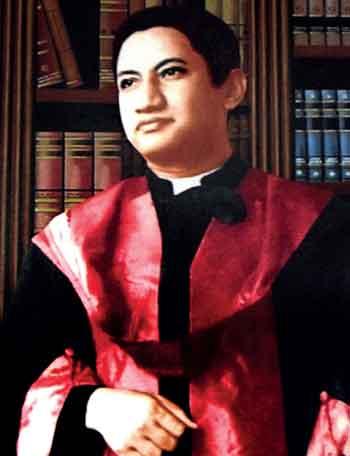 |
| Rev. Dr. Harold Panditharatne |
He was our Rector only till the year 1981. He continued to be on the teaching staff even thereafter. We met him mostly in the lecture hall for his vibrant and energetic lecture hours on logic and epistemology. Occasionally, he conducted an evening conference for us in the Sacket auditorium and presided over Sunday Mass with a homily he read out quite audibly and lucidly. We used to see him on evening walks to Kandy town, and once in a while, we bumped into him while strolling around the Kandy lake. However, on such occasions, he seemed engulfed in a thought world of his own. He did not notice us passing him by. I clearly recall how once we bumped into him right in the centre of a zebra-crossing, close to the clock tower near the main bus stand. His umbrella was dangling down his hand and he was walking right up to us. I smiled and was about to say good evening Yet he briskly brushed passed us without the slightest hint of familiarity.
On another evening, I was conducting a group study session just before the term examinations. Our study hall in the old building close to Fr Martin Quere’s room was not spacious enough for such discussions. I think it was late Fr. Ranjith Silva (then, for the diocese of Galle) who organised the session in the dormitory. It was around 7 pm, and there were at least 15 of us; some on beds and some on the ground, with a few others seated even on small cupboards. We were actually listening to a lecture summary. I myself was on a small cupboard and was leading the discussion. Suddenly the dormitory door was flared open and Fr. Pandith appeared. He was enraged and yelled at us, ordering us all to his office immediately. Without much choice, we appeared before the fuming Rector. He reproached us severely, and for some time we could not even raise our heads to witness his effervescing countenance of resentment. Eventually, he asked, “Who was on that cupboard and what on earth were you doing on the cupboards when you should be in the study hall?” I had to speak. I apologetically stated I was the one seated on the cupboard. I also informed them that we were in a group discussion in preparation for the examination the next day. To my utmost surprise, he then calmed down. He said he saw us while he was walking to have a shower and thought we were having fun in the dormitory. Upon learning we were in fact at a study session, he calmed down and requested that we continue our group study, also suggesting we use one of the lecture rooms for such discussions in future.
In the classroom he was truly in his element; beaming and delivering his lectures hammer and tongs. We saw how meticulously logical he was in his presentations; each inference and conclusion neatly written on the blackboard in picturesque cursive style
In the classroom he was truly in his element; beaming and delivering his lectures hammer and tongs. We saw how meticulously logical he was in his presentations; each inference and conclusion neatly written on the blackboard in picturesque cursive style. He was a totally different person during lectures. His enjoyment at every minute of teaching was rather evident.
I would also never forget my oral examination with him at the baccalaureate in Philosophy. I was answering all his questions well. He then told me that he would give me top marks if I answered his last question. He posed the question and I could not read him well enough. My response was probably somewhat beside the mark but he was all smiles as I walked over to the next table to continue my exam.
Outside the classroom, and when not conducting any conferences for us, Fr. Pandith was an entirely different kettle of fish. He hardly met us. In fact, I do not ever recall him meeting us individually in his capacity as the Rector of the Seminary. He chose to stay confined to his office, which actually was part of his personal study lounge. If at all we entered his room, we were bound to see him reading, writing or browsing through his personal library. Being a chain smoker, his office usually reeked with cigarettes and cigars. His mind was encaptured by what he was reading or writing, so much so that he was probably not aware of how many cigarettes he smoked at a stretch. He seemed so polarised in his conduct, that we found him rather enigmatic. Frankly, it took me quite some time to figure out how I should read him. It was much later that I understood him gradually, especially when I began to read some of his writings after my ordination to the priesthood.
To the surprise and also disappointment of many, he has not authored any books. Little wonder though, as he kept discarding and eliminating; choosing and sorting the matter minutely. It must have been quite strenuous for him to eventually arrive at some unchallengeable statement. Probably, no one else would challenge it, except himself. He, as is evident from what is said above, explored the core of things. However, he has left us his doctoral theses, and a few scholarly articles. Reading his Doctoral thesis matter is rather onerous, to say the least. However, some of his articles are quite absorbing, provided the reader doesn’t finally feel left high and dry. Each word is calculated; each punctuation mark buttresses the desired idea and each sentence affirms the logic of thought. Fr. Pandith belonged to a rare calibre of scholars. At times, with the best of intentions, such scholarly argument might sit on issues far too long, to the extent of driving go-getters insane.
Another feature of Fr. Pandith’s life was his passion to trace blending patterns of Eastern thinking with those of the West. Often, we keep these two regions and their characteristic features tightly compartmentalised and mix-proofed. Hailing from a milieu that is receptive to four major religions and their cultures, Fr. Pandith ventured out to analyse how Western philosophers look at Eastern philosophies and vice versa. For instance, in tracing Hegelian concepts of Indian Philosophy in his first Doctoral Thesis, he begins with Henry Thomas Colebrook (1765-1837), an Englishman who was a Sanskrit scholar. He was appointed to India by the British Empire in 1782 and held administrative, legal and academic posts. He studied Sanskrit and wrote Sanskrit Grammar (1805), some papers on Hindu religious ceremonies and a well-known Essay on the Vedas (also 1805).
Colebrook’s understanding of the Samkhya system of Indian Philosophy divides all concrete existences or creatures into three worlds; the upper world of the gods where satva guna prevails, the middle world of men where rajas prevails and the lower world of the animals, plants and other inorganic bodies. The essential constituents of any creature in any of these worlds comprise a soul, seventeen principles that make up the subtle person and a gross body. Sketchily this was what Hegel captured from Colebrook’s Samkhya analysis. Hegel saw aspects which were absent in Colebrook’s thinking of the above system. Fr. Pandith discovers Hegel’s stress on mythological popular aspects of Indian philosophy and worship, which is largely foreign to the speculative and reasoned mindset of the West. It is crucial that we identify and value what is typically oriental and Eastern, and maintain a balanced unbiased attitude. Often, our inputs in Philosophy tend to be founded almost totally on Western thought, and we tend to underestimate Eastern thought, and at times even have an overrated attitude toward the Western world and thinking.
In my humble opinion, Fr Pandith’s final aim was not to master Aristotle, Aquinas or Hegel. He was in profound search of the truth about Being, with a view to understanding man in relation to God and Salvation History. Once he explored philosophy both as a science and as an art, and once he achieved stability of thought for sure, he was able to look at man from an entirely new perspective. Thereafter he was ready to look at faith as a genuine seeker. Many of us begin our search for God, man and the world from somewhere. In fact, we are not even aware of where. We are unable to tap to the very core, and we are mostly incapable of handling such issues. We are happy to begin at a place which is comfortable to us; mostly it is a place that is provided to us by our mentors. We are bound to end our searches and research mostly uneventfully. For instance, from where do we begin to learn about who man is in the Sacred Scripture and in the History of Salvation? Have we ever raised this question to us? In all degrees of probability, this may even sound like a nonsensical query. But, it is indeed a valid one. Moreover, we are content with an academic achievement or a title we could brag about. Albeit the goals of philosophical studies transcend such narrow objectives.
Certainly, Fr Pandith was a distinct scholar. His aims, his research paths, as well as his ends, were all clear to him. His aim was not one of academic excellence, but the sheer joy of having understood Being; the core element of everything. His goal was to know the truth. In his article entitled Philosophical Formation of Catholic Clergy, he quotes Francis Bacon’s essay of 1612 on Truth. The discussion begins with the question posed by Pontius Pilate who asked Jesus What is Truth? But could not wait until Jesus answered. Fr Pandith comments that Pilate’s impatience characterises many of us. We give up when a satisfying answer to our question about the truth of things is not immediately available. In his own words, Fr Pandith says: “Anything that takes time to uncover is seen today by many as hardly worth considering. Yet the problem of truth and its attainment is the key problem that has to be faced in this grave matter of the philosophical formation of future priests”.
As Rector of the National Seminary, his contribution to Philosophy remains unmatched. He may not have been the pioneer to talk about the importance of Philosophy in formation, because this need is underlined in documents such as the Vatican II Decree Optatam Totius which was published in 1965. Number 15 of the Decree states: “The philosophical disciplines are to be taught in such a way that the students are first of all led to acquire a solid and coherent knowledge of man, the world, and of God, relying on a philosophical patrimony which is perennially valid and taking into account the philosophical investigations of later ages. …The net result should be that the students, correctly understanding the characteristics of the contemporary mind, will be duly prepared for dialogue with men of their time. The history of philosophy should be so taught that the students, while reaching the ultimate principles of the various systems, will hold on to what is proven to be true therein and will be able to detect the roots of errors and refute them. In my view, it was Fr. Pandith who clarified the mind of the Church lucidly for our formation in the National Seminary on philosophical formation, also being the one who personally monitored its implementation. He quotes Canon 251 in the article mentioned above, which says that philosophical formation would sharpen the mental edge of those who are aspiring to begin their theological formation. For him, philosophical formation would help the seminarian to achieve stability of thought, being one of the primary goals of philosophical formation, which extends to manifest in practical affairs, in such matters as commitment to priestly vocation.
Personally, I find Fr. Pandith convincingly constructing a solid academic bridge between the East and the West, not only in his thinking, but also in teaching, and more importantly in his attitude towards the formation of seminarians.
He explains how Western philosophy mostly tends to consider man as a this-worldly being, thereby denying any relation to a transcendental divine reality. This trend of thought is mostly evident in naturalistic philosophies such as Marxism, in existentialism proposed by Sartre and Positivism etc. Fr. Pandith shows how David Hume arrived at the conclusion that no ethical proposition can be logically derived from any metaphysical or theological statement. This is where he tries to balance his thinking with the religious philosophies of the East, such as Hinduism, Theravada Buddhism and Zen Buddhism. Let me cite a few lines from the final paragraph of his article on the Philosophical Formation of Clergy: If philosophy departments of seminaries in Asia have the conviction that East and West have something to offer one another…it seems to follow that they should be convinced that one of their most pressing ethical tasks is the progressive realisation of a unified and harmonious world-society, one which while respecting cultural differences, will transcend the limits set by national and regional boundaries…Philosophers of both East and West might then well start, as did Heidegger, with reflection on man himself, the questioner. This in a way summarises the mission he probably had in his mind as a priest and a formator.
Illustrious and eminent academicians such as Fr. Harold Panditharatne are not considered celebrities. It is sad to note that since his passing away in 1998, and after three years short of three decades, his unique life and mission are already almost forgotten history amongst us. I wonder how many of our younger clergy have had the opportunity to explore the seminarian who was called the Philosopher, even when he was studying in Rome. As my caption states, he was indeed a virtuoso enigma, a genius of our times, who could not be easily understood.
The writer is a Rector at the Daham Sevana Propaedeutic Seminary in Kaluthara