Reply To:
Name - Reply Comment
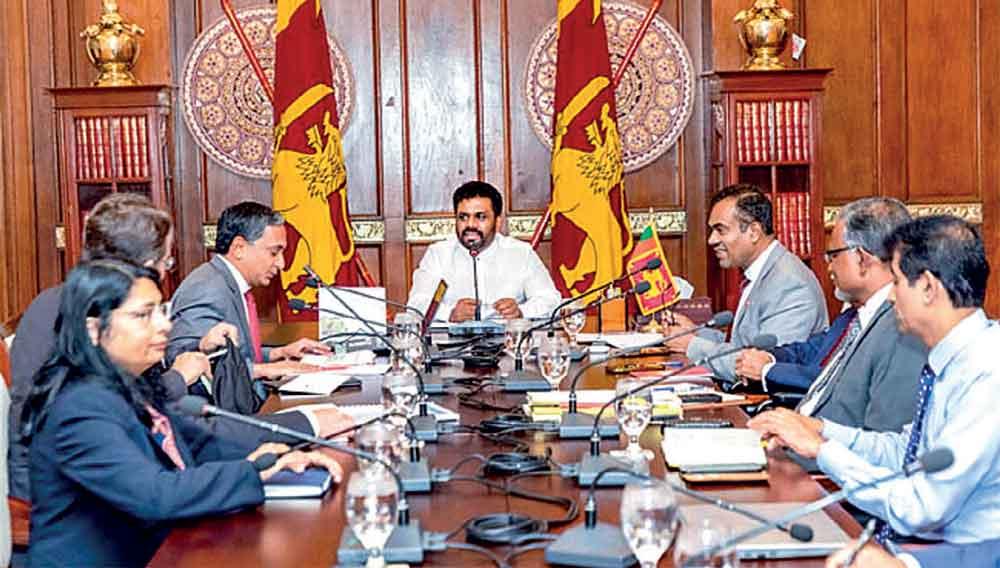
The picture shows a high-level delegation from the International Monetary Fund (IMF) visiting Sri Lanka last year and meeting President Anura Kumara Dissanayake at the Presidential Secretariat in Colombo
 Restructuring is often a top down process. The Board of Directors may want to restructure a company by laying off workers. A Government may decide to restructure State Owned Enterprises (SOEs) by privatising them.
The IMF may demand that a country restructure its debt by imposing austerity measures. Furthermore, such painful measures are justified as necessary for integration with better institutional and economic structures. But what if the problem lies with the powerful actors and the very structures that are the objective of such restructuring?
For decades now the global economy and certainly countries in the Global South have been experiencing repeated and deepening crises. The solution pushed by the global powers and the IMF was greater integration with the international economic order through privatisation and the free flow of capital and goods. Not only have such policies failed, rarely has a country successfully recovered from a crisis through an IMF programme. Furthermore, the neoliberal class project that created the contemporary international economic order over the last five decades itself is now in crisis.
In this context of neoliberal globalisation unravelling, what would restructuring of the international economic order look like from the periphery, and particularly for small states like Sri Lanka? I argue that such restructuring will have to begin by abolishing the IMF. Furthermore, a new international economic order through “delinking” and creating a bloc of small states would be a prudent solution to the devastating economic crisis of the 2020s.
Delinking
When the global economy went through a long downturn in the 1970s there were competing views on the way forward. The golden age of capitalism for the Western economies that had gained from over two decades of exceptional growth because of the stimulus of post-war reconstruction was in trouble. A couple decades after decolonisation, the Third World countries were also indebted and in a desperate state. In response the United Nations Conference on Trade and Development (UNCTAD) led by Gamini Corea put forward a vision for a New International Economic Order (NIEO) in 1974. While NIEO had the support of the majority of the countries in the United Nations, the West rejected it in favour of what benefited their capitalist class, particularly finance capital. Backed by the US Treasury, the IMF and the World Bank took forward structural adjustment programmes that drastically changed the structures of the Third World countries leading to open economies that were increasingly crisis prone.
It was during this time that Egyptian economist Samir Amin put forward the powerful idea of delinking. Amin saw the difficulties for Third World countries to develop in an unequal world, and a capitalist system dominated by the Western powers. As a result, his proposal was for an alternate bloc of Third World countries. However, he emphasised that delinking is not autarky. Rather, delinking is an alternative form of linking among Third World countries, which means South-South solidarity for trade and investment. It is on equal terms that small states can develop. Otherwise, the terms of trade – the value of exports of developing countries in relation to the value of imports from developed countries – is unfavourable. This tendency contributes to repeated debt crises. Furthermore, the kind of investment that comes from capitalist powers will only lead to extraction and accumulation in the metropolis to the detriment of countries in the periphery.
Way forward
The crisis of the 2020s is epitomised by the fact that half of the world’s developing countries are in debt distress. With tremendous shocks such as the Covid pandemic, price hikes with the war in Ukraine, and now the Trump trade shock, there is a need for a new set of policies that have been denied to the developing world through IMF programmes.
First, as with any economic depression like the one facing Sri Lanka, austerity is not only devastating. It undermines recovery. In contrast, deficit financing and counter cyclical fiscal policies are needed. Given that the profit-driven private sector will not invest or expand production during a crisis, it is the government that should stimulate production and employment through a virtuous cycle of investment. In the medium term, as I argued in my last column, there is a need for domestic development banks that can initiate new sectors and ensure growth. But here again, the only two development banks of Sri Lanka were privatised and made into commercial banks under IMF pressure in the 1990s.
Next, the West and the IMF have double standards. There is one set of policies for the West and another for the Global South. The West is now pursuing industrial policies. But for decades they have been insisting that developing countries allow the market to determine the future of their economies. Southern countries must now construct their own industrial policies in addition to devising new methods of national planning.
A restructured international order for countries like ours, should be taken forward with South-South solidarity to form a delinked bloc. Indeed, powerful countries are never going to save us, which is indeed the lesson from centuries of colonial and imperialist extraction. Rather, it is our initiative, of progressive governments in small states coming together as equals and scaling up to meet the power of hegemons, which can succeed in creating effective barriers to imperialist accumulation through dispossession, and secure our own development. Such a program would necessarily involve national planning, industrial policies, and domestic as well as regional development banks under the control of a group of small states. Furthermore, self-sufficiency should become both a concrete policy and an ideological vision to confront the legacy of dependency.
While I put forward some ideas above as a way forward inspired by some Third World economists including Samir Amin, all this, of course, is subject to debate. Indeed, rigorous debates are necessary from within the Global South if a different international economic order is to be created in the years and decades ahead.
In this context, to discuss and debate such ideas, over a dozen economists from Africa, Asia and Latin America will be participating in a two day conference on the legacy of the Bandung Conference, where many leaders of formerly colonised countries came together in Indonesia in 1955 to chart a different path. The conference titled, ‘70 Years after Bandung: Challenges and Struggles on the Road to Self-Determination and South – South Solidarity,’ and co-hosted by the International Development Economics Associates (IDEAs), the Bandaranaike Centre for International Studies (BCIS) and Yukthi Debt Justice Movement, will be held at BCIS in Colombo on 2nd and 3rd June 2025.