Reply To:
Name - Reply Comment
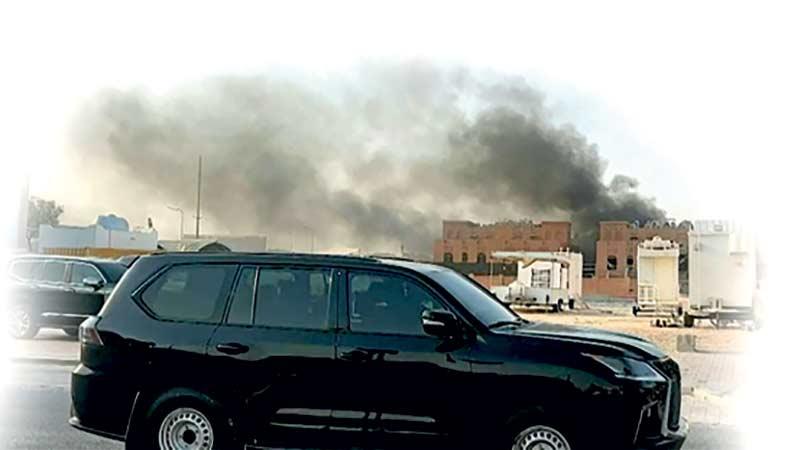
The Doha residence that housed the Hamas team came under Israeli attack on Tuesday. AFP
Tuesday’s attack on Qatar is teaching the Gulf states—and other Arab and Islamic nations, including Turkey—a key lesson they’ve long had in their defence playbook but refused to learn: all defence treaties with the US or any Western power come to naught if the aggressor is Israel
 “With friends like these, who needs enemies?” Whoever first uttered those words, the idiom has gained more traction in politics than in any other field. After Israel’s attack on Qatar on Tuesday, one imagines the tiny Gulf state repeating them with bitter irony.
Sometimes international relations take the shape of a love triangle. But on Tuesday, Qatar learned that despite its endearing words, pleasantries, gifts, concessions, and companionship, it was only a sidekick; the United States’ true love is Israel.
Like the woman betrayed in a love triangle, Qatar must be wailing, muttering these words: “Oh, what of the gifts and praises I heaped on you the last time you came to see me? None gave you a more expensive gift than I did—a US$400 million luxury jet fit for a king of kings. I even gave you a trillion-dollar cheque. Yet in my hour of crisis, you took the side of your true love, even though it was she who attacked me and violated my dignity.”
The US was not there for Qatar in its hour of need. Period.
After the United States’ failure to protect Qatar when Israel attacked a residence housing Hamas leadership involved in negotiations to end Israel’s genocidal war on Gaza, we, the Middle Eastern watchers, are reminded of the famous words of Cardinal Thomas Wolsey after the king whom he served failed to defend him: “If I had served my God as diligently as I served my King, He would not have given me over in my gray hairs.”
Qatar may be a small state, but it plays a larger-than-life role in global diplomacy. Besides its tireless efforts to broker a ceasefire in Gaza and facilitate humanitarian aid to the besieged Palestinian territory, it also serves as a peacemaker in global conflicts—Afghanistan, Congo, and Libya, to name a few.
In diplomacy, global peacemaking, and humanitarianism, Qatar—the world’s richest country by GDP per capita—stands as a giant. But when it comes to defending itself, it relies on the United States, even while stockpiling advanced American and Western weapons—weapons it is not permitted to use against (you guessed it) Israel
The US signed a defence agreement with Qatar in 1992. The deal allows the US to maintain its Central Command in Qatar and implies security guarantees, though it does not explicitly include an equivalent of NATO’s Article 5 that would warrant US military intervention if Qatar was attacked by an external force.
When Qatar went into panic mode during Iran’s retaliatory attack on a US base in Qatar last June, the US came in with all guns blazing to defend it. Qatar saw the strike as an attack on its sovereignty, though the Iranian assault was largely performative, with Qatar and the US being intimated well in advance.
But this Tuesday, the US guns were silent. Strangely, its advanced radars failed to detect the incoming Israeli jets that passed through the airspace of neighbouring ‘friendly’ Arab states.
By the time the US informed Qatar of the Israeli attack, ten long, harrowing minutes had already passed—Israel had completed its mission. And they still call this the US commitment to protect Qatar, a country it regards as a special non-NATO ally.
To console Qatar, US President Trump said he was not thrilled about Israel’s attack, which he claimed did not advance either Israel’s or America’s goals. Yet he endorsed Israel’s target—Hamas leadership. Was he adding insult to Qatar’s intelligence? Qatar erroneously believed that it was safe because of its defence alliance with the US, and Israel would, therefore, not harm the Hamas negotiators it was hosting, even though Israel had previously killed Hamas leader Ismail Haniyeh in Iran and other high-profile resistance figures in various countries.
Meanwhile, Western media appear to be in overdrive, trying to lend credibility to the claim that an angry Trump, in a phone call to the Israeli Prime Minister, reprimanded him for the attack.
To seasoned analysts, Trump’s angry words seem like a wink-and-nod performance. After all, the US and Israel are one mind, two hands: if the right hand moves, the left cannot claim it did not know.
If we accept that Trump’s reprimand of Israel is genuine, then Israel’s actions amount to a stab in the back of the United States. But the US wouldn’t mind. The USS Liberty incident in 1967 shows that even if Israel kills American servicemen, the US will still support it. The guiding principle is this: Netanyahu may be a son of a b****, but he’s still our son of a b****. For the United States, there is more to gain by bedding with Israel than by forging alliances with any Arab country. Hours after the attack, Trump called Qatar’s Emir, Sheikh Tamim bin Hamad Al Thani, to promise that the US would take “all necessary measures” to safeguard Qatar’s security and sovereignty. Qatar appears to accept the United States’ assurance. This may be Qatar’s diplomacy—but it also signals Qatar’s desperation. On whom else can Qatar rely if it is attacked by a country other than Israel? Only the US.
The Gulf Cooperation Council (GCC) has a NATO-like collective defence arrangement—the Peninsula Shield Force. There is no indication that Qatar invoked this mechanism in the aftermath of Tuesday’s Israeli attack. Against Israel, the GCC’s defence pact is as good as dead from the word go.
Neither the Peninsula Shield Force nor the various defence agreements that Gulf countries have signed—collectively or individually—with the United States offer any protection against Israel’s aggression. The Peninsula Shield Force is largely focused on Iran, with Israel and the US promoting Iranophobia in their unscrupulous bid to pressure Arab nations into signing the so-called Abraham Accords and to buy their silence to Israel’s atrocities in Palestine.
By the time the US informed Qatar of the Israeli attack, ten long, harrowing minutes had already passed—Israel had completed its mission. And they still call this the US commitment to protect Qatar, a country it regards as a key non-NATO ally
Tuesday’s attack on Qatar is teaching the Gulf states—and other Arab and Islamic nations, including Turkey—a key lesson—all their defence treaties with the US or any Western power come to naught if the aggressor is Israel. Middle East watchers would stake their careers—or even their lives—on the claim that NATO’s Article 5, which treats an attack on one member state as an attack on all, may not apply if Turkey, a NATO member, is attacked by Israel. Such is the hold Israel has on the United States.
The way forward is Arab unity and defence arrangements devoid of US involvement. The combined wealth of the Gulf Arab nations could certainly work miracles—producing homegrown weapons that rival US and Israeli sophistication. Iran’s development of hypersonic missiles and advanced drones should serve as an eye-opener. But Israel and the Zionist-friendly West will not allow the Arabs to unite under a single authority—be it a Khilafah or a United States of Arabia. The venom injected into the Arab body politic by the 1916 Sykes-Picot Agreement—brokered between Britain and France—continues to divide the region into nation-states and remains active to this day. As long as Arabs think in terms of fragmented national identities rather than Pan-Arab solidarity, Israel will continue destabilising the Middle East and expanding into Arab lands.