Reply To:
Name - Reply Comment
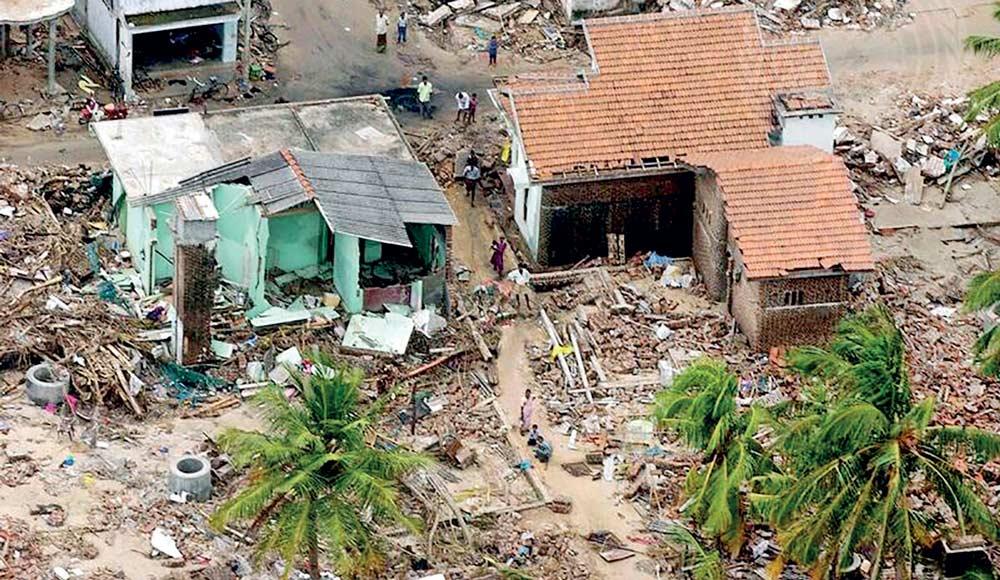
The tsunami offers a template for how Sri Lanka could harness international assistance now
 One might say that despite the government’s pre-disaster response being lackadaisical, bordering on criminal negligence, its post-disaster response has so far been commendable.
Much praise should go to the CEB for the speedy restoration of power supply to flood-affected areas, and to state agencies and the military for restoring a large part of the flood and landslide-affected road network
A vast swathe of farm land and crops have been decimated: according to the Director General of essential services, 137,265 acres of farmland and 305 minor irrigation projects have been damaged
 As Sri Lanka assesses the scale of the devastation of Cyclone Ditwah, the worst-ever natural disaster since the Indian Ocean tsunami of 2004, it should also plan for the next phase of reconstruction in earnest. And given the scale of destruction, the government should organise an international conference to harness international assistance. The Tokyo donor conference of 2003 may offer the template—and India, with its elevated global profile, should be the partner.
The full picture of the damage will only be available when the World Bank finalises its detailed assessment of destruction and the financial requirements for reconstruction. The government has commissioned the World Bank to conduct a Global Rapid-Post Disaster Damage Estimation (GRADE), which should be available by next week.
The devastation is already overwhelming: 638 dead, 19 missing, half a million families affected, 5,354 houses completely damaged, and 20,373 families still housed in temporary safety shelters, according to the Disaster Management Centre as of 9 am yesterday (December 9th).
A geospatial analysis from the United Nations Development Programme (UNDP) shows that almost 20 per cent of the country —1.1 million hectares— were inundated by flood waters, and 16,000 kilometres of road (twelve times the coastline) were exposed, including over 278 km of railway tracks and 480 bridges. Only 30 per cent of the 1,593 km of railway lines are currently operational.
A vast swathe of farm land and crops have been decimated: according to the Director General of essential services, 137,265 acres of farmland and 305 minor irrigation projects have been damaged.
The government has mobilised a sweeping Rs 72.2 billion relief package for flood victims, including monthly payments for the displaced, education expenses, grants for livestock losses and crop damage, and compensation for partially or fully damaged houses.
One might say that despite the government’s pre-disaster response being lackadaisical, bordering on criminal negligence, its post-disaster response has so far been commendable. Much praise should go to the CEB for the speedy restoration of power supply to flood-affected areas, and to state agencies and the military for restoring a large part of the flood and landslide-affected road network.
The government’s decision to ban resettlement in identified landslide-prone areas and in areas above 5,000 feet is also commendable. Until the disaster, such a political directive could not have been popular or politically palatable. Yet the extent of the devastation highlights the cost of long-term negligence.
However, the stubborn truth is that, despite the government’s best efforts, Sri Lanka could not bear the cost of reconstruction alone. Already, back-of-the-envelope figures on the extent of the damage are floating around. The Director-General of essential services has claimed the damage to be in the tune of $6-7 billion or about 6-7 per cent of the GDP.
The General Manager of the Railway has estimated that railway tracks have incurred damage of around 190 billion rupees (about $600 million).
Some others have even claimed that the destruction of the recent disaster far exceeded that ofthe tsunami. Such comparisons are misleading and would undermine the credibility of the government’s pronouncements. If the damage is higher on paper in nominal terms, that is because the Sri Lankan economy at the time of the tsunami was barely one-fifth of its current size ($20 billion in 2004). Tsunami was a juggernaut that decimated one half of the coastal belt and claimed 35,000 lives, which has no comparison to the recent tragedy.
However, the tsunami offers a template for how Sri Lanka could harness international assistance for the post-disaster reconstruction. For instance, in May 2005, the country hosted a major conference in Kandy with over 100 foreign delegates, including representatives from the UN and the World Bank, to support post-tsunami reconstruction and accelerate aid delivery to the then conflict-affected areas in the North-East.
Another example would be the Tokyo donor conference, held on June 9-10, 2003, with the participation of 51 countries and 20 international financial institutions, which granted US$ 4.5 billion to Sri Lanka over four years. The pledges amounted to 25 per cent of the Sri Lankan GDP at the time, though much of that fizzled away after the LTTE, which boycotted the conference, later launched the fourth Eelam war.
Sri Lanka should proceed to organise an international summit for the post-Ditwah reconstruction in earnest, soon after it takes stock of the scale of the damage, which the government should receive through the World Bank assessment by next week.
However, such an endeavour is where the government’s foreign policy acumen and partnerships could come to play. For instance, the Tokyo donor conference was organised by Japan at the request of the Ranil Wickremesinghe administration at the time. Though one might lampoon a member of the old guard like Wickeremesinghe for many of his idiosyncrasies, that was a case of how personal and diplomatic ties come into play when the country is in need.
One should not expect the NPP/JVP to replicate Wickremesinghe’s strengths and follies. But it could still mobilise its newly cultivated foreign policy goodwill and reach out to Sri Lanka’s traditional friends of India, China, Japan, America, and the EU to rebuild Sri Lanka after the deluge. One must agree that the international context for foreign assistance is not as conducive as it was twenty years back. The United States, at best, pays cursory attention, and mobilising substantial resources to aid a far-flung land is no longer politically popular and is strongly opposed by Donald Trump’s MAGA base.
The European countries, which, then, had sufficient resources and a foreign policy will, are now besieged by multifaceted domestic discontent over immigrants and worsening fiscal conditions while bankrolling the war in Ukraine. Japan has seen its international profile decline over the past two decades and is threatened by rising China. Sri Lanka might have damaged its bridges with Tokyo over the unilateral suspension of the Colombo metro-railway project and other allegations over the construction of the second terminal at the Katunayake international airport.
All of that negative impact, though, might not matter as much as it threatens to be. The extent of Indian assistance, and a series of high-profile visits undertaken by the Sri Lankan leadership, including the President and the Prime Minister, to New Delhi, suggest that the new administration has perfected—if not nearly perfected—its relationship with India. That’s where Sri Lanka’s opportunity lies. The President, who had already spoken to Prime Minister Modi over our travails, should now reach out to New Delhi to organise a conference to rebuild Sri Lanka on our behalf.
The Tokyo donor conference could provide a template. At a time of widespread international fatigue with foreign assistance, India’s elevated international profile should help Sri Lanka harness support. If the government goes it alone, we might end up with scraps. India’s emphasis on its neighbourhood-first policy should also serve Sri Lanka’s interests.
The government could also reach out to China separately for help – though Beijing itself is exhausted with a myriad of its own economic problems, which might constrain the scale of assistance.
Some pundits insist that the government burns through its unspent 1.2 trillion rupees of capital expenditure earmarked for this year. Such calls, though politically opportune, are counterproductive—thought that could be the last resort if international help is not forthcoming.
Sajith Premadasa wants to cancel the IMF agreement. Such calls are a mark of opportunism and stupidity. Sri Lanka should reach out to the world for help, and given our fragile economic recovery, international friends will heed the call. Unless any foreign policy genius could find a better alternative, which is unlikely, India should be the conduit. Or else we might end up with petty cash. And Sri Lanka should move fast, before the rest of the world forgets the tragedy and moves on.
Follow @Rangajayasuriya on X