Reply To:
Name - Reply Comment
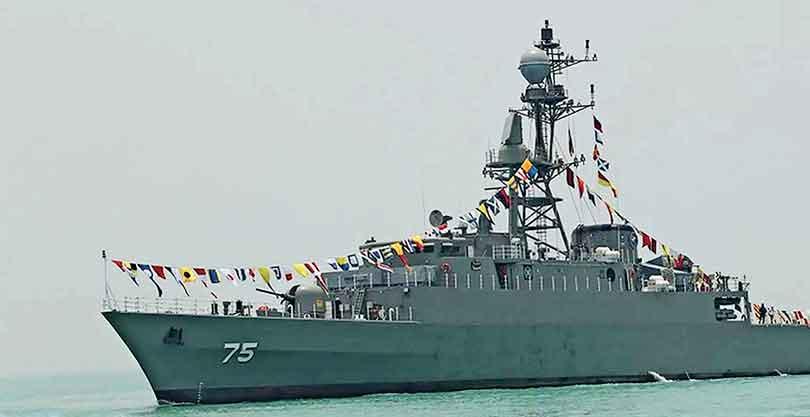
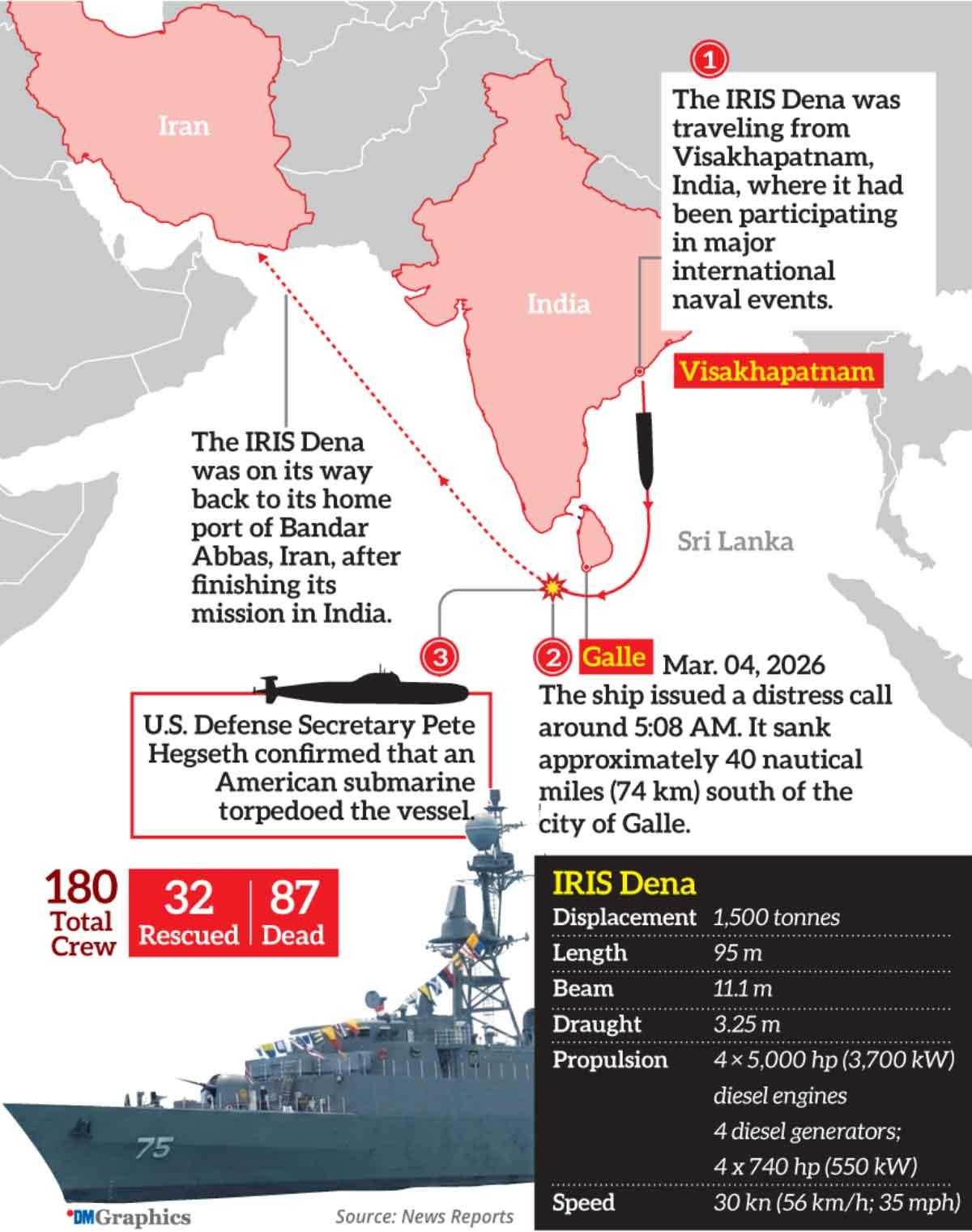
IRIS Dena, pennant number 75, which belonged to the Iranian Navy’s Southern Fleet, was sunk in the southern cost of Sri Lanka (Picture source: Iranian MoD)
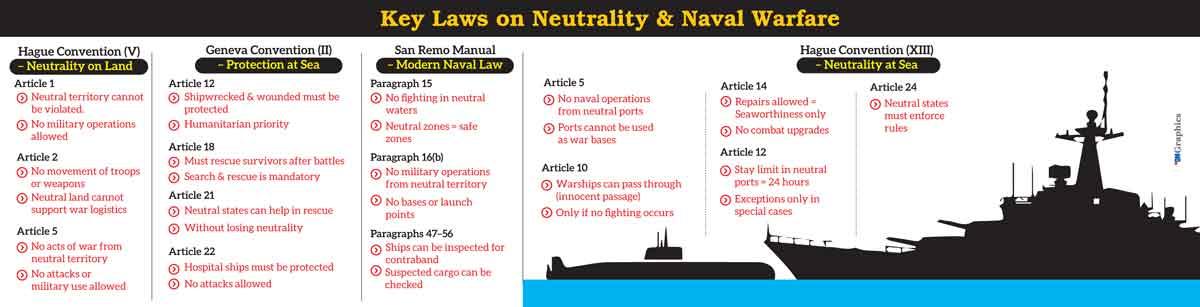
- Hague Conventions V and XIII limited belligerent warship entry into neutral ports to 24 hours
- The Montevideo episode, taught in legal and diplomatic schools, resonates in Sri Lanka following the sinking of IRIS Dena
- Neutrality in International Law Neutrality is the legal status assumed by states that choose not to participate in an armed conflict
 The story of the German pocket battleship Admiral Graf Spee in 1939 remains one of the most cited lessons in the law of neutrality. During her commerce-raiding mission in the South Atlantic and Indian Ocean between September and December 1939, Graf Spee sank nine merchant ships totalling over 50,000 GRT. Her actions forced the British to deploy multiple hunting groups across vast oceans, culminating in the Battle of the River Plate, where British cruisers HMS Exeter, HMS Ajax, and HMNZS Achilles engaged her. Severely damaged, Graf Spee sought refuge in the neutral port of Montevideo, Uruguay, before being scuttled. This incident highlighted the strict application of neutrality principles under the 1907 Hague Conventions V and XIII—rules still referenced in modern maritime law.
The conventions limited belligerent warship entry into neutral ports to 24 hours, allowed repairs only to restore seaworthiness (not combat capability), and prohibited replenishment beyond provisions for the crew. Neutral states were also responsible for ensuring impartial treatment of all belligerents. The Montevideo episode, often taught in legal and diplomatic schools, resonates today in Sri Lanka, following the sinking of the Iranian naval vessel IRIS Dena and the temporary shelter granted to her accompanying ships, IRIS Bushehr and IRIS Lavan, in Colombo and Kochi, India.
Understanding Neutrality in International Law Neutrality is the legal status assumed by states that choose not to participate in an armed conflict while maintaining impartial relations with all belligerents. Neutral states refrain from providing military support and undertake obligations to prevent hostilities from spreading through their territory or waters.
The Hague Conventions of 1907, V on land warfare and XIII on naval warfare, codified longstanding customs about the rights and duties of neutral states. These principles are reinforced today by customary international law, the Geneva Conventions, and the San Remo Manual on Naval Warfare, which clarifies modern naval operations involving neutral waters. Neutrality applies only in international armed conflicts between states. By assuming a neutral status, third states commit to abstaining from hostilities and ensuring that their territory and waters are not exploited for military purposes.
Historical Roots
Neutrality evolved to prevent wars from spreading geographically and to protect commerce.
By the 17th and 18th centuries, maritime powers began asserting neutral rights, particularly the protection of merchant shipping. The Declaration of Paris (1856) strengthened these protections, recognising neutral flags and codifying blockades. Later, the Hague Peace Conferences formalised obligations to prevent neutral territory from being used as a base for belligerent operations. These frameworks laid the foundation for modern neutrality, balancing sovereignty, commerce, and conflict containment.
Core Principles
The law of neutrality rests on three pillars:
Abstention – Neutral states must refrain from participating in hostilities or aiding belligerents with troops, weapons, or military facilities.
Impartiality – Neutral states must apply rules equally, ensuring no belligerent gains an advantage by exploiting neutrality.
Prevention – Neutral states must stop their territory from being used for military actions, including attacks, recruitment, or establishing bases.
At sea, these principles are codified in Hague XIII, which limits warship stays, repairs, and supplies in neutral ports. Modern interpretations in the San Remo Manual reaffirm these obligations.
Modern Conflicts and “Undeclared Wars”
Today, wars often occur without formal declarations. Military operations, limited strikes, or hybrid conflicts challenge traditional neutrality. Under the Geneva Conventions’ Common Article 2, an international armed conflict exists whenever hostilities occur between states, triggering neutral obligations.
The Russia–Ukraine war illustrates this. Third states face complex decisions, balancing assistance, neutrality, and legal obligations. Similarly, attacks like the sinking of IRIS Dena test neutral states’ ability to uphold the law while responding to regional crises.
Neutrality and Strategic Dilemmas
The Persian Gulf highlights modern tensions between neutrality law and military realities. Gulf States such as Qatar, Bahrain, Kuwait, and the United Arab Emirates host significant United States military bases that are central to regional security arrangements, yet aim to avoid direct involvement in regional conflicts. Traditional neutrality forbids belligerents from using neutral territory for operations, but permanent military installations complicate matters.
States often adopt “benevolent neutrality,” officially neutral while indirectly supporting one side. Historical examples include U.S. Lend-Lease aid to Allies before entering World War II.
Gulf States today may provide logistical or defensive support while avoiding direct combat.
Yet the distinction between support and participation is subtle; command centres, intelligence operations, and logistical hubs can implicate neutral states in hostilities if they directly aid military operations. This ambiguity creates a strategic paradox for Gulf States in the current conflict, trying to stay neutral while hosting major foreign military infrastructure. On one side, such bases offer security guarantees, deterrence, and advanced defensive capabilities. On the other hand, their involvement in military networks that support active hostilities exposes the host states to constant devastating retaliation by Iran and undermines the credibility of neutrality claims. The Persian Gulf thus exemplifies how the classical law of neutrality, developed in an era of geographically limited wars, faces significant challenges.
Indian Ocean Security and
Neutral Ports
The conflicts in the Gulf involving Iran carry wider consequences for the Indian Ocean, a historically peaceful maritime zone. Disruption of shipping through chokepoints such as the Strait of Hormuz risks disrupting global trade and triggering an energy crisis and eventually an economic recession should the conflict be prolonged. Iran’s unilateral closure of the Strait of Hormuz, a strategic Strait used for international navigation, let alone sporadic attacks on oil tankers, lacks any legal basis. Under UNCLOS, the Transit Passage is unimpeded, and International Law on armed conflict at sea (Hague Convention XII) prohibits attacks on merchant vessels unless a ship ascertains a military objective. Mining and conductingindiscriminatory attacks on ships, restricting transit passage, is illegal as well.
The Indian Ocean hosts crucial East–West sea routes connecting the Gulf, South Asia, and Southeast Asia. Incidents like the Dena incident highlight the importance of neutrality in maintaining maritime order. By rescuing survivors and controlling port access, neutral states safeguard trade, human lives, and regional stability. The maritime security and freedom of navigation in the Indian Ocean will be at an unprecedented threat in the event of escalation of belligerency at sea through direct or Proxy attacks, which was evident in 2023 through 2024, when merchant vessels were subject to attack using drones both in the air and on the surface.
Belligerents may board or search neutral merchant vessels for contraband, and potentially the USA, attempting to exercise an embargo on Iran, with overreach could escalate conflict in the Indian Ocean. Neutral ports play a key role. Hague XIII restricts belligerent warship stays, repairs, and operations in neutral waters. On 4th March 2026, IRIS Dena, a modern 1,500-ton frigate of the Iranian Navy, was torpedoed by a US Navy Submarine 19 nautical miles off Galle. Sri Lanka Navy recovered 32 survivors and 84 bodies. Her accompanying ships, Bushehr and Lavan, were granted temporary refuge in Colombo and Kochi, in accordance with strict neutrality rules.
Legal Implications
The Second Geneva Convention mandates humane treatment for wounded or shipwrecked forces, regardless of nationality. Neutral states may temporarily intern personnel while preventing the port from being used for military operations. Attacks outside neutral waters are lawful under the San Remo Manual and customary international law, provided they respect the principles of distinction, proportionality, and military necessity and explain the legitimacy of the US submarine to sink IRIS Dena outside the Sri Lankan
Territorial Sea.
Neutral states must also regulate repairs and replenishments. Hague XIII allows only what is necessary for seaworthiness, prohibits enhancements to combat capability, and imposes strict time limits. Impartiality is essential: all belligerent vessels must be treated the same. Sri Lanka and India applied these rules with care, preserving neutrality while fulfilling humanitarian duties.
Limits of Innocent Passage
Under UNCLOS, belligerent warships may pass through territorial seas via “innocent passage.” However, damaged ships that actively avoid combat or return to operations may lose this right. Although Article 10 of Hague XIII also allows belligerent warships to be in ‘mere passage’ within territorial waters, Articles 1 and 5, taken together, prevent a belligerent from exploiting neutral waters for protection from the enemy. Coastal states may restrict passage to prevent their waters from becoming tactical corridors. This principle explains why Dena, Bushehr, and Lavan required entry into neutral ports rather than violating neutral seas for safe passage.
Neutral states must actively enforce neutrality in their territorial waters. Failure to do so may invite belligerents to intervene, undermining neutrality. In 1940, during World War II, the British destroyer HMS Cossack entered neutral Norwegian waters, boarded the German tanker Altmark, and rescued 300 British prisoners captured by German raiders while the tanker was passing through Norwegian territorial waters.
Lessons from history
The Graf Spee incident in 1939 and the IRIS Dena in 2026 demonstrate continuity in neutrality law. Montevideo and Colombo showed how neutral ports can mediate crises, enforce legal limits on belligerent activity, and offer humanitarian aid while managing diplomatic pressure from belligerent states. Neutrality law, grounded in abstention, impartiality, and prevention, continues to guide states in complex modern conflicts, balancing legal, strategic, and humanitarian considerations. This incident was not the first time Sri Lanka had been in the spotlight for its neutrality. Sri Lanka faced a similar challenge earlier when Pakistan air force planes were permitted to land and refuel in 1976, during the East Pakistan war, after India closed its airspace to West Pakistan. The unique stance taken by the Sri Lankan government was that East and West Pakistan are not belligerent states, and that neutrality, as applied in international armed conflict, was irrelevant.
Conclusion
While warfare has evolved, the principles of neutrality remain vital. Classical laws codified in the Hague Conventions, the Geneva Conventions, and the San Remo Manual remain fully applicable in the 21st century. Coastal states such as Sri Lanka and India demonstrate that adherence to these laws preserves sovereignty, protects lives, and stabilises critical maritime corridors. The IRIS Dena incident is not only a contemporary test of neutrality, but also a reaffirmation of its enduring relevance in international law.
(The writer is the 25th Commander of the Sri Lanka Navy)