Reply To:
Name - Reply Comment
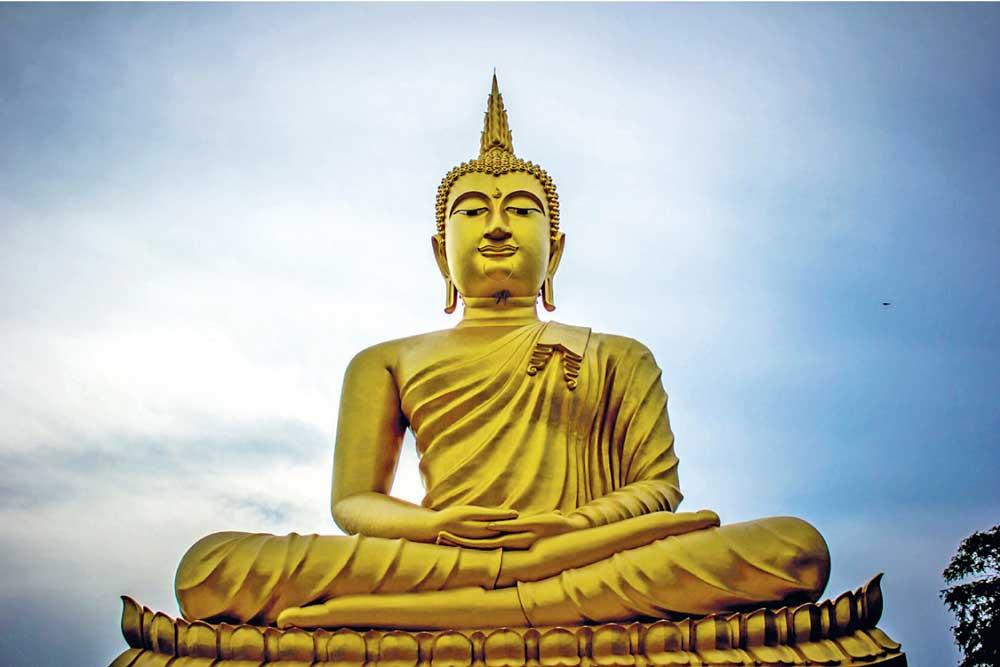
This doctrine of anatta (no self) in Buddhism is a prime example of a concept that has profound metaphysical implications
 Metaphysics explores fundamental questions about reality, existence, and being, primarily through abstract thought and reasoning. Metaphysics should be distinguished from philosophy. While metaphysics is a specific branch of philosophy, its scope is narrower in focus and has a narrower connotation than philosophy.
Metaphysical and philosophical concepts are closely intertwined with Buddhism and many other religious traditions. Metaphysical doctrines in Buddhism explore philosophical beliefs that extend beyond the physical realm.
Buddhism presents a profound set of metaphysical doctrines, such as the concept of Nirvana, the Four Noble Truths, the Noble Eightfold Path, the concept of Dependent Origination, the Law of Kamma, and the Three Marks of Existence. Together, these teachings offer invaluable insights into the nature of reality, the root of suffering, and the transformative path to liberation.
Overall, the Buddha’s teachings present a distinctive perspective on fundamental questions of existence, emphasising the self and human experience while incorporating both philosophical and esoteric insights. Through this lens, Buddhism provides distinctive perspectives on existence compared to other philosophical traditions.
Different schools within Buddhism approach these questions in diverse ways, with some formulating elaborate philosophical frameworks, while others focus on dismantling all viewpoints, including metaphysical ones.
Western philosophical perspectives often classify Buddhism as nontheistic, as it does not subscribe to specific notions of divinity or formal theology. In theistic traditions, the concepts typically associated with God, such as omnipotence, omniscience, transcendence, and eternity, are firmly within the metaphysical domain and intrinsically linked to metaphysical inquiries.
However, the classification of Buddhism as entirely non-theistic and non-metaphysical merits reconsideration, as many Buddhist sutras refer to a variety of supernatural beings, such as demigods, devas, and other celestial beings that exist within the Buddhist cosmology. These celestial beings, which fall within the realm of metaphysics, are not regarded as creators or eternal entities; rather, their existence is part of the cycle of rebirth known as samsara.
The concept of nirvana, rooted in metaphysical principles, occupies a distinctive place within Buddhist thought. Nirvana, in the context of Buddhist philosophy, is a complex and multifaceted concept that encompasses not only metaphysical elements but also philosophical and psychological dimensions. It represents the ultimate liberation from suffering and the dissolution of desire, a state a person achieves through their perseverance. Nirvana is elusive, beyond the reach of ordinary perception and comprehension through conventional means. Some interpret it as a profound realisation of the ultimate truth attained through deep meditation and wisdom. The Buddha likened Nirvana to a fire that is extinguished or a flame that has gone out, symbolising the complete cessation of suffering and desire.
Three marks of existence
Additionally, Buddhism articulates fundamental metaphysical principles through the illustration of the three marks of existence. In the Pali tradition of the Theravada school, the three marks are (a) Sabbe sankara anicca, that is, all conditioned things are impermanent. Buddhism maintains that all material phenomena are transient, undergoing a continuous cycle of birth, growth, decline, and dissolution. Living beings come into existence, develop, age, and ultimately cease to exist. (b), Sabbe sankhara dukka, that is, all conditioned things are unsatisfactory, imperfect and unstable. Dukka can be mental or physical; it can be anything from small irritations up to intense suffering. (c) Sabbe dhamma anatta, that is, all conditioned and unconditioned things have no unchanging self or soul. This doctrine of anatta (no self) in Buddhism is a prime example of a concept that has profound metaphysical implications.
Moreover, the doctrine of dependent origination (paticca samuppada) exemplifies another cardinal principle of Buddhist metaphysics, demonstrating the interconnectedness of existence and the conditions that lead to suffering. The doctrine of Dependent Origination stands as one of the most profound teachings within Buddhism, accessible only to those who have attained a high degree of spiritual maturity. This profound doctrine can be comprehended with spiritual maturity.
The Middle Way or Middle Path in Buddhism, which serves as another cornerstone of Buddhist philosophy, refers to two major aspects of Dhamma, the first teaching of the Buddha upon awakening. Firstly, it refers to a spiritual practice that steers clear of both extreme ascetism and sensual indulgence.
In Buddhism, the concept of rebirth signifies the cyclical journey of birth, death, and rebirth, intricately intertwined with the workings of kamma (or karma).
Moreover, the idea of rebirth, often synonymous with reincarnation, is a cornerstone in numerous religious and spiritual traditions. However, the Buddhist doctrine of rebirth is different from the theory of reincarnation and transmigration in other religious traditions.
Kamma, another central tenet in Buddhist philosophy, is a profound metaphysical construct essential for grasping the rhythm of rebirth and the ramifications of our actions. It signifies intentional action rooted in volition that shapes our experiences and moulds our future existences. Operating as a natural law of cause and effect, kamma stands independent of any divine interference, devoid of rewards or punishments bestowed by an external deity. It is not merely the act itself that defines kamma; it is the underlying intention that infuses it with meaning.
Although the Four Noble Truths of Buddhism are not inherently metaphysical, dealing with abstract, unobservable entities or concepts, they encompass metaphysical dimensions, particularly regarding the nature of reality and the cycle of existence.
The first Truth Dukka (suffering) acknowledges the pervasive nature of human suffering. Dukka encompasses a spectrum of human experiences ranging from minor irritations to intense suffering and deep discontent. The reality of suffering encompasses not only physical pain but also the fundamental unsatisfactoriness and fleeting nature of all conditioned experiences. The second Truth, the origin of suffering (Samudaya). Suffering arises from craving, attachment, and ignorance.
The Third Truth, the cessation of Suffering.(Nirodha) It is possible to end suffering by eliminating craving and attachment.
The Fourth Truth, the path leading to the cessation of suffering.(Magga). It is the Noble Eightfold Path that leads to the end of suffering.
Buddhists hold the belief that there are various realms or dimensions of existence, which fall within the metaphysical domain. A human being goes through repeated cycles of birth and death until achieving supreme bliss, known as Nibbana. Buddhist cosmology identifies six realms in which rebirth can occur, encompassing the cycle of existence called samsara. These realms include the Hell Realm (Naraka), the Hungry Ghost Realm (Preta), the Animal Realm (Tiryagyon), the Demigod Realm (Asura), and the God Realm (Deva).
Rather than being viewed as physical locations, these realms are often understood as states of being shaped by one’s kamma (actions) and mental afflictions. They represent varying levels of existence, ranging from blissful experiences to those marked by profound suffering. When we examine the fundamentals of Buddhism, they reveal a particular way of viewing human life and a unique understanding of reality and human existence, which constitutes a distinct metaphysical vision.