Reply To:
Name - Reply Comment
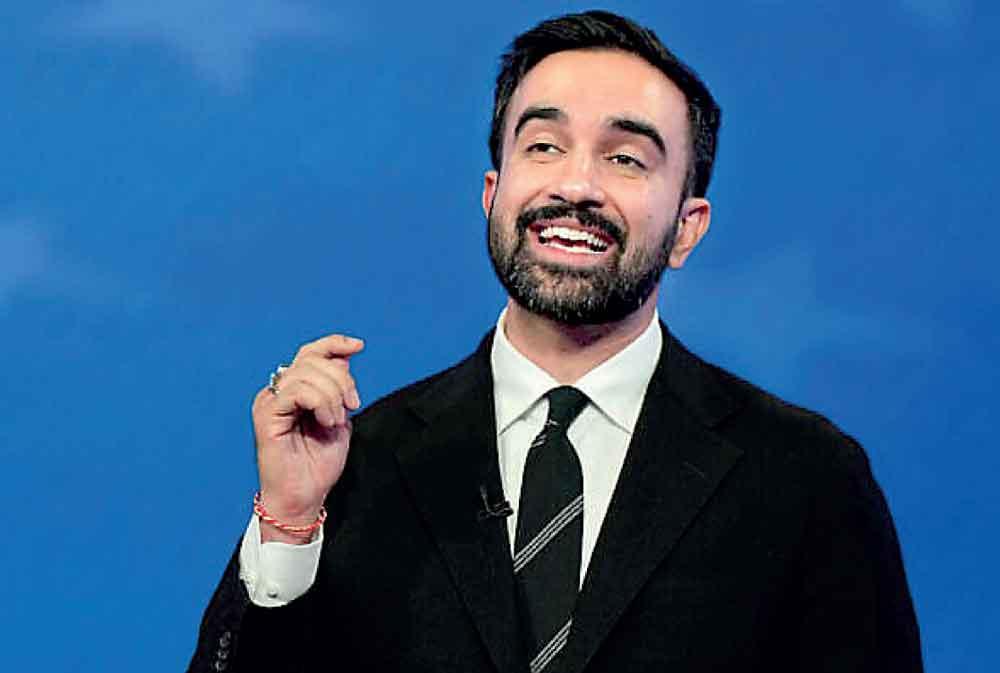
Zohraan Mamdani
In an American context, where the words communist and socialist are treated as taboos, Mamdani’s success in New York’s mayoral election—where voters chose a democratic socialist as their mayor—was nothing short of a historic victory that shook the U.S. political establishment
 It is no secret that the true power behind America’s political doctrine lies with its traditional capitalist elite. Within that social order, challenging their ideological framework is often seen as political suicide. In line with this doctrine, those who identify as socialists or communists are viewed as criminals, and Muslims are automatically branded as terrorists. This global narrative—constructed and propagated by powerful ruling elites—is the reality we witness today.
Against such a backdrop, Zohraan Mamdani’s bold declaration, “I am a democratic socialist,” and his fearless decision to contest an election under that banner was truly remarkable.
When Mamdani articulated his vision of democratic socialism, I was reminded of a moment from 1963, when the United National Party (UNP) of Sri Lanka officially adopted “Democratic Socialism” as its guiding philosophy during its two-day convention in Kalutara. Unlike the typical leader-centric gatherings of the time, that convention reflected participatory democracy as delegates debated, deliberated, and made collective decisions.
After heated debate, the UNP declared democratic socialism as its official ideology, and Dudley Senanayake devoted his political life to upholding that path.
In an American context, where the words communist and socialist are treated as taboos, Mamdani’s success in New York’s mayoral election—where voters chose a democratic socialist as their mayor—was nothing short of a historic victory that shook the U.S. political establishment.
Throughout his campaign, Mamdani focused on social and economic justice, highlighting the widening gap between the rich and the poor and the structural inequalities that sustain it. He challenged the traditional ruling class, holding them accountable for systemic failures, and presenting a political charge sheet against entrenched power.
His campaign built a broad-based coalition of moderates, social democrats, and diverse social groups. Identifying and uniting around the aspirations of ordinary voters became the central strength of his movement.
Facing a deeply polarised and corrupt political culture symbolised by Donald Trump, Mamdani’s campaign was far from an easy one. His political strategist, Maurice Katz, then only 28 years old, later recalled that when he was first approached to lead the campaign, his initial thought was: “How on earth could Mamdani possibly win this election?”
There was reason for doubt. The Democratic Party was deeply divided, Islamophobia was rampant, and Mamdani —a South Asian, African, Muslim — was hardly the profile of a “winnable” candidate in such an atmosphere.
Yet Mamdani’s unwavering belief in his vision, his determination, charisma, empathy, and exceptional ability to communicate with voters became the hallmarks of his campaign.
Instead of focusing solely on traditional Democratic strongholds, he ventured into areas where the party had historically performed poorly—meeting residents face to face, engaging in open dialogue, and telling them personally, “I need your support for this change.” This personal outreach proved transformative.
The results were telling. In precincts where Trump had previously won, Mamdani secured an even larger share of the vote. Media reports noted that he won around 30% of the Jewish vote in New York—a city with a significant Jewish population—and over 50% of the vote among African American, Latino, and other minority communities.
Over 100,000 volunteers participated in his campaign, demonstrating the depth of grassroots engagement and citizen enthusiasm that powered his success.
For the traditional right-wing establishment—accustomed to dominating U.S. politics through financial muscle—Mamdani’s message of justice was a direct challenge. Reports suggested that enormous sums were spent to defeat him, accompanied by a barrage of personal attacks: accusations of being a communist, links to Middle Eastern terror groups, and claims that he was unqualified for office.
But despite all this, Mamdani’s victory was a genuine people’s triumph—a resounding rejection of the notion that political success in America is possible only with elite backing.
The election underscored that economic and social justice must be placed at the forefront of American society.
The outcome of this election clearly shows that the call for economic and social justice in American society must indeed be given priority.
Tolerant of diversity
It also clearly reveals the influence of a new generation that is tolerant of diversity and ready to live in harmony with it.
These election results further indicate the emergence of an American society that is mindful of global justice.
It is a victory that rejects and defeats the fear instilled by Trump-led forces that promoted Islamophobia and hostility toward immigrants.
I see this election result as a turning point that subjects the traditional course of American politics to a revolutionary transformation, marking the beginning of a new populist political trend.