Reply To:
Name - Reply Comment
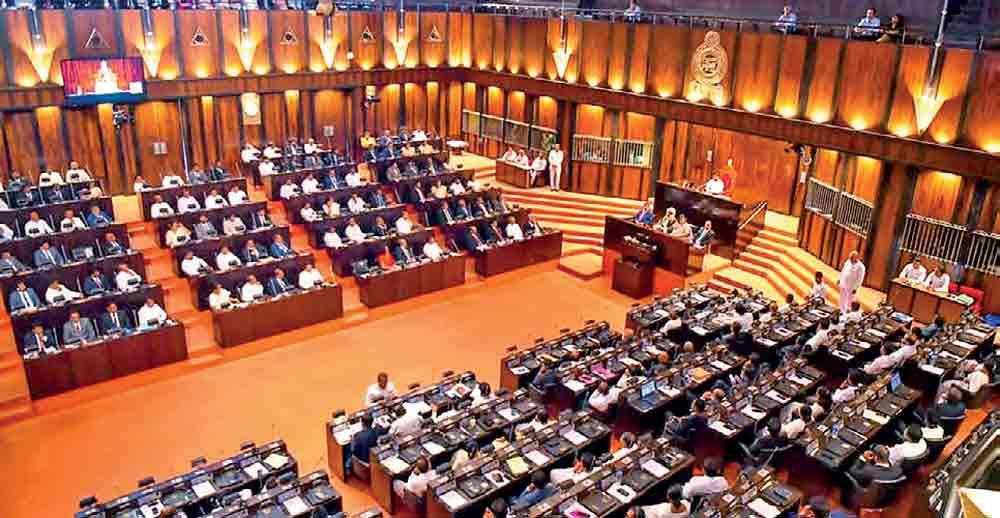
Members must take care not to resort to unparliamentary speech
 Speaker Jagath Wickramaratne on Monday has said that an investigation will be conducted by the office of the Secretary General of Parliament regarding the use of unparliamentary language used by some MPs during the previous day’s sessions.
It is not clear as to why the Speaker wants to investigate the usage of unparliamentary language of certain members on a particular day while it has been a common occurrence in the House for a long time. He might be of the view that actions against those members who breached the rules during a particular day would serve as a deterrent for the future.
However, stopping the MP from using unparliamentary language for good is highly unlikely given the lax qualification prescribed in the law for members of Parliament and the voters. One can be a voter or an elector as mentioned in the Constitution just by being a Sri Lankan citizen of over 18 years of age, not having served a prison term of six months during the past seven years and not being found to be of unsound mind.
Any elector (voter) is qualified to become a member of Parliament if he did not hold any office paid by the state. He does not need to have any educational or any other qualification of honesty, intellectual capacity or talent to become a legislator.
On the other hand, many political parties are more concerned about the winnability of candidates at an election rather than their capacity to serve the constituency and the country with their knowledge and aptitudes. The United People’s Freedom Alliance (UPFA) led by Mahinda Rajapaksa gave nomination to Premalal Jayasekara to contest at the 2015 Parliamentary election, despite him having been remanded for a murder. Jayasekara again ran for the 2020 election on behalf of the Sri Lanka Podujana Peramuna (SLPP), another party under Rajapaksa, after he was convicted for the same murder.
Sivanesathurai Chandrakanthan alias Pillayan also signed his nomination paper at the same election from the Batticaloa prison where he had been remanded in connection with a murder. Lasantha Wickramasekara, Chairman of the Weligama Pradeshiya Sabha was a suspect of six court cases while serving a suspended prison term when he was killed on October 22. This was just six months before he was nominated by the Samagi Jana Balawegaya (SJB) for the Pradeshiya Sabha election. Interestingly, all these three politicians outshone many candidates of their party at those elections.
The behaviour of members of Parliament is governed by the standing orders of the House. According to those rules, Members should avoid speaking on irrelevant matters. They are required not to indulge in repetition. They should not impute improper motives to other members or refer to any matter which is sub-judice. They must also take special care not to use unparliamentary language and should not interrupt a member who is addressing the House unless the member speaking gives way.
However, it is common knowledge that these rules in most cases are confined to the book. Irrelevancy has been so common in speeches of legislators that once in the 1980s Speaker M.H. Mohamed, when he was pointed out that a certain member was talking things not related to the issue at hand, told the House that “everything under the sun is relevant” and asked the member who was on his feet to continue. He was compelled to do so as it was a day when pandemonium reined in Parliament throughout.
Imputing improper motives to other members, though members are required not to indulge in, has also been a common practice. Opponents are always portrayed as thieves, rogues, perverts, gays, lesbians or prostitutes by implication
Imputing improper motives to other members, though members are required not to indulge in, has also been a common practice. Opponents are always portrayed as thieves, rogues, perverts, gays, lesbians or prostitutes by implication. SLPP member Tissa Kuttiarachhi’s famous reference in 2021 to a female SJB member and certain vegetables, implying a vulgar action, is a best case in point. Unfortunately, not a single learned member including professors of his party who were present in the chamber thought of asking their colleague to withdraw that unparliamentary remark.
Days ago, a SJB member made an implied unseemly attack against Prime Minister Dr. Harini Amarasuriya, whom leader of the Opposition and the SJB Sajith Premadasa once described as one of his teachers. It is not clear how these members face their own children and parents after making such improper public comments.
Some male members, when countered by female members in Parliament, attempt to silence the latter by casting sexist aspersions against them.
In the recent days, Speaker Dr. Jagath Wickramaratne and Deputy Speaker Dr. Rizvie Salih have been attempting to prevent members from both sides from using unparliamentary language. Even the leaders of the National People’s Power (NPP) who vowed to usher in a cultured society are being accused in this regard. Those unparliamentary remarks are usually expunged from the Hansard. But it is only a move to hide vulgarity or impropriety from readers of the Hansard in the future. Since the Parliamentary proceedings are live streamed, and social media picks up those controversial moments instantly, erring members are being exposed.
Despite interrupting a member who is addressing the House being a breach of rules, it has become such a norm now that a new member might deem it an accepted practice. It has become a habit of members of Parliament to obstruct other members’ speeches in the guise of raising a point of order, as the standing orders of the House require any member to stop his/her speech if another member informs that he wants to raise point of order.
What then happens is this; the interrupting member taking time of the House to make a speech, in most cases without raising any point of order. In a survey conducted by Manthi.lk, a website run by the Colombo based think tank Verite Reserch, it was found that between 2012 and 2014, 53 percent of the 1222 points of order raised in parliament by members during that period were disruptions or abuse of the procedure.
Former Chairman of Committee on Public Enterprises (COPE) and the General Secretary (leader) of the Communist Party of Sri Lanka (CPSL) D. E. W. Gunasekara said during the 2020 general election that only a handful of members in the previous Parliament were qualified to be called lawmakers. He listed four qualifications that a Parliamentarian should possess. They are the capability in contributing to law making, policy making, monitoring of public financing and representation of people who elect them to the legislature. Yet, parties nominate candidates and the people who elect them are not aware of or/and concerned about such qualifications.