Reply To:
Name - Reply Comment
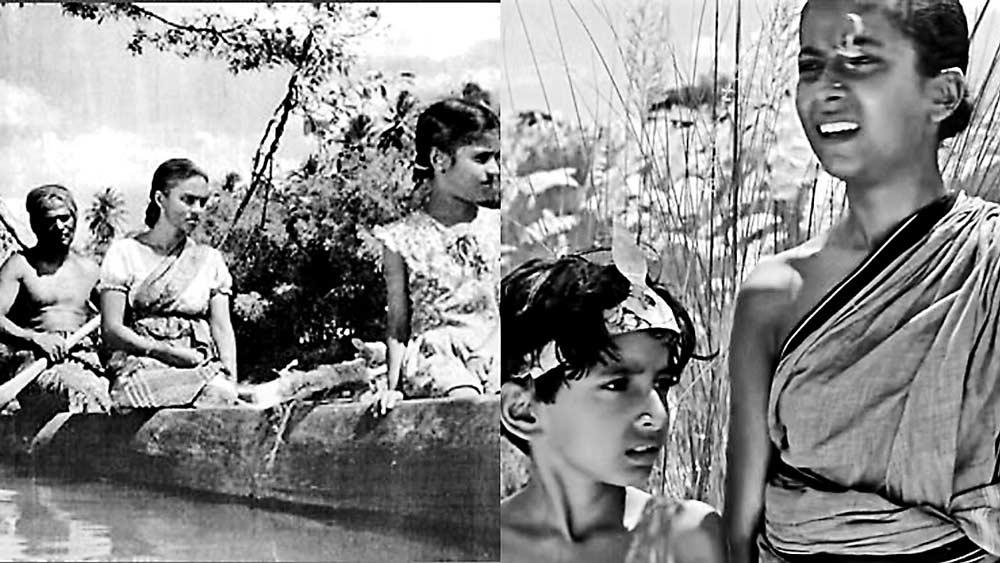
Innocence and intrusion, where the rural dream collides with modern reality.
(Left:- a still from Lester’s Rekava. Right:- a still from Ray’s Pather Panchali)
 Two great filmmakers emerged from Sri Lanka and India three-quarters of a century ago – Lester James Peries and Sathyajit Ray. Both had a great deal in common, culturally speaking, and the first features they made, establishing them as masters of cinema, paid homage to rural cultures, folklore and identities, though both came from urban, westernised backgrounds.
Sathyajith Ray (1921-1992) was born in Calcutta (now Kolkata), India. Lester James Peiries (1919-2018) was born in Dehiwela, suburban Colombo, when both India and Sri Lanka were British colonies. Ray worked in Britain as a young man (in advertising), and the young Lester met renowned British documentary filmmaker Basil Wright (creator of the classic documentary ‘Song of Ceylon’) and was deeply influenced by him. Lester was introduced to Wright by pioneer photographer Lionel Wendt, who was Lester’s mentor. Lester’s brother Ivan Peiries was a leading modernist painter at the time.
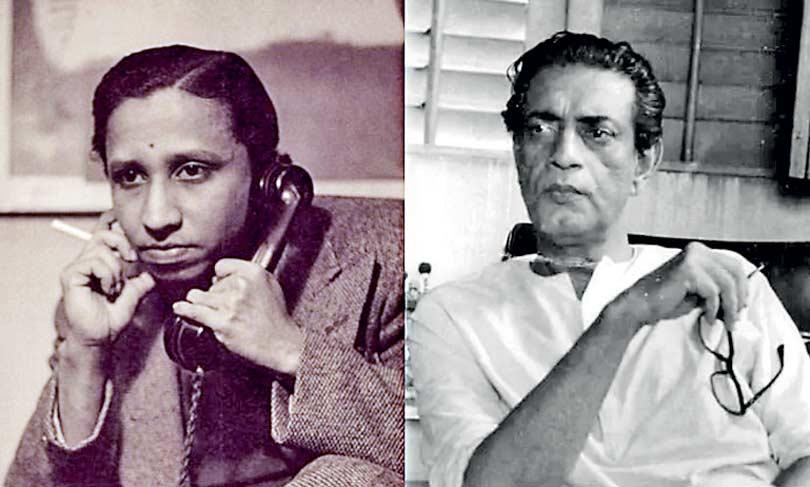
| Lester | Sathyajith Ray |
Two filmmakers, two nations, but both had one vision for showcasing truth on screen
Ray was born in a Kolkata home which housed a printing press run by his grandfather. He started a career in advertising as a young man, working for a British firm and was sent to London by his employers, but he dreamed of making films. He may have been influenced by the great French filmmaker Jean Renoir, who visited India in 1951 to make The River, a lyrical, sensuous story about the friendship between the children of a British family and an Indian child.
Ray already had the idea of filming Pather Panchali (Song of the Road), the first part of a coming-of-age trilogy by Bengali novelist Bibhutibhushan Bandyopadhyay. When he told Renoir about it, the latter told him: “It’s a wonderful idea. Go ahead and do it.”
It’s possible that The River made a deep impression on him, though Ray maintained that it was Vittorio de Sica’s neorealist film ‘The Bicycle Thief’ which he had seen earlier, that set his heart on filmmaking.
This wasn’t purely nostalgia for a pastoral culture increasingly threatened by urbanism and modernisation. Without romanticising their respective rural milieus, they emphasised the deep bonding and harmony which existed within that rural poverty. But it’s a serenity threatened by industrialisation and commercialism – the innocent kite in a child’s hand in Lester’s ‘Rekava’ becomes a nightmarishly threatening aircraft, and the distant, smoke-belching train which fascinates the children in Ray’s Pather Panchali is an aberration in an unpolluted landscape. In both films, external phenomena – an apparition of a flying monster in Rekava and monsoonal rains in Pather Panchali, bring illness and death, respectively, to the child characters.
Being artists, Ray and Lester treated their pastoral themes differently while focusing on the lyricism. Ray had a published novel as his source material. Lester had to write his own screenplay, and he brought in factors such as rural beliefs, superstitions and tensions underlying the surface calm and beauty. He showed that villagers too, can be cunning and manipulative. He also introduced songs, making a bow to the song-based musical culture that charactised Lankan cinema (based on the Indian commercial model) till then. Worth noting here that Lankan cinema was only eight years old when Rekava was screened.
Ray’s approach was somewhat different. Without romanticising his village characters, he showed them without sentimentality, and left out the superstitions, the cunning and manipulation. He did not shy away from the harsh realities of poverty that the two children (brother and sister Apu and Durga) must face every day. But the poverty cannot entirely submerge the beauty and innocence of their lives. Ray’s mix of unsentimental realism balanced with lyrical content is what made Pather Panchali such a success with Western audiences, especially American, when it was shown worldwide after its Indian release. It changed their stereotype understanding of poverty in India.
Ray chose maestro Ravi Shanker to compose the background music because he felt Indian classic music played principally with the sitar was the ideal form of musical expression given the story’s very Indian setting. Later, he departed from this and began to compose his own music when he began exploring urban themes. Lester did not compose his own music, though he followed a similar route – maestro Sunil Shantha composed the music for Rekava, but Lester chose music and songs by pop musician Neville Fernando for Ran Salu, a film set in an urban milieu.
Lester was already familiar with aspects of filmmaking and editing when he made Rekava. He was part of the government film unit. Ray, trained in advertising, printing and graphics, had no such training when he embarked on making Pather Panchali. Rekava was filmed by Willie Blake. It was his first feature, but he was no amateur, and a perfect match as cinematographer for Lester’s vision.
Ray, on the other hand, hired a 21-year-old with little experience to film Pather Panchali. Both Lester and Ray departed from existing film-making conventions – studio settings and lighting. Incidentally, Rekava is the first Sinhala film to be made entirely in Sri Lanka, eschewing the existing tradition of filming in South Indian studios. Both faced the same problems. Producers refused to back Pather Panchali when Ray told them he wanted to use outdoor locations without studio lighting. They said that was documentary filmmaking, and not for the theatres.
With little money, Ray could not afford a continuous shooting schedule. There were gaps in between. Once, after selecting a patch of grassland for one scene, they found it completely grazed by cattle when they went there to shoot.
Both Lester and Ray used industry-proven 35mm Arriflex film cameras. When critics said they would not work well or film effectively in rain or in darkness, Ray borrowed a 16mm film camera to film in rain and at night, and proved that it could be done outdoors and without artificial lighting.
Ray was luckier in his audiences than Lester. In Bengal, there was a cultured audience for literature, poetry, music, cinema, drama – all the arts. Though the initial response in Kolkata was poor when Pather Panchali was released in 1955, it grew gradually. In Sri Lanka, Lester only had a very small audience who could understand and appreciate his groundbreaking film as a work of art.